
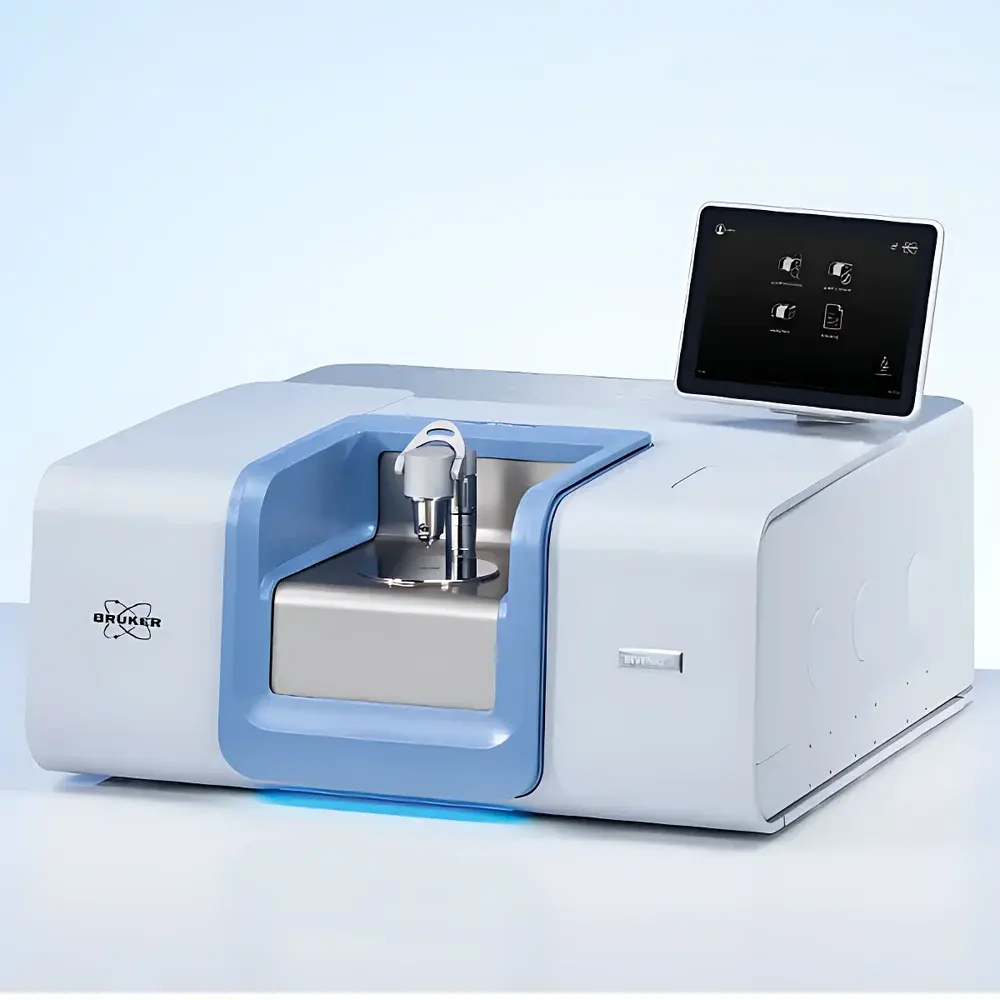
Bruker INVENIO Fourier Transform Infrared (FTIR) Spectrometer Platform
| Brand | Bruker |
|---|---|
| Origin | Germany |
| Model | INVENIO |
| Instrument Type | Laboratory FTIR Spectrometer |
| Wavenumber Range | 8,000 – 350 cm⁻¹ |
| Spectral Resolution | 0.16 cm⁻¹ |
| Scan Speed | 20 spectra/sec |
| Signal-to-Noise Ratio | >10,000:1 (typical), up to 60,000:1 (optimized configuration) |
| Detector Capacity | Up to 7 detectors (UV/VIS to far-IR) |
| Interferometer | Maintenance-free, dynamically aligned |
| Compliance | FDA 21 CFR Part 11, cGMP, cGLP |
Overview
The Bruker INVENIO is a modular, high-performance Fourier Transform Infrared (FTIR) spectrometer platform engineered for demanding analytical laboratories requiring long-term stability, spectral fidelity, and operational flexibility. At its core, the INVENIO employs a permanently aligned, dynamically balanced Michelson interferometer—designed with zero-maintenance operation and intrinsic immunity to mechanical drift. This architecture ensures exceptional wavenumber accuracy (<0.005 cm⁻¹), reproducibility (<0.01 cm⁻¹ over 24 h), and baseline stability across the full spectral range of 8,000–350 cm⁻¹. Its optical design integrates multi-beam input and output ports, enabling simultaneous or sequential coupling to external accessories—including microscopes, gas cells, reaction chambers, and fiber-optic probes—without realignment. The system’s thermal management and vibration-damped optical bench support uninterrupted operation under variable ambient conditions, making it suitable for both routine QC environments and advanced research applications in pharmaceuticals, polymers, catalysis, and materials science.
Key Features
- Maintenance-free, dynamically aligned interferometer with active alignment monitoring and self-compensation for thermal drift
- Ultra-high signal-to-noise ratio: >10,000:1 (standard measurement, 4 cm⁻¹, 1 min scan); up to 60,000:1 achievable with optimized detector and apodization settings
- Configurable detector bay supporting up to seven independent detectors—from UV/VIS silicon and InGaAs through MCT and DTGS to bolometric far-IR options—enabling seamless spectral domain extension
- Automated beam splitter changer with motorized positioning and software-controlled selection for optimal spectral coverage and throughput
- High-intensity, stabilized IR source with extended lifetime (>20,000 h) and consistent radiant flux across spectral regions
- Real-time system diagnostics via OPUS software’s Smart Monitoring suite, delivering predictive alerts for optics status, purge efficiency, and environmental parameters
- Modular expansion architecture supporting field-upgradable components—including new detector modules, accessory interfaces, and firmware-defined scanning modes (rapid-scan, step-scan, and time-resolved)
Sample Compatibility & Compliance
The INVENIO platform accommodates a broad spectrum of sample forms and measurement modalities: transmission, ATR, reflection-absorption (RAIRS), diffuse reflectance (DRIFTS), photoacoustic (PAS), and emission spectroscopy. Its standardized optical interface complies with ISO 17025 calibration traceability requirements and supports NIST-traceable wavelength and absorbance validation protocols. For regulated environments, the system meets FDA 21 CFR Part 11 requirements through integrated electronic signatures, audit trails, user role-based access control, and immutable data archiving within OPUS. Full cGMP and cGLP compliance is enabled via validated SOP workflows, instrument qualification documentation (IQ/OQ/PQ templates), and electronic record integrity safeguards—including checksum verification and tamper-evident metadata embedding.
Software & Data Management
Controlled exclusively by Bruker’s OPUS spectroscopy software (v9.x or later), the INVENIO provides a unified environment for acquisition, processing, quantitation, and reporting. OPUS features embedded chemometric tools (PLS, PCA, cluster analysis), spectral library search (including commercial and custom databases), and automated peak identification with customizable thresholds. All raw interferograms and processed spectra are stored in Bruker’s proprietary, non-proprietary binary format (.0, .1, .2), ensuring bit-level integrity and backward compatibility. Data export supports ASTM E131, JCAMP-DX, CSV, and HDF5 formats. Networked deployment enables centralized license management, remote diagnostics, and integration with LIMS and ELN systems via OPC UA and RESTful API endpoints.
Applications
The INVENIO serves as a foundational platform for structural elucidation, quantitative analysis, and kinetic monitoring across diverse sectors. In pharmaceutical development, it supports polymorph screening, excipient compatibility studies, and cleaning validation per ICH Q5A/Q5C guidelines. In polymer science, it enables real-time curing analysis, degradation profiling, and copolymer composition mapping. Catalysis researchers leverage its step-scan capability for time-resolved surface adsorption studies, while materials scientists apply DRIFTS and RAIRS for thin-film characterization and interfacial chemistry. Its multi-detector architecture also facilitates correlative spectroscopy—for example, synchronizing mid-IR absorption with UV-Vis electronic transitions in hybrid perovskite films.
FAQ
Is the INVENIO compatible with attenuated total reflectance (ATR) accessories?
Yes—the INVENIO supports all standard Bruker ATR modules (e.g., Platinum ATR, MultiScope II) via its universal sample compartment interface, with automatic recognition and parameter optimization.
Can the system be upgraded post-purchase to add new detectors or measurement modes?
Yes—its modular design allows field installation of additional detectors, beam splitters, and scanning modules without hardware modification or factory recalibration.
What level of spectral calibration assurance does the INVENIO provide?
It includes factory-certified wavenumber accuracy (±0.005 cm⁻¹) and linearity verification using polystyrene film and NIST SRM 1921a; annual recalibration services are available with ISO/IEC 17025-accredited certificates.
Does the system require continuous dry-air or nitrogen purging?
While optional, continuous purge is recommended for high-resolution work below 1,500 cm⁻¹ to minimize atmospheric CO₂ and H₂O interference; the built-in purge monitor provides real-time humidity and flow-rate feedback.
How is data integrity maintained during long-term unattended operation?
OPUS enforces automatic checksum generation, timestamped audit logs, and encrypted session files—all compliant with ALCOA+ principles for GxP-regulated data handling.





