
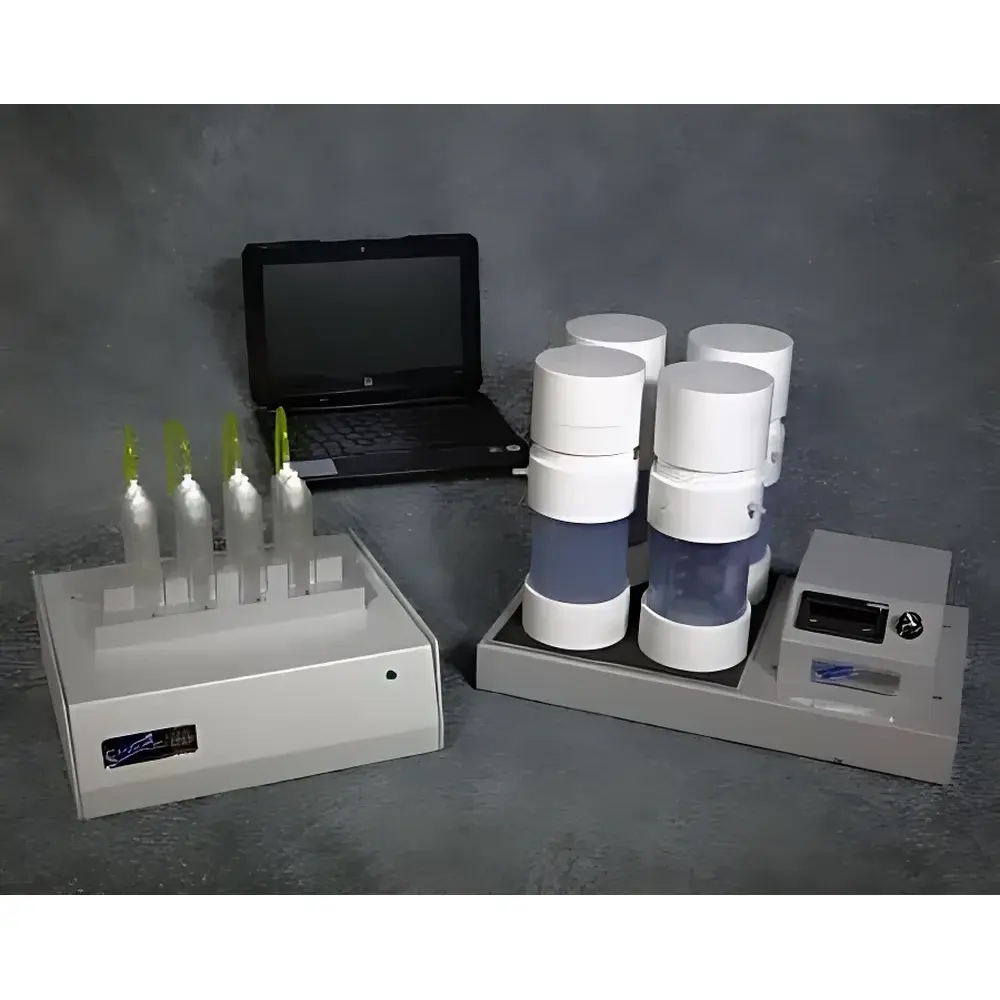
Challenge 208 Solid-Phase Microbial Respiration Analyzer for Compost Maturity Assessment
| Origin | USA |
|---|---|
| Manufacturer Type | Authorized Distributor |
| Product Origin | Imported |
| Model | 208 |
| Instrument Category | Fertilizer/Nutrient Analyzer |
| Pricing | Available Upon Request |
Overview
The Challenge 208 Solid-Phase Microbial Respiration Analyzer is an engineered system designed to quantify aerobic microbial activity in solid organic matrices—primarily compost, soil, sewage sludge, and municipal solid waste—through real-time, non-invasive measurement of oxygen consumption and/or carbon dioxide evolution. Based on standardized respirometric principles aligned with ISO 17556 (Determination of ultimate aerobic biodegradability of plastic materials in soil by measuring oxygen demand in a closed respirometer) and ASTM D5338 (Standard Test Method for Determining Aerobic Biodegradation of Plastic Materials Under Controlled Composting Conditions), the system operates via sealed, magnetically stirred reaction columns interfaced with Challenge’s proprietary Flow Cell technology. This architecture enables continuous, high-fidelity gas-phase monitoring without headspace disturbance, supporting both short-term (24–96 h) and long-term (days to weeks) incubation protocols under controlled temperature and humidity conditions. The analyzer delivers quantitative metrics critical to compost maturity assessment—including cumulative O₂ uptake, specific respiration rate (mg O₂·g⁻¹ VS·h⁻¹), and stabilization index—thereby supporting regulatory compliance, process optimization, and scientific validation of biological stability.
Key Features
- Modular, autoclavable reaction column design (stainless steel and borosilicate glass construction) enabling full sterilization and cross-contamination prevention between samples.
- Integrated magnetic stirring mechanism ensuring homogeneous substrate mixing and consistent mass transfer without mechanical shaft penetration—preserving seal integrity and minimizing shear stress on microbial consortia.
- Patented Flow Cell gas interface with electrochemical O₂ and NDIR CO₂ sensors, providing sub-ppm resolution and drift-stabilized calibration over extended operation.
- Programmable incubation control: precise temperature regulation (±0.2 °C) from 20–45 °C and optional humidity management for representative field-condition simulation.
- Real-time data acquisition at user-defined intervals (1–60 min), with onboard logging and USB/RS-232 export compatibility for traceable GLP/GMP-compliant recordkeeping.
- Scalable configuration: supports up to 8 parallel reaction columns per base unit, facilitating replicated experimental designs and comparative batch analysis.
Sample Compatibility & Compliance
The 208 analyzer accommodates heterogeneous solid substrates including green waste compost, anaerobically digested sludge, biochar-amended soils, lignocellulosic feedstocks, and synthetic polymer test materials. Sample mass ranges from 5–100 g (dry weight basis), with adjustable moisture content (40–70% w/w) maintained via gravimetric or capacitance-based feedback. All operational protocols adhere to internationally recognized frameworks: ISO 14855-1 (aerobic biodegradation in controlled compost), CEN/TS 16115 (compost maturity indicators), and US EPA SW-846 Method 9045D (soil respiration). Data outputs satisfy audit requirements for FDA 21 CFR Part 11–compliant electronic records when paired with validated third-party LIMS integration.
Software & Data Management
The system includes Challenge RespiroSoft™ v4.x—a platform-independent application supporting automated protocol scheduling, real-time curve visualization (O₂ depletion vs. time, CO₂ accumulation kinetics), and derivation of key maturity parameters: DT₅₀ (time to 50% O₂ depletion), R₂₄ (respiration rate at 24 h), and the Solvay Index (CO₂/Corg ratio). Raw sensor data are stored in CSV and SQLite formats with embedded metadata (operator ID, sample ID, calibration timestamp, environmental setpoints). Audit trails log all parameter modifications, user logins, and data exports, meeting GLP documentation standards. Optional cloud synchronization enables remote monitoring and multi-site collaborative analysis.
Applications
- Compost facility QA/QC: verification of biological stability prior to land application per EU Regulation (EC) No 1069/2009 and US Composting Council STA standards.
- Soil bioremediation studies: quantification of hydrocarbon or pesticide mineralization rates under simulated field conditions.
- Biodegradable polymer certification: OECD 301F-compliant aerobic degradation testing for EN 13432 and ASTM D6400 submissions.
- Microbial inoculant efficacy screening: evaluation of commercial bioaugmentation products on respiration enhancement in recalcitrant waste streams.
- Research on priming effects: investigation of labile carbon addition impacts on native soil organic matter turnover kinetics.
- Regulatory method development: reference instrumentation for validating rapid maturity proxies (e.g., DOC, NH₄⁺/NO₃⁻ ratios, FTIR spectral indices).
FAQ
What biological endpoints does the 208 system directly measure?
It measures real-time oxygen consumption and carbon dioxide production rates in solid-phase samples under controlled aerobic conditions.
Can the system operate under anaerobic or microaerophilic conditions?
No—the standard configuration is optimized for aerobic respiration; anaerobic modules require custom sensor reconfiguration and are not part of the base 208 platform.
Is calibration traceable to NIST standards?
Yes—O₂ sensors are calibrated against certified gas mixtures (NIST-traceable 20.9% O₂ in N₂); CO₂ sensors use dual-point calibration with certified 0% and 5% CO₂ standards.
How is moisture content controlled during long-term assays?
Pre-incubation equilibration is performed gravimetrically; passive humidity buffering using saturated salt solutions is supported within the incubation chamber, though active vapor control requires optional add-on hardware.
Does the system support automatic data reporting for regulatory submissions?
Yes—RespiroSoft™ generates PDF summary reports with embedded digital signatures, compliant with ISO/IEC 17025 documentation requirements for accredited testing laboratories.
Related Products







