
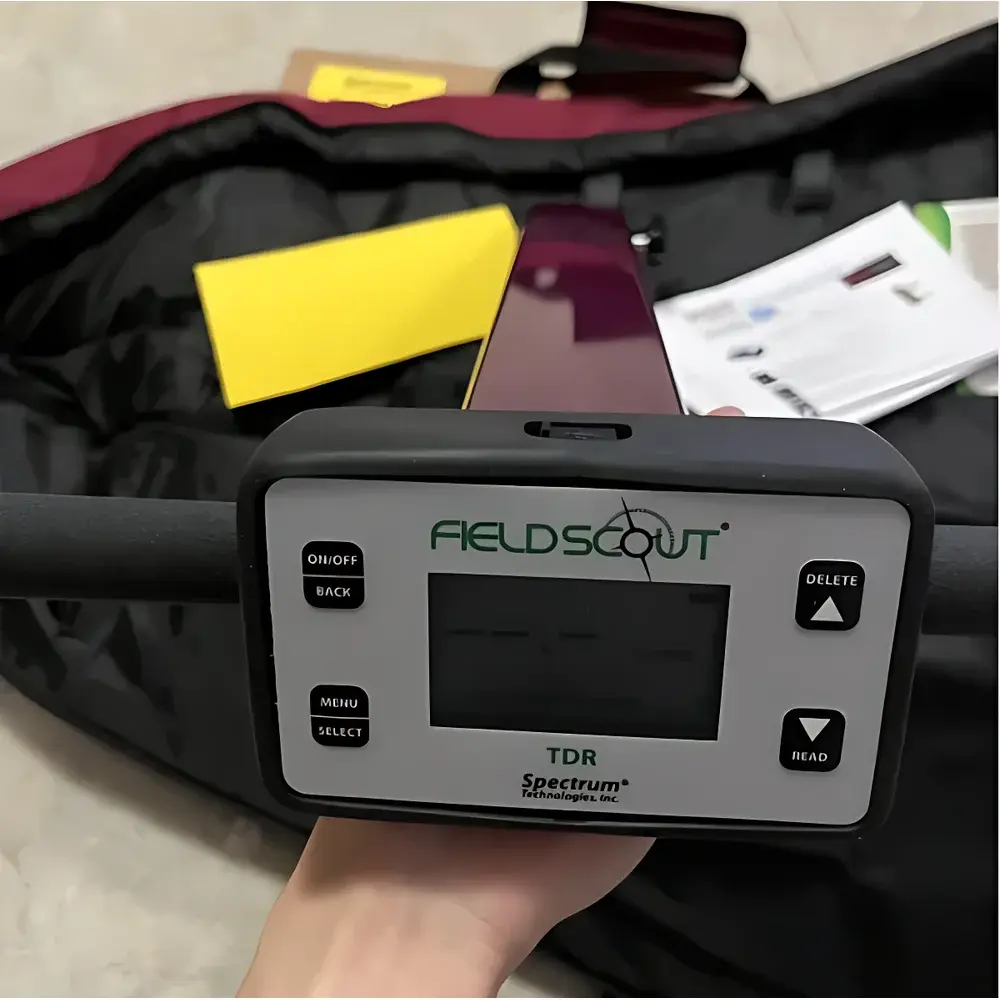
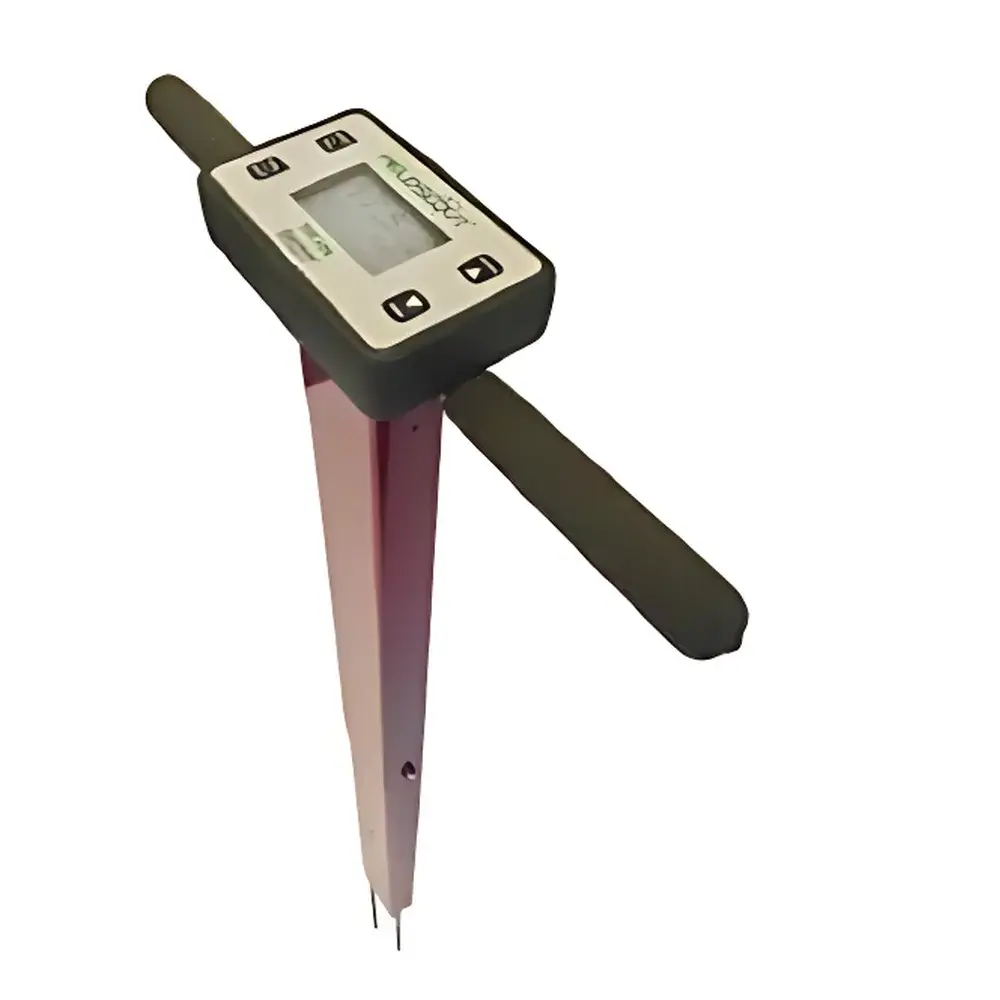
Spectrum Technologies TDR 350 Soil Moisture, Temperature, and Electrical Conductivity Analyzer
| Brand | Spectrum Technologies |
|---|---|
| Origin | USA |
| Model | TDR 350 |
| Instrument Type | Multifunctional Soil Analyzer |
| Measurement Principle | Time-Domain Reflectometry (TDR) |
| Soil Moisture Range | Full-scale volumetric water content (VWC) measurement |
| EC Measurement | Yes, integrated for VWC correction |
| Temperature Sensing | Built-in soil temperature sensor + optional infrared canopy/surface sensor |
| Data Storage | >50,000 GPS-tagged records |
| Connectivity | Integrated Bluetooth v4.2 |
| Display | Backlit monochrome LCD |
| Probe Options | Multiple rod lengths (standard: 10 cm, 20 cm, 30 cm) |
| Power | Rechargeable Li-ion battery (≥12 hrs continuous operation) |
| Environmental Rating | IP67-rated housing |
Overview
The Spectrum Technologies TDR 350 is a field-deployable, multifunctional soil analyzer engineered for high-reproducibility measurement of volumetric water content (VWC), bulk electrical conductivity (EC), and soil temperature using time-domain reflectometry (TDR) — a physically grounded electromagnetic technique standardized in ASTM D5778 and ISO 11272. Unlike capacitance-based sensors, TDR measures the dielectric permittivity of soil by propagating a fast-rise-time electromagnetic pulse along parallel stainless-steel rods; the travel time of the reflected signal correlates directly with VWC, independent of soil texture, salinity, or temperature — provided EC is simultaneously acquired and applied as a correction factor. The TDR 350 integrates dual-sensor capability: a calibrated TDR probe array for subsurface soil parameters and an optional IR sensor (Model 3676T) for non-contact surface or canopy temperature acquisition. This co-located, multi-parameter architecture enables simultaneous assessment of soil water status and thermal stress indicators — critical for irrigation scheduling, drought monitoring, turfgrass management, and evapotranspiration modeling.
Key Features
- True TDR-based volumetric water content measurement compliant with USDA NRCS protocols and FAO irrigation guidelines
- On-board bulk EC measurement (0–10 dS/m range) used in real time to correct VWC readings for saline or variable-texture soils
- Integrated high-stability thermistor for direct soil temperature profiling at probe depth (±0.2°C accuracy)
- Industry-exclusive backlit LCD interface optimized for outdoor visibility under full sun or low-light conditions
- Embedded Bluetooth 4.2 module enabling wireless data transfer to iOS/Android tablets and PC-based Spectrum Connect software
- GPS geotagging (±3 m CEP) for every recorded measurement, supporting spatial interpolation and GIS integration
- Modular probe system with interchangeable rod lengths (10 cm, 20 cm, 30 cm) and telescoping mounting bracket for consistent insertion depth control
- Rugged IP67-rated enclosure with corrosion-resistant stainless-steel probe rods and sealed electronics for long-term field deployment
Sample Compatibility & Compliance
The TDR 350 is validated for use across mineral soils (sand to clay loam), organic substrates (peat, compost), and engineered growing media. It does not require soil-specific calibration due to its physics-based TDR methodology. All firmware and data logging routines comply with GLP-aligned audit trail requirements, including timestamped operator ID assignment, measurement sequence logs, and immutable GPS metadata. The device meets FCC Part 15 Class B and CE RED Directive standards. Optional IR sensor (3676T) conforms to IEC 62906-5-2 for non-contact radiometric temperature measurement (8–14 µm spectral band, ±0.5°C accuracy at 25°C ambient).
Software & Data Management
Data collection and post-processing are supported via Spectrum Connect — a Windows/macOS desktop application that imports .csv and .xml exports, visualizes spatiotemporal trends, and generates export-ready reports compliant with ISO/IEC 17025 documentation frameworks. Raw TDR waveforms can be reviewed for signal integrity validation. The software supports batch correction using user-defined EC-VWC calibration curves and allows overlay of IR temperature maps onto GIS shapefiles. All stored records include embedded hash signatures for data integrity verification, satisfying FDA 21 CFR Part 11 electronic record requirements when configured with user authentication and audit logging enabled.
Applications
- Precision irrigation management in agronomic and horticultural systems
- Turfgrass health monitoring on golf courses, sports fields, and municipal landscapes
- Soil moisture network deployment for watershed-scale hydrological modeling
- Field validation of satellite-derived soil moisture products (e.g., SMAP, Sentinel-1)
- Research applications in plant-water relations, root-zone dynamics, and climate resilience studies
- Regulatory compliance monitoring for landfill cover systems and remediation sites
FAQ
Does the TDR 350 require factory recalibration after probe replacement?
No — each probe is individually characterized during manufacturing and stores its unique calibration coefficients in onboard memory. Replacement probes auto-configure upon connection.
Can the IR sensor (3676T) be used independently of the TDR probe?
Yes — it operates as a standalone radiometric unit with its own power and display mode, but full integration (synchronized timestamps, combined CSV export) requires physical attachment to the TDR 350 host unit.
Is the GPS module active during data logging when Bluetooth is disabled?
Yes — GPS functionality is hardware-independent of Bluetooth; geotagging remains fully operational in standalone logging mode.
What is the minimum detectable change in volumetric water content?
The system resolution is 0.001 m³/m³ (0.1% VWC) with repeatability better than ±0.003 m³/m³ under controlled field conditions.
How does the TDR 350 handle frozen or highly saturated soils?
TDR waveform analysis includes automatic detection of signal distortion caused by ice formation or pore-water saturation; flagged measurements are annotated in the data log with diagnostic codes per ASTM D5778 Annex A3.







