
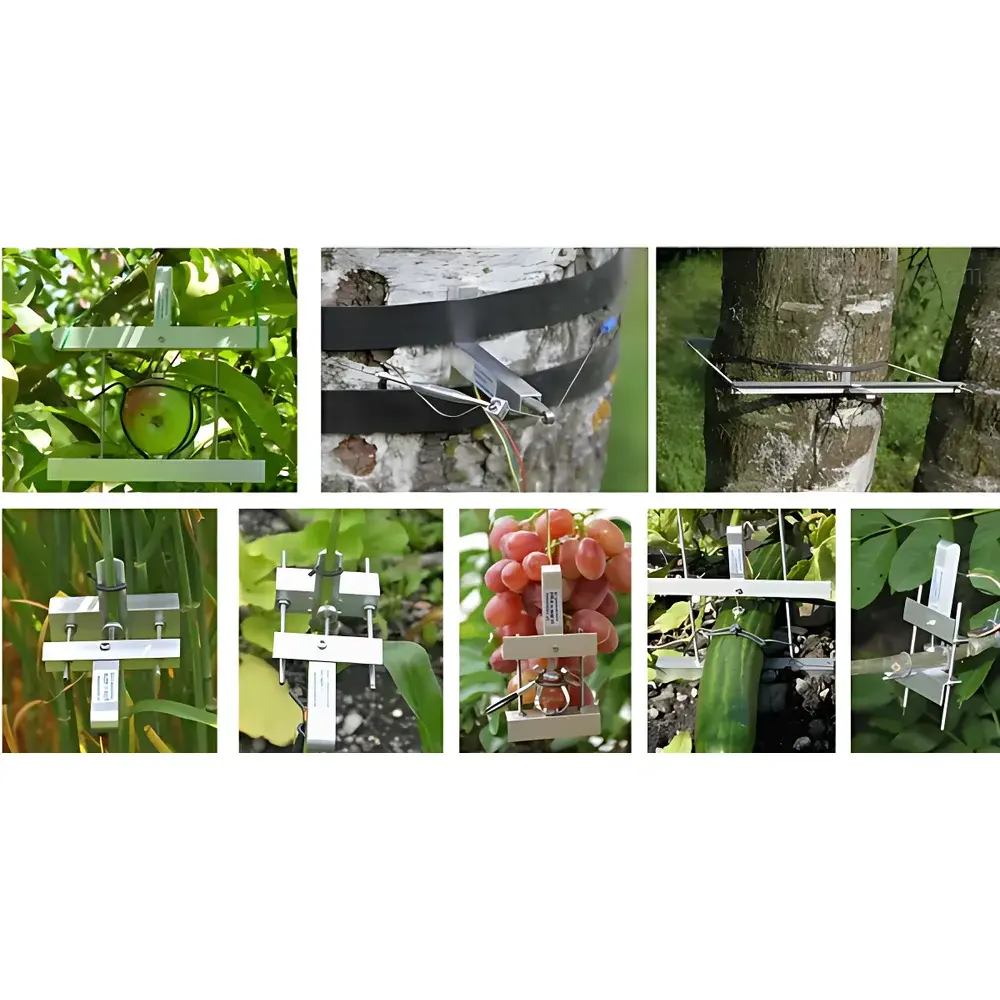
PSI DD-L Plant Dendrometer
| Brand | PSI (Photon Systems Instruments) |
|---|---|
| Origin | Czech Republic |
| Model | DD-L |
| Measurement Range | 3–30 cm (diameter) |
| Resolution | up to 0.2 µm (dependent on data logger) |
| Power Consumption | Ultra-low (compatible with DL15 datalogger |
| Temperature Compensation | Integrated, plant-tissue-specific |
| Data Logger Compatibility | Universal (CR1000, DL15, HOBO, Campbell Scientific, etc.) |
| Compliance | Designed for long-term field deployment under ISO 17025-aligned environmental monitoring protocols |
| Operating Environments | Polar, alpine, arid, tropical (15+ years of global validation) |
Overview
The PSI DD-L Plant Dendrometer is a high-precision, non-invasive mechanical sensor engineered for continuous, in situ measurement of stem or trunk diameter fluctuations in woody and herbaceous plants. Based on the principle of capacitive displacement transduction coupled with temperature-compensated linear variable differential transformer (LVDT)-style micrometric sensing, the DD-L detects sub-micron dimensional changes induced by turgor-driven radial expansion/contraction, phloem activity, and structural water redistribution. Unlike optical or ultrasonic alternatives, the DD-L delivers direct mechanical contact measurement with minimal hysteresis and long-term zero-drift stability—critical for multi-season phenological studies and climate-response modeling. It is specifically calibrated for diameter-range applications from 3 to 30 cm, making it suitable for mature trees, orchard species, urban street trees, and large shrubs deployed in ecological observatories, agricultural research stations, and forest ecophysiology networks.
Key Features
- Sub-micron resolution: Capable of resolving diameter changes down to 0.2 µm when paired with high-resolution dataloggers (e.g., Campbell Scientific CR1000X or PSI DL15), enabling detection of diurnal turgor cycles and slow growth increments.
- Integrated thermal compensation: Onboard thermistor array corrects for thermal expansion artifacts across −30 °C to +60 °C ambient range—essential for boreal, alpine, and desert deployments.
- Low-power architecture: Draws <15 µA in sleep mode; compatible with standard AA/CR123 batteries and solar-rechargeable systems for unattended operation exceeding 12 months.
- Modular mechanical design: Stainless-steel frame with adjustable clamping geometry ensures stable mounting on irregular bark surfaces without girdling or tissue compression artifacts.
- Multi-parameter output: Delivers raw displacement (µm), compensated diameter (mm), and derived metrics including daily growth rate (µm day⁻¹), shrinkage amplitude (µm), and cumulative growth integral (µm·day).
- Global field-proven reliability: Validated across 15+ years and >40 countries—including Antarctic research stations, Himalayan treeline transects, Sahelian agroforestry plots, and Amazonian canopy towers—under GLP-compliant long-term monitoring programs.
Sample Compatibility & Compliance
The DD-L is optimized for perennial woody species with diameters between 3 cm and 30 cm at sensor height, including but not limited to Fagus sylvatica, Quercus robur, Picea abies, Populus tremula, and cultivated fruit trees (Malus domestica, Prunus avium). Its clamping mechanism accommodates bark thicknesses up to 18 mm and surface roughness up to ISO 4287 Rz 150 µm. The sensor meets IEC 60529 IP67 ingress protection standards and complies with EN 12602:2019 (field instrumentation for environmental monitoring). Data acquisition workflows support audit-trail-enabled logging per FDA 21 CFR Part 11 requirements when integrated with certified dataloggers and secure cloud platforms (e.g., PSI’s PlantScreen™ Cloud).
Software & Data Management
Raw displacement data are acquired via analog voltage (0–2.5 V) or digital SDI-12 output, fully compatible with industry-standard platforms including Campbell Scientific LoggerNet, HOBOware Pro, and LabVIEW-based custom DAQ systems. PSI provides the open-source DendroTools Python library for automated baseline correction, growth onset detection (using double logistic fitting), frost-event identification (via rapid contraction thresholds), and sap flow integration (when synchronized with Granier-type or heat ratio sensors). All calibration coefficients, temperature compensation polynomials, and mounting metadata are stored in embedded EEPROM and exported as FAIR-compliant NetCDF4 files (CF-1.8 conventions).
Applications
- Phenological phase detection: Objective determination of growth onset/end dates for dendrochronological calibration and climate sensitivity analysis.
- Frost damage assessment: Identification of micro-fracture events through abrupt radial contraction signatures correlated with sub-zero air temperature minima.
- Irrigation scheduling: Real-time feedback on plant water status via diurnal shrinkage amplitude, reducing reliance on soil moisture proxies.
- Urban tree risk assessment: Long-term monitoring of trunk diameter stability in response to wind loading, root zone compaction, or vascular disease progression.
- Ecophysiological modeling: Input parameterization for hydraulic architecture models (e.g., Tuzet et al. 2003) and carbon allocation simulations.
- Climate change impact studies: Multi-year datasets used in IPCC AR6 WGII Annex II forest resilience indicators.
FAQ
How does the DD-L differ from capacitance-based dendrometers?
The DD-L employs a mechanically referenced LVDT-style transducer—not a capacitive gap sensor—ensuring immunity to dielectric interference from dew, rain, or bark exudates.
Can the DD-L be installed on young saplings or thin-stemmed herbs?
No—the DD-L is dimensionally optimized for 3–30 cm diameter stems. For stems <3 cm, PSI recommends the DD-S (small-diameter) or DRO (root-oriented) variants.
Is firmware upgrade supported in the field?
Yes—via UART interface and PSI’s DFU utility; all firmware revisions maintain backward compatibility with legacy calibration profiles.
Does the sensor require annual recalibration?
No—factory calibration is NIST-traceable and drift-stabilized; field verification using reference gauge blocks is recommended only after mechanical impact or extreme thermal cycling (>100 °C differential).
What is the maximum cable length between sensor and datalogger?
Up to 100 m using shielded twisted-pair (STP) cable with proper grounding; signal integrity maintained per ANSI/TIA-568-C.2 specifications.



