
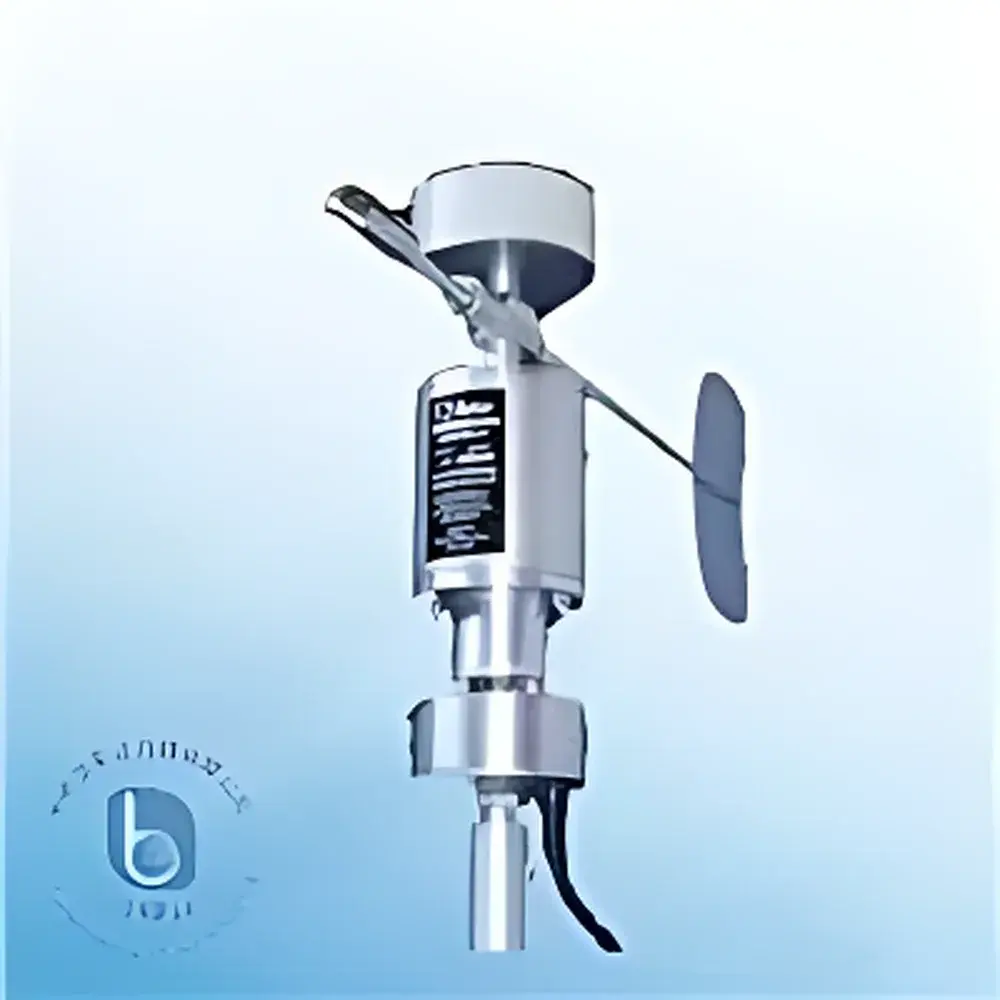
WINBLOG™-8041005 Precision Cup-and-Vane Anemometer with Digital & Analog Outputs
| Origin | Germany |
|---|---|
| Manufacturer Type | Authorized Distributor |
| Origin Category | Imported Instrument |
| Model | WINBLOG™-8041005 |
| Price | USD 4,850 (FOB Hamburg) |
| Wind Speed Range | 0–68 m/s |
| Wind Speed Accuracy | ±3% of full scale |
| Startup Wind Speed (Speed) | 0.4 m/s |
| Wind Direction Range | 0–360° |
| Wind Direction Accuracy | ±3° |
| Startup Wind Speed (Direction) | 0.8 m/s |
| Output Options | RS232 digital interface |
| Optional analog outputs | 4–20 mA or 0–1 V |
| Sensor Type | Three-cup anemometer (speed), vane-type wind vane (direction) |
Overview
The WINBLOG™-8041005 is a high-reliability, dual-parameter meteorological sensor engineered for continuous outdoor environmental monitoring in industrial, research, and regulatory compliance settings. It integrates a precision three-cup anemometer and a balanced wind vane into a single robust housing, enabling simultaneous measurement of wind speed and wind direction under demanding atmospheric conditions. The instrument operates on proven mechanical transduction principles: rotational velocity of the cup assembly is converted to proportional electrical signals via a calibrated magnetic pickup, while directional orientation is determined by a low-friction potentiometric or optical encoder mounted coaxially with the vane shaft. Designed and assembled in Germany to DIN EN ISO 9001-certified manufacturing standards, the WINBLOG™-8041005 delivers long-term stability and minimal drift across temperature ranges from −30 °C to +70 °C. Its modular output architecture supports integration into SCADA systems, weather stations, emission monitoring networks, and occupational health & safety platforms—particularly where real-time wind data informs dispersion modeling, stack monitoring, or site boundary air quality assessments.
Key Features
- Simultaneous wind speed and wind direction measurement with independent calibration certificates traceable to PTB (Physikalisch-Technische Bundesanstalt)
- Three-cup rotor with aerodynamically optimized aluminum alloy cups and stainless-steel shaft; validated for linear response up to 68 m/s (152 mph) per IEC 61400-12-1 Annex D
- Vane assembly featuring low-inertia polymer construction and sealed ball-bearing pivot for consistent azimuth resolution at sub-1 m/s wind speeds
- Dual-output capability: standard RS232 serial interface (ASCII protocol, configurable baud rate) plus field-selectable analog outputs (4–20 mA loop-powered or 0–1 V voltage output)
- IP65-rated aluminum enclosure with UV-stabilized polycarbonate dome and integrated desiccant chamber for condensation resistance
- Low-power operation (≤1.2 W nominal) compatible with solar-battery telemetry systems used in remote monitoring deployments
Sample Compatibility & Compliance
The WINBLOG™-8041005 is designed for direct exposure to ambient outdoor air without filtration or conditioning. It meets the mechanical and environmental requirements for Class II meteorological sensors as defined in WMO No. 8 (Guide to Meteorological Instruments and Methods of Observation). Its performance characteristics align with ASTM D5096–22 (Standard Practice for Calibration of Anemometers) and support data integrity requirements under EPA Method 9 and ISO 9001/14001 quality management systems. The device carries CE marking per Directive 2014/30/EU (EMC) and 2014/35/EU (LVD), and its analog output modules comply with NAMUR NE43 fault signaling conventions. No sample preparation or consumables are required—measurements are performed in situ on undisturbed airflow.
Software & Data Management
The instrument communicates natively via ASCII-based RS232 protocol with fixed frame structure (e.g., “$WIND,12.45,237.2,*XX<CR><LF>”), enabling plug-and-play integration with industry-standard data loggers (e.g., Campbell Scientific CR1000X, Onset HOBO RX3000) and SCADA HMI platforms (Ignition, Siemens Desigo CC). Optional configuration software (WINBLOG ConfigTool v3.2, Windows-only) permits adjustment of output scaling, averaging intervals (1–60 s), and diagnostic reporting thresholds. All analog output channels support 12-bit effective resolution and include built-in zero/span verification routines. Audit trails, calibration history, and firmware version logs are stored internally and retrievable via serial command—supporting GLP-compliant record retention and FDA 21 CFR Part 11–aligned electronic signature workflows when deployed with validated host software.
Applications
- Continuous emissions monitoring system (CEMS) wind compensation for stack gas dilution calculations
- Renewable energy site assessment and turbine wake analysis
- Industrial hygiene monitoring around chemical storage or loading zones per OSHA 1910.120 and ACGIH TLV guidelines
- Urban air quality networks requiring spatially resolved wind vector inputs for PM2.5 and NOx dispersion modeling
- Research-grade microclimate studies in agricultural, ecological, and glaciological field campaigns
- Emergency response planning and real-time hazard plume tracking during VOC or H2S release events
FAQ
What is the recommended mounting height and orientation for optimal accuracy?
Mount the sensor at least 10 m above ground level on a non-turbulent mast, clear of obstructions within a 10× radius. Ensure the vane’s zero-degree reference aligns true north using a calibrated compass or GNSS-derived azimuth.
Can the WINBLOG™-8041005 be used indoors or in ducted airflow applications?
No—it is calibrated for open-air atmospheric flow dynamics. Duct installation introduces boundary layer distortion and violates its WMO-defined operational envelope.
Is NIST-traceable calibration documentation included with shipment?
Yes: each unit ships with a factory calibration certificate (valid for 12 months) referencing PTB-accredited standards; optional on-site recalibration services available through authorized EU service centers.
How does the device handle icing or heavy rain conditions?
The heated cup assembly option (WINBLOG™-8041005-H) is available for sub-zero environments; standard units rely on hydrophobic coating and thermal mass to minimize rain-induced drag error and ice adhesion below −5 °C.
What is the typical service life and maintenance interval?
With annual visual inspection and biennial bearing lubrication (per DIN 51502 KP2K-20), mean time between failures exceeds 60,000 operating hours; rotor and vane components are field-replaceable without recalibration.
Related Products







