
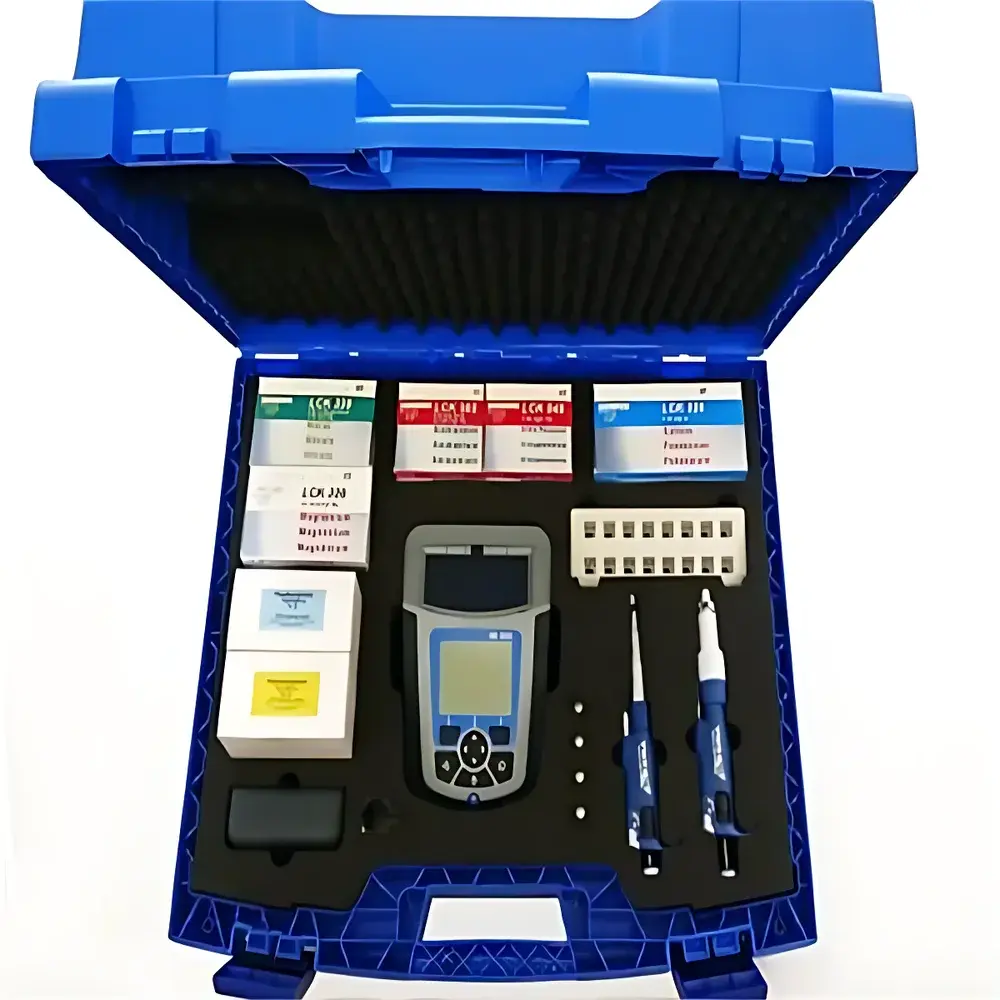
COMBI 5000 Portable Multi-Parameter Soil Analyzer
| Origin | Germany |
|---|---|
| Manufacturer Type | Authorized Distributor |
| Origin Category | Imported |
| Model | COMBI 5000 |
| Instrument Type | Multiparameter Soil Analyzer |
| Housing | IP67-rated waterproof & impact-resistant aluminum alloy enclosure |
| Connectivity | BNC + 8-pin proprietary sensor interface |
| Power Supply | 9 V alkaline battery (≥4,000 measurements per set) |
| Dimensions | 180 × 85 × 50 mm |
| Weight | 280 g |
| Salinity Range | 0–10 g/L |
| Salinity Resolution | 0.01 g/L |
| Probe Options | Stainless steel, 2-electrode configuration, available in 250 / 500 / 750 mm lengths |
| Display Language | English & German (optional: French, Italian, Spanish, Russian) |
| Sensor Auto-ID | Yes |
| Auto-Unit Switching | Yes |
| Temperature Compensation | Integrated Pt1000 RTD |
| Operating Temperature | −10 °C to +50 °C |
| Storage Temperature | −20 °C to +60 °C |
Overview
The COMBI 5000 Portable Multi-Parameter Soil Analyzer is an engineered field instrument designed for rapid, on-site assessment of key soil physicochemical parameters critical to agronomic decision-making, horticultural substrate management, and environmental site characterization. Based on robust electrochemical and thermometric sensing principles, the device simultaneously measures pH, electrical conductivity (EC), salinity (as NaCl-equivalent mass concentration), volumetric water content (via dielectric permittivity correlation), and temperature — all within a single handheld platform. Its measurement architecture adheres to standardized electrochemical protocols aligned with ISO 11260 (soil pH determination), ISO 11265 (soil EC), and ASTM D2777 (precision and bias in field analytical methods). The integrated Pt1000 temperature sensor enables automatic temperature compensation across all electrochemical readings, ensuring traceable accuracy under variable ambient conditions. Unlike benchtop analyzers requiring sample extraction and suspension preparation, the COMBI 5000 supports direct insertion into undisturbed soil or growing media — minimizing sampling artifacts and preserving in-situ matrix integrity.
Key Features
- IP67-rated ruggedized aluminum housing with shock-absorbing elastomer overmold, certified for field deployment in dusty, humid, or rain-exposed environments
- Intelligent sensor auto-identification via embedded EEPROM chips in all compatible probes — eliminates manual mode selection and reduces operator error
- Real-time auto-unit switching: device automatically selects appropriate units (e.g., pH, mS/cm, g/L, % v/v, °C) based on connected sensor configuration
- Factory-calibrated sensor suite with documented NIST-traceable calibration certificates; no routine recalibration required under normal operating conditions
- Dual-language firmware (English/German) with optional multilingual UI packs supporting ISO-standard terminology for international regulatory alignment
- Low-power microcontroller architecture delivering >4,000 discrete measurements per 9 V alkaline battery set — validated per IEC 60086-2 cycle testing
- Ergonomic hand grip with tactile button feedback and high-contrast backlit LCD optimized for outdoor readability under direct sunlight
Sample Compatibility & Compliance
The COMBI 5000 is validated for direct measurement in mineral soils (sand, loam, clay), organic substrates (peat, coco coir, compost), hydroponic nutrient solutions, and greenhouse growing media. Its stainless-steel 2-electrode salinity probe operates on conductimetric principles compliant with DIN EN 27888 for aqueous extract analysis and adapted for in-situ use via empirical correction algorithms accounting for soil moisture and bulk density effects. All firmware and hardware design elements conform to CE marking requirements under Directive 2014/30/EU (EMC) and 2014/35/EU (LVD). Data logging functionality supports audit-ready operation under GLP-compliant workflows when paired with optional PC synchronization software.
Software & Data Management
While the COMBI 5000 operates autonomously without external software, it supports optional USB-C data export (via adapter) to Windows-based desktop application COMBI-Link v3.2. This application provides CSV export, time-stamped measurement history (including GPS metadata if enabled via Bluetooth-connected smartphone), statistical summaries (mean, SD, min/max), and customizable report templates aligned with ISO/IEC 17025 documentation frameworks. All stored data include immutable timestamps, sensor ID, operator ID fields, and firmware revision tags — satisfying minimum requirements for 21 CFR Part 11 electronic record integrity where local validation protocols are implemented.
Applications
- Agronomic soil health monitoring: real-time detection of salinization trends in irrigated cropland and orchards
- Greenhouse substrate QA/QC: verification of pH and EC stability during propagation and finishing cycles
- Land remediation site screening: rapid stratified profiling of contaminant-affected zones using multi-depth probe insertion
- Ecological field surveys: non-destructive assessment of rhizosphere conditions across vegetation transects
- Educational field labs: undergraduate soil science instruction with immediate quantitative feedback on pedogenic processes
- Regulatory pre-screening: preliminary compliance checks against national soil quality thresholds (e.g., EU Soil Thematic Strategy limits)
FAQ
Is the COMBI 5000 suitable for saturated paste extracts?
No — it is designed exclusively for in-situ direct insertion. For saturated paste analysis, laboratory-based EC/pH meters with standardized extraction protocols are recommended.
Can the salinity probe be used in seawater or brine solutions?
Not advised — its calibration and algorithmic corrections are optimized for soil solution ionic strength ranges (0–10 g/L NaCl); higher concentrations induce nonlinearity and electrode polarization effects.
Does the device meet FDA or EPA field method equivalency criteria?
It aligns with EPA Method 9045D (pH) and 9012B (EC) conceptual frameworks but is not listed as an approved field kit; users must validate performance against site-specific reference methods per EPA SW-846 Chapter 1 guidance.
What maintenance is required between field deployments?
Rinse probe tips with deionized water after each use; inspect O-rings and connector pins quarterly; store in supplied aluminum case with desiccant pack.
Is firmware upgrade capability supported?
Yes — updates are distributed via COMBI-Link software and require USB-C connection; version history and release notes comply with IEC 62304 Class B software lifecycle requirements.







