
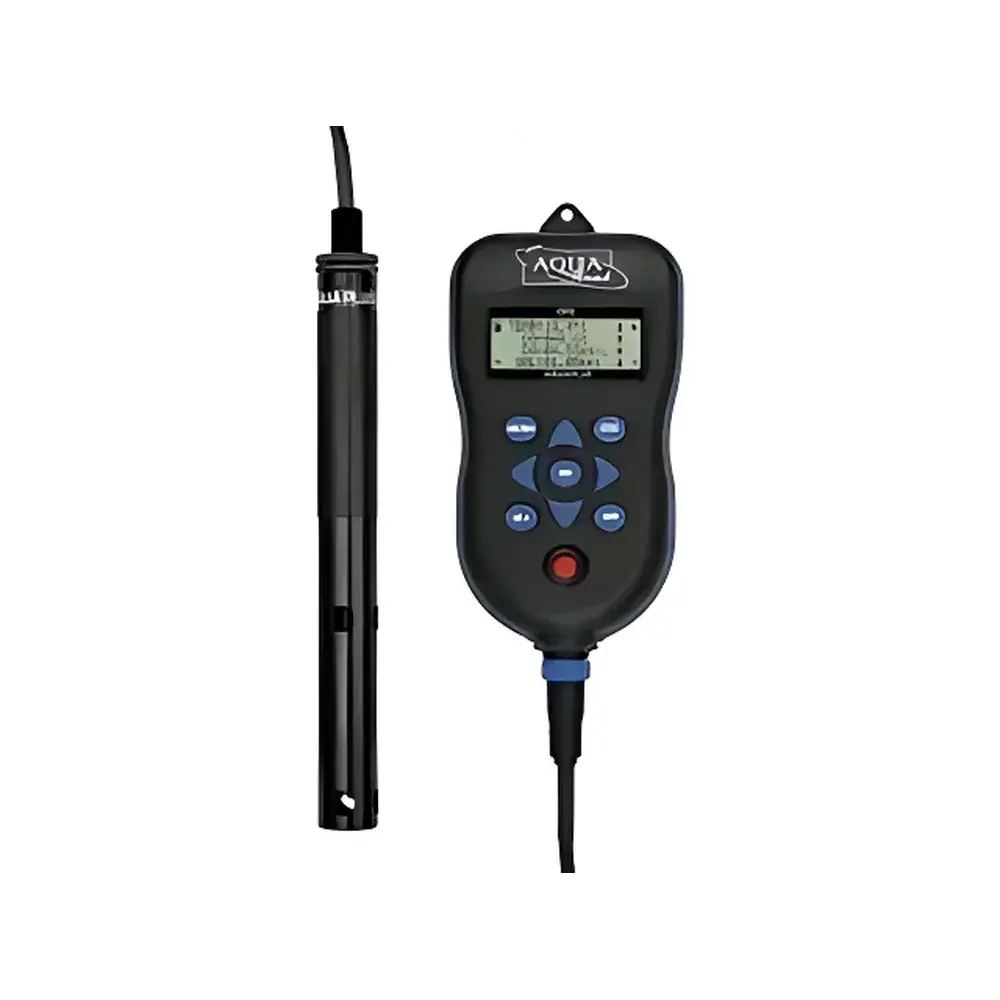
AQUAREAD Aqua-Plus Fluorescence-Based Dissolved Oxygen Meter
| Brand | AQUAREAD |
|---|---|
| Origin | United Kingdom |
| Manufacturer Type | Authorized Distributor |
| Origin Category | Imported |
| Model | Aqua-Plus |
| Instrument Type | Portable |
| Measurement Principle | Fluorescence Quenching |
| Measurement Range | 0–80 mg/L (or % saturation) |
| Accuracy | ±0.1 mg/L |
| Repeatability | ±0.05% of reading |
| Detection Limit | 2 ppb (O₂) |
Overview
The AQUAREAD Aqua-Plus Fluorescence-Based Dissolved Oxygen Meter is a field-deployable, multi-parameter water quality analyzer engineered for high-fidelity, maintenance-free dissolved oxygen (DO) measurement in freshwater, estuarine, and marine environments. Unlike electrochemical DO sensors that rely on oxygen diffusion through membranes and consume electrolyte, the Aqua-Plus employs optical fluorescence quenching — a solid-state, membrane-free detection principle. In this method, a blue LED excites a proprietary ruthenium-based luminophore immobilized on the sensor surface; molecular oxygen quenches the resulting red phosphorescence in direct proportion to its partial pressure. The phase-shift or intensity decay of the emitted signal is measured with precision photodetectors and converted into DO concentration (mg/L) and percent saturation (%), fully compensated for temperature, salinity, and atmospheric pressure. This physics-based approach eliminates drift from membrane fouling, electrolyte depletion, or cathode polarization — ensuring long-term stability and calibration integrity across diverse aquatic matrices.
Key Features
- Triple-parameter capability: Simultaneous real-time measurement of dissolved oxygen (mg/L and % saturation), conductivity (µS/cm), and temperature (°C)
- Integrated environmental compensation: Built-in barometric pressure sensor and thermistor enable automatic, on-the-fly DO correction per ISO 5814 and ASTM D888 standards
- Ruggedized field design: IP67-rated meter housing with oversized tactile buttons, sunlight-readable backlit display, and integrated lanyard mount for hands-free operation
- Submersible probe with IP68 rating: Stainless-steel-bodied Aqua-Plus Probe features resin-filled, hermetically sealed optics; rated for continuous underwater deployment up to 100 m depth
- Zero-maintenance optical sensing: No membranes, no electrolyte, no polarization time — sensor cap replacement only required every 24 months under typical use conditions
- Flow-independent measurement: Unaffected by water velocity, turbulence, or presence of sulfides, chlorides, CO₂, or ammonia — validated per US EPA Method 360.1 for interferent resistance
Sample Compatibility & Compliance
The Aqua-Plus system is validated for use across natural waters (rivers, lakes, wetlands), wastewater effluents, aquaculture systems, and full-salinity seawater (up to 45 ppt). Its optical DO sensor exhibits negligible cross-sensitivity to common aquatic interferents, enabling reliable operation in sulfidic sediments, hypoxic zones, and industrial discharge monitoring scenarios. The instrument complies with ISO 5814:2012 (Water quality — Determination of dissolved oxygen — Electrochemical probe method) for optical equivalence, and supports data traceability requirements aligned with GLP and ISO/IEC 17025 laboratory accreditation frameworks. All firmware and calibration logs are timestamped and stored with metadata (GPS coordinates, barometric pressure, operator ID), facilitating audit-ready reporting under regulatory programs including EU WFD and US Clean Water Act Section 303(d).
Software & Data Management
Data acquisition and post-processing are supported via AQUAREAD’s AQView™ desktop software (Windows/macOS), which enables batch calibration validation, QA/QC flagging, and automated report generation compliant with ISO/IEC 17025 documentation standards. Field-collected datasets — including DO, conductivity, temperature, GPS position, and atmospheric pressure — export natively to CSV, KML, and ESRI Shapefile formats. KML output is directly compatible with Google Earth™ and Google Maps™ for spatial visualization of longitudinal DO profiles, hypoxia mapping, and watershed-scale trend analysis. Firmware updates and sensor calibration certificates are digitally signed and version-controlled, supporting FDA 21 CFR Part 11-compliant electronic records when deployed in regulated environmental monitoring programs.
Applications
- Regulatory ambient water quality monitoring (EPA Region 10, Environment Agency UK, EEA WISE)
- Hypoxia and dead zone characterization in coastal and estuarine systems
- Aquaculture pond management and dissolved oxygen stress assessment
- Wastewater treatment plant influent/effluent compliance verification
- Research-grade biogeochemical profiling in benthic chambers and mesocosms
- Climate change impact studies involving thermal stratification and oxygen minimum zone expansion
FAQ
Does the Aqua-Plus require recalibration after sensor cap replacement?
Yes — a two-point calibration (zero and span) is required following cap replacement, using certified zero-oxygen solution and air-saturated water at known temperature and salinity.
Can the probe be used in turbid or biofouling-prone waters?
Yes — the optical sensing surface is chemically inert and resistant to organic adhesion; optional anti-fouling caps with copper alloy mesh are available for extended deployments in eutrophic systems.
Is GPS data embedded in exported files?
Yes — all measurements include geotagged metadata (WGS84 latitude/longitude, altitude, UTC timestamp) stored in both internal memory and exported KML/CSV files.
What is the maximum operating depth for continuous submersion?
The probe is rated IP68 to 100 meters static water depth; the meter itself is IP67 (1 m for 30 min) and intended for surface or handheld use.
How is temperature compensation applied during DO calculation?
Temperature is measured via a Pt1000 RTD embedded in the probe tip; compensation follows the Benson-Krause equation as implemented in ISO 5814 Annex B, with salinity correction per UNESCO 1983 algorithms.







