
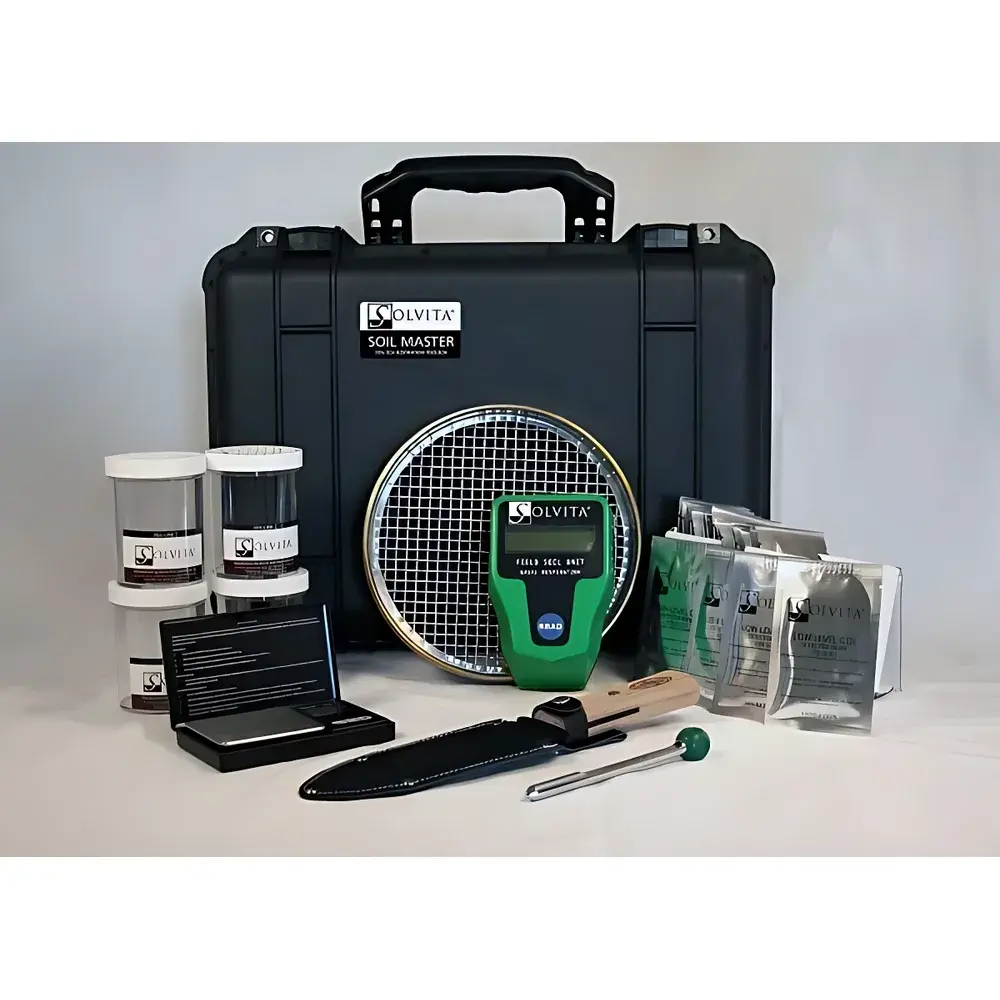
Soil Master Portable Soil CO₂ Flux Analyzer
| Origin | USA |
|---|---|
| Manufacturer Type | Distributor |
| Origin Category | Imported |
| Model | Soil Master |
| Price Range | USD 2,800–7,000 |
| Instrument Type | Multifunctional Soil Analyzer |
Overview
The Soil Master Portable Soil CO₂ Flux Analyzer is a field-deployable, battery-powered gas exchange system engineered for high-temporal-resolution measurement of soil respiration (CO₂ efflux) under natural environmental conditions. It operates on the principle of open-path, non-steady-state chamber methodology coupled with integrated infrared gas analysis (IRGA), enabling real-time quantification of CO₂ concentration gradients across the soil–atmosphere interface. Unlike closed-chamber systems that induce pressure artifacts or CO₂ accumulation, the Soil Master maintains continuous ambient air circulation through its 1-L elliptical soil chamber—minimizing chamber-induced microclimate perturbation while preserving in situ soil physical and biological integrity. The IRGA sensor is mounted directly inside the chamber headspace, reducing sample transport delay to <100 ms and ensuring sub-second response to dynamic CO₂ flux changes. Temperature-compensated measurements are synchronized with simultaneous monitoring of soil temperature (0–50 °C), chamber air temperature, photosynthetically active radiation (PAR), and water vapor partial pressure—critical for normalizing flux data to standard environmental drivers per ISO 16634-2 and ASTM D7928 protocols.
Key Features
- Integrated dual-channel IRGA with 1 ppm CO₂ resolution (0–2000 ppm range) and <0.1% RSD at 350 ppm; temperature drift <0.05% FS/°C
- High-fidelity dual fast-response capacitive hygrometers for H₂O measurement (0–75 mbar, 0.1 mbar resolution, ±0.5% RSD)
- Ergonomic 4.4 kg main console with 230 × 110 × 170 mm footprint; 1 L elliptical chamber (11 × 85 × 145 mm, 190 g) with stainless steel insertion collar for minimal soil disturbance
- Onboard 512 KB RAM data logger (expandable to 1 MB) storing up to 8,000 timestamped records including CO₂ flux, temperature gradients, PAR, and flow rate
- Configurable airflow control (100–500 mL/min) with pressure-relief valve to prevent back-diffusion and maintain atmospheric equilibrium during measurement
- 12 V / 6.8 Ah sealed lead-acid battery supporting >16 hours of continuous operation; universal AC charger (90–260 V, 50/60 Hz)
- 240 × 60 pixel graphical LCD with real-time flux curve plotting and on-device statistical summary (mean, SD, min/max over user-defined intervals)
Sample Compatibility & Compliance
The Soil Master accommodates heterogeneous soil matrices—including sandy loam, clay-rich aggregates, organic peat, and disturbed agricultural plots—without requiring pre-conditioning or homogenization. Its low-profile insertion collar ensures consistent chamber sealing across variable surface roughness and moisture content. All sensors meet IEC 61326-1 electromagnetic compatibility standards for field instrumentation. Data acquisition complies with GLP traceability requirements: each measurement includes embedded timestamps, operator ID fields, GPS metadata (via optional RS232-connected receiver), and hardware-calibration log entries. Firmware supports audit trail export in CSV format compatible with FDA 21 CFR Part 11–compliant review workflows when used in regulatory environmental monitoring programs.
Software & Data Management
Raw sensor outputs and calculated flux values are accessible via RS232 serial interface (up to 38,400 baud) for integration with third-party data acquisition platforms (e.g., LabVIEW, MATLAB, Python-based PySerial pipelines). The onboard firmware implements the Hutchinson–Mosier nonlinear regression algorithm for non-steady-state flux calculation, with user-selectable integration windows (10–120 s). Exported datasets include columnar headers compliant with FAO’s Global Soil Laboratory Network (GLOSOLAN) metadata schema. Optional PC software provides batch processing, diurnal pattern decomposition, temperature response curve fitting (Q₁₀ modeling), and automated outlier detection based on residual variance thresholds.
Applications
- Long-term carbon balance assessment across ecosystem gradients (forest–grassland–wetland transitions)
- Microbial activity monitoring in response to pesticide application, biochar amendment, or nitrogen fertilization trials
- Soil health diagnostics in regenerative agriculture systems, correlating CO₂ pulse dynamics with labile carbon pools
- Validation of eddy covariance tower data via spatially distributed chamber networks (supports multiplexer expansion for up to 16 chambers)
- Climate change impact studies: measuring thermal sensitivity of heterotrophic respiration across elevation transects
- Urban soil remediation tracking—quantifying microbial reactivation post-contaminant removal
FAQ
What calibration procedures are required before field deployment?
A two-point CO₂ span calibration (zero air and 350 ppm standard) and single-point H₂O verification are recommended prior to each 48-hour field campaign. Factory calibration certificates are provided with NIST-traceable gas standards.
Can the system operate autonomously for unattended multi-day measurements?
Yes—when paired with an external solar charging kit and weatherproof enclosure, the unit supports scheduled 30-minute interval measurements over 72+ hours using the internal scheduler and sleep-mode power management.
Is the Soil Master compatible with existing eddy covariance infrastructure?
It interfaces natively with Campbell Scientific CR1000X and LI-COR LI-850 data loggers via analog voltage output (0–5 V) or Modbus RTU over RS485 (adapter required).
How is soil temperature measured, and what is the probe insertion depth?
A calibrated Type-T thermocouple is embedded in the chamber baseplate, measuring surface soil temperature at 0–1 cm depth; optional 5-cm depth probes are available as accessories.
Does the firmware support custom flux calculation algorithms?
User-defined regression models can be uploaded via ASCII script files through the RS232 port, provided they conform to the onboard parser syntax (IEEE 754 floating-point arithmetic, max 256 instruction steps).
Related Products







