
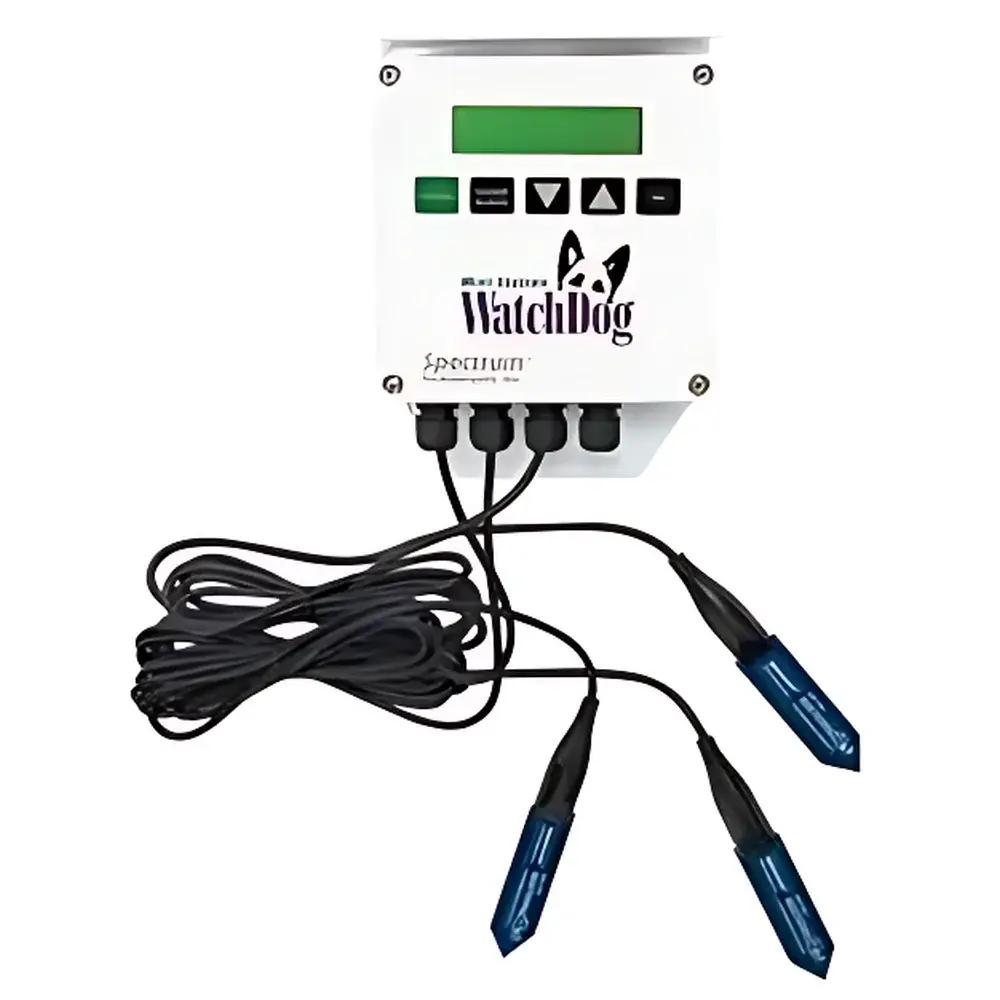
Spectrum WatchDog 2400 Soil Moisture Monitoring Station
| Brand | Spectrum |
|---|---|
| Origin | USA |
| Manufacturer Type | Authorized Distributor |
| Product Category | Imported Instrument |
| Model | WatchDog 2400 |
| Instrument Type | Soil Moisture / Water Potential Analyzer |
| Data Logger Channels | 4 |
| Memory Capacity | 8,800 data points |
| Sampling Intervals | 1, 10, 15, 30, 60, 120 minutes |
| Display | Integrated LCD |
| Power Supply | 4 × AA batteries (12-month typical life) |
| Sensor Cable Options | 1.8 m or 6 m (extendable to 15 m) |
| Output Signal | Analog voltage, time-division multiplexed |
| Soil Moisture Range | 0–100% VWC (volumetric water content), Resolution: 0.1% VWC, Accuracy: ±3% VWC |
| Electrical Conductivity Range | 0–10 mS/cm, Resolution: 0.01 mS/cm, Accuracy: ±2% |
| Temperature Range | −18°C to +50°C, Resolution: 0.1°C, Accuracy: ±0.8°C |
Overview
The Spectrum WatchDog 2400 Soil Moisture Monitoring Station is a field-deployable, battery-powered environmental data logging system engineered for long-term, unattended monitoring of soil physical parameters in agricultural research, ecological studies, irrigation management, and hydrological modeling. It operates on the principle of time-domain reflectometry (TDR) for volumetric water content (VWC) measurement—leveraging electromagnetic pulse propagation velocity through soil to derive dielectric permittivity, which correlates directly with water content. Simultaneously, integrated sensors measure electrical conductivity (EC) and temperature, enabling correction of EC for thermal effects and supporting salinity assessment in accordance with ASTM D511 and ISO 11265 standards. Designed for rugged outdoor use, the WatchDog 2400 features an IP67-rated enclosure, low-power architecture, and a built-in LCD for real-time field verification—eliminating reliance on external interfaces during routine site checks.
Key Features
- Four-channel analog input architecture supporting simultaneous connection of up to four TDR-based soil moisture, EC, and temperature probes—including compatible Spectrum TDR300 sensors.
- Onboard non-volatile memory stores up to 8,800 timestamped data records; configurable sampling intervals (1–120 min) enable flexible deployment strategies—from high-resolution drought response studies to seasonal trend analysis.
- Integrated backlit LCD display provides immediate access to live sensor readings, battery status, memory usage, and sampling interval settings—critical for rapid validation during field calibration or troubleshooting.
- Time-division multiplexed analog voltage output (0–2.5 V) ensures compatibility with third-party dataloggers and SCADA systems without signal degradation over extended cable runs (up to 15 m with optional extension).
- Optimized power management delivers >12 months of continuous operation on four standard AA alkaline cells under typical 30-minute sampling, minimizing maintenance frequency across remote or inaccessible sites.
Sample Compatibility & Compliance
The WatchDog 2400 is validated for use with Spectrum’s family of calibrated soil probes—including the TDR300 series—and supports third-party sensors meeting 0–2.5 V analog output specifications and 6–10 mA current draw requirements. All measurements adhere to internationally recognized methodologies: VWC determination follows ASTM D511-22 (Standard Test Methods for Soluble Salts in Soil) and ISO 11265:2022 (Soil quality — Determination of electrical conductivity), while temperature compensation algorithms conform to US EPA Method 9045D guidelines. The system meets IEC 60529 IP67 ingress protection for dust and temporary immersion, and its firmware architecture supports audit-ready data integrity per GLP principles—ensuring traceability for regulatory submissions or peer-reviewed publication.
Software & Data Management
Data retrieval is performed via USB-to-serial interface using Spectrum’s proprietary WatchDog Software (Windows-compatible), which enables batch download, time-series visualization, unit conversion (e.g., VWC ↔ matric potential using van Genuchten parameters), and export to CSV, Excel, or XML formats for integration into GIS platforms or statistical analysis tools (R, Python pandas). The software enforces metadata tagging—including site ID, probe depth, soil texture class, and calibration date—to support FAIR (Findable, Accessible, Interoperable, Reusable) data practices. While the WatchDog 2400 does not natively support cloud transmission or 21 CFR Part 11 electronic signature compliance, raw binary logs retain full timestamp precision and checksum validation—facilitating post-acquisition verification and forensic reconstruction of measurement history.
Applications
- Deficit irrigation scheduling in orchards and vineyards, where precise VWC thresholds trigger automated drip control systems.
- Long-term soil moisture flux modeling in watershed-scale ecohydrology projects requiring synchronized multi-depth profiles.
- Salinity monitoring in coastal agriculture or reclaimed soils, combining EC and temperature to calculate pore-water salinity (dS/m) and assess crop stress thresholds.
- Calibration and validation of satellite-based soil moisture products (e.g., SMAP, Sentinel-1) at ground-truth reference sites.
- Classroom and undergraduate field labs—its intuitive interface and plug-and-play sensor compatibility lower technical barriers for teaching instrumentation fundamentals and environmental data literacy.
FAQ
Can the WatchDog 2400 operate in frozen soil conditions?
Yes—its temperature range extends to −18°C, and TDR-based moisture measurement remains functional below 0°C, though interpretation of VWC requires adjustment for ice-phase dielectric properties per ISO/TS 17892-10.
Is sensor calibration required before deployment?
Factory-calibrated probes are supplied with NIST-traceable certificates; however, site-specific calibration using gravimetric sampling is recommended for applications demanding <±2% VWC accuracy.
Does the system support wireless data transmission?
No—the WatchDog 2400 relies on wired USB download; for telemetry, it must be paired with an external cellular or LoRaWAN gateway via its analog outputs.
How is temperature used in the measurement workflow?
Temperature data corrects EC readings for thermal drift and informs VWC-to-water-potential conversions using soil-specific pedotransfer functions.
What is the maximum allowable cable length between the logger and sensor?
Standard cables are 1.8 m or 6 m; with low-capacitance shielded extension cables, total run length may reach 15 m without signal attenuation beyond specification limits.
Related Products







