
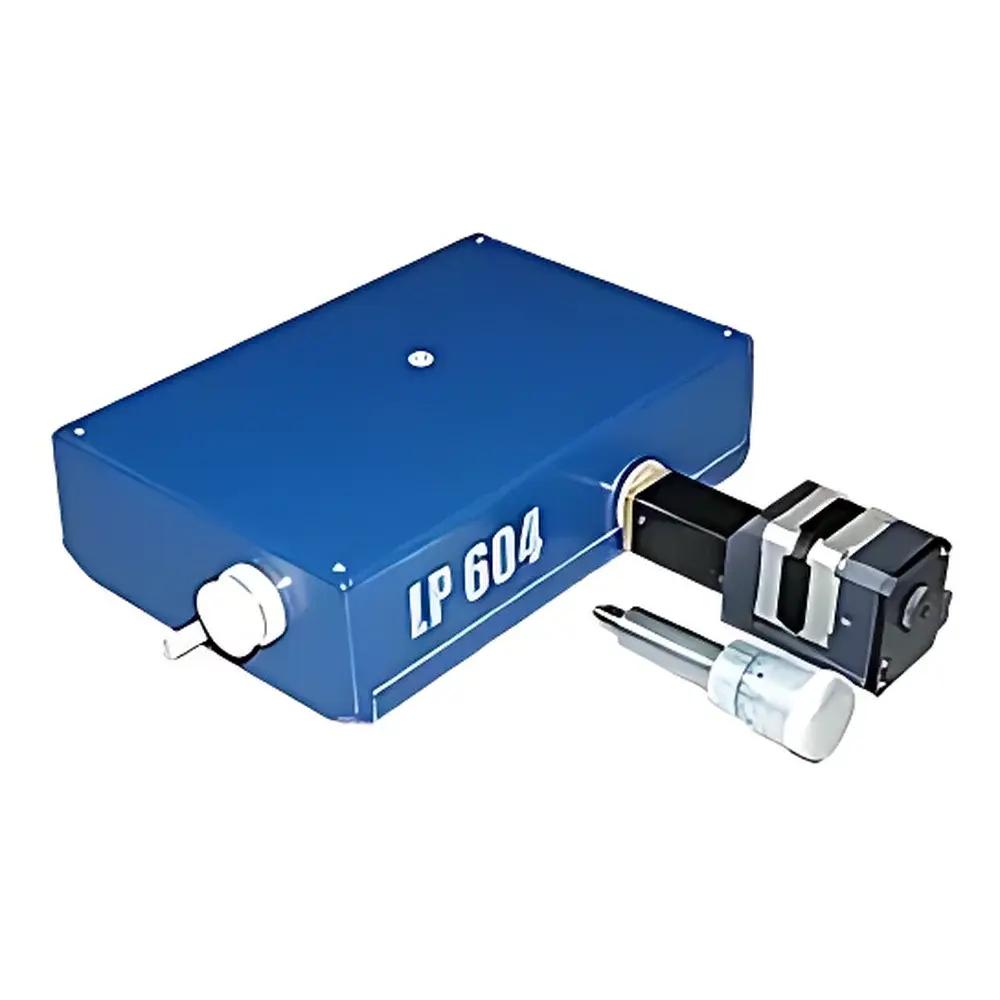
Solar+LP601 Tunable Laser Source with Optical Parametric Oscillator (OPO)
| Brand | SOLARS |
|---|---|
| Origin | Russia |
| Model | LP601 |
| Pump Wavelength | 355 nm |
| Tuning Range (Signal + Idler) | 410–2500 nm |
| Second-Harmonic Generation (SHG) Range | 210–420 nm |
| Linewidth | ≤4 cm⁻¹ (typ.) |
| Nonlinear Crystal | BBO |
| Pump Requirements | Nd:YAG, 355 nm, ≤100 mJ, 4–12 ns, ≤60 MW/cm² |
| Dimensions | 255 × 155 × 70 mm |
| OPO Architecture | Intracavity or Standalone Synchronous OPO |
Overview
The Solar LP601 is a compact, solid-state tunable laser source based on optical parametric oscillation (OPO) technology. Engineered for precision spectroscopy, nonlinear optics research, and time-resolved photophysics, the LP601 utilizes third-harmonic (355 nm) Nd:YAG laser radiation as its pump source to generate coherent output across the ultraviolet–near-infrared spectrum via difference-frequency mixing in a beta-barium borate (BBO) nonlinear crystal. Its core architecture supports both signal and idler wave generation, enabling continuous spectral coverage from 410 nm to 2500 nm — a range spanning deep UV through short-wave infrared (SWIR). With a typical linewidth of ≤4 cm⁻¹ (corresponding to ~0.1–0.3 nm depending on wavelength), the system delivers high spectral resolution suitable for absorption spectroscopy, photoacoustic detection, and pump–probe experiments. Unlike broadly tunable Ti:sapphire or OPO systems requiring complex cavity stabilization, the LP601 employs a robust, alignment-insensitive resonator design optimized for laboratory-grade reproducibility and long-term operational stability under ambient conditions.
Key Features
- High-conversion-efficiency OPO core using phase-matched BBO crystal with >35% total optical-to-tunable conversion efficiency
- Single-unit integration of OPO cavity, harmonic separation optics, and beam delivery path — no external alignment required
- Real-time wavelength display via integrated digital readout; optional miniature fiber-coupled spectrometer for in-situ spectral verification
- Configurable second-harmonic generation (SHG) module extending usable output into the deep-UV (210–420 nm)
- Compact footprint (255 × 155 × 70 mm) and low power consumption compatible with standard optical tables and OEM integration
- Support for custom OPO configurations including difference-frequency generation (DFG) stages for mid-infrared extension up to 20 µm (subject to engineering review)
- Full remote control via RS-232/USB interface with LabVIEW-compatible drivers and SCPI command set
Sample Compatibility & Compliance
The LP601 is designed for use with standard Nd:YAG pump lasers meeting specified pulse energy (≤100 mJ), duration (4–12 ns), and spatial profile (multimode, uniform intensity distribution, divergence <1 mrad). It complies with IEC 60825-1:2014 Class 4 laser safety requirements when operated with appropriate interlocks and beam enclosures. All optical components are certified for vacuum compatibility and thermal stability over −10 °C to +40 °C ambient operation. The system meets electromagnetic compatibility (EMC) standards per EN 61326-1 for laboratory instrumentation. While not pre-certified for GMP or FDA 21 CFR Part 11 environments, its firmware supports audit-trail logging and user-access-level controls when deployed with validated host software — facilitating qualification under ISO/IEC 17025 or GLP frameworks for analytical method development.
Software & Data Management
Control and calibration are managed through SOLARS’ proprietary “OPOControl” software suite (Windows 10/11, 64-bit), providing intuitive GUI-based wavelength selection, pulse synchronization setup, and real-time power monitoring. The application exports spectral data in ASCII and HDF5 formats, supporting direct import into Igor Pro, MATLAB, and Python-based analysis pipelines (e.g., SciPy, LMFIT). Firmware includes non-volatile memory for storing up to 128 user-defined wavelength presets with associated pump energy compensation profiles. For automated workflows, the LP601 supports TTL-triggered operation and programmable delay sequencing synchronized to external detectors or choppers. Optional SDK enables integration into custom DAQ platforms compliant with NI-DAQmx or EPICS control architectures.
Applications
- Ultrafast transient absorption spectroscopy (TAS) requiring broadband tunable probe pulses
- Photoacoustic spectroscopy (PAS) and cavity-enhanced absorption measurements in gas-phase trace analysis
- Nonlinear microscopy including coherent anti-Stokes Raman scattering (CARS) and stimulated Raman scattering (SRS)
- Calibration of FTIR spectrometers, monochromators, and CCD/InGaAs array detectors
- Development of wavelength-specific photodetectors and quantum dot characterization
- Mid-IR source seeding for difference-frequency generation (DFG) systems targeting molecular fingerprint region (3–12 µm)
FAQ
What pump laser specifications are mandatory for reliable LP601 operation?
The LP601 requires a Q-switched Nd:YAG laser emitting at 355 nm with pulse energy ≤100 mJ, pulse duration between 4–12 ns, and beam quality sufficient to maintain ≤60 MW/cm² peak intensity on the BBO crystal surface. Multimode TEM₀₀-like beams with uniform spatial profile and divergence <1 mrad are recommended.
Can the LP601 be used for continuous-wave (CW) applications?
No — the LP601 is a pulsed OPO system designed exclusively for nanosecond-pulsed pump sources. It does not support CW pumping or intracavity CW OPO configurations.
Is spectral calibration traceable to NIST standards?
Yes — factory calibration uses a calibrated Ocean Insight HR4000 spectrometer referenced to NIST-traceable emission lines (e.g., Hg/Ar lamp). Users may perform field recalibration using optional external wavemeter modules.
What is the expected lifetime of the BBO crystal under nominal operating conditions?
With proper thermal management and adherence to maximum fluence limits, the BBO crystal maintains >95% conversion efficiency after ≥1 × 10⁶ shots at 10 Hz repetition rate, corresponding to approximately 2 years of daily 8-hour operation.
Does the LP601 support external triggering for time-resolved experiments?
Yes — it accepts TTL-level external trigger signals (5 V CMOS) with adjustable delay (0–100 ms, 10 ns resolution) and jitter <5 ns, enabling precise synchronization with pump lasers, streak cameras, or gated detectors.





