
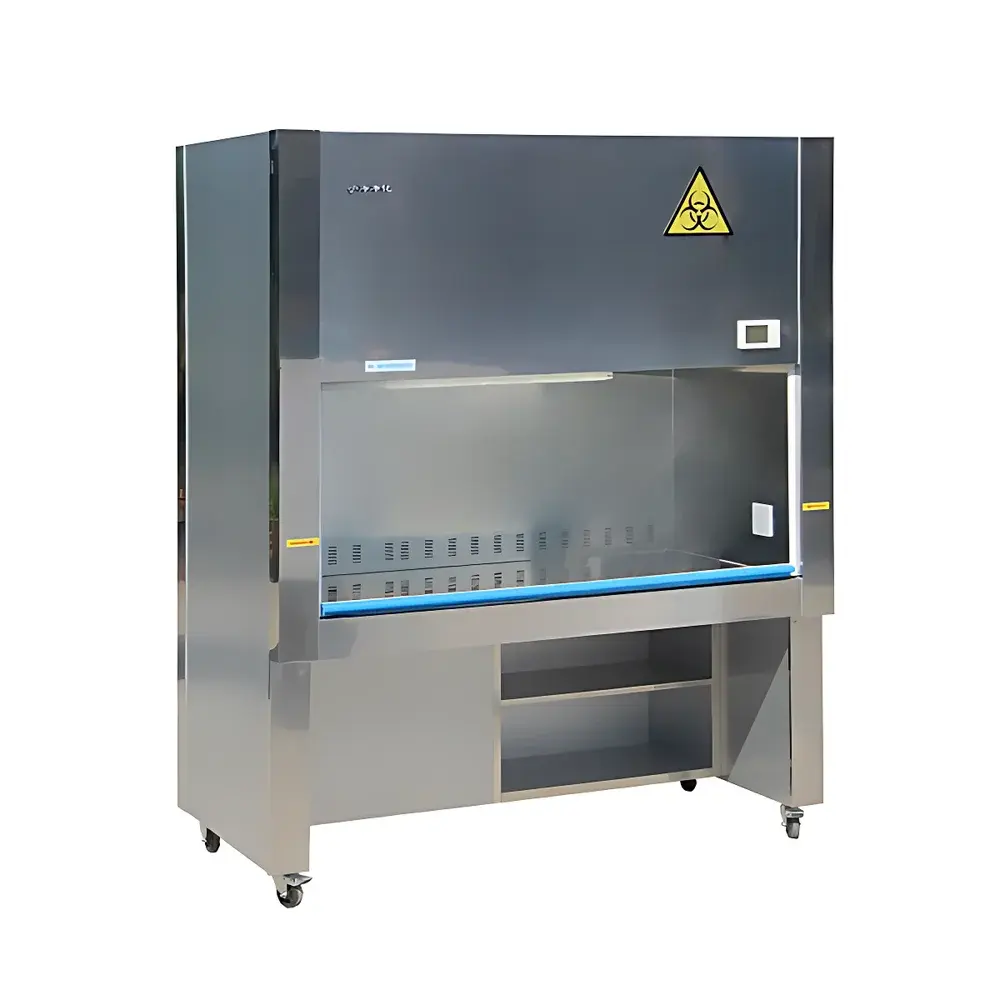
HJ BHC-1300IIA/B2 Semi-Recirculating Class II Type A2 Biological Safety Cabinet
| Brand | HJ Purification |
|---|---|
| Origin | Shanghai, China |
| Manufacturer Type | Direct Manufacturer |
| Product Category | Domestic |
| Model | BHC-1300IIA/B2 |
| Unit Price | USD 2,300 (FOB Shanghai) |
| External Dimensions (L×W×H) | 1200 × 780 × 1950 mm |
| Internal Work Area Dimensions (L×W×H) | 1000 × 700 × 680 mm |
| Filter Efficiency (HEPA) | ≥99.99% @ 0.3 µm (EN 1822-1:2019 compliant) |
| Airflow Velocity (Inflow) | 0.55 ± 0.025 m/s (70% exhaust, 30% recirculation) |
| Average Work Surface Velocity | 0.26–0.38 m/s (adjustable via variable-frequency drive) |
| Noise Level | ≤62 dB(A) |
| Illumination | ≥480 lux (measured at work surface) |
| Power Supply | AC 220 V, 50 Hz |
| Max. Power Consumption | 800 W |
| Net Weight | 220 kg |
| Lighting | 20 W fluorescent lamp × 1 + 20 W UV germicidal lamp × 1 |
| HEPA Filter Size & Qty | 995 × 640 × 50 mm × 1 |
| Compliance | NSF/ANSI 49-2022, YY 0569-2011, ISO 14644-1 Class 5 (ISO Class 5 equivalent to Fed Std 209E Class 100), EN 12469:2000 |
Overview
The HJ BHC-1300IIA/B2 is a semi-recirculating Class II Type A2 biological safety cabinet engineered for containment of low-to-moderate risk biological agents (BSL-1 and BSL-2). It operates on the principle of laminar airflow generated by a dual-fan system: one motor drives downward vertical airflow through a supply HEPA filter to maintain ISO Class 5 (Fed Std 209E Class 100) cleanliness over the work surface; the second motor draws room air inward across the front opening (inflow velocity 0.55 ± 0.025 m/s), then routes ~70% of total airflow through an exhaust HEPA filter before discharge via ducted or thimble-connected external venting, while ~30% is recirculated after passing through the same supply HEPA filter. This configuration ensures simultaneous personnel, product, and environmental protection—critical for routine microbiological culture, sterile pharmaceutical compounding, and molecular biology workflows where aerosol-generating procedures are performed.
Key Features
- Air curtain isolation system with vertically sliding sash (height-adjustable up to 200 mm opening) minimizes cross-contamination between operator and work area.
- Dual independent variable-frequency drive (VFD) fans enable precise, stepless control of inflow and downflow velocities—ensuring stable performance under varying ambient pressure conditions and filter loading.
- Integrated HEPA filtration: single 995 × 640 × 50 mm high-efficiency particulate air filter certified to EN 1822-1:2019 (≥99.99% efficiency at 0.3 µm MPPS), installed in both supply and exhaust paths.
- Front access panel with IP44-rated waterproof socket (220 V, 50 Hz) supports auxiliary equipment such as centrifuges or pipette controllers without compromising containment integrity.
- LCD digital control interface displays real-time airflow velocity, UV lamp operational status, and filter service life indicators—enabling proactive maintenance scheduling per GLP-compliant laboratory protocols.
- Acoustically damped enclosure and vibration-isolated work surface (semi-peak vibration ≤5 µm) ensure stable handling of sensitive reagents and microplates during extended operation.
Sample Compatibility & Compliance
The BHC-1300IIA/B2 accommodates standard biosafety workflows involving liquid cultures, agar plates (Φ90 mm), tissue culture flasks (T-75, T-175), and PCR setup stations. Its internal work area (1000 × 700 × 680 mm) permits concurrent use of up to three Class II-compatible devices. The cabinet meets NSF/ANSI 49-2022 requirements for Type A2 cabinets—including containment verification via potassium iodide (KI) smoke testing, inflow velocity validation, and HEPA filter leak testing using photometer scanning. It also conforms to YY 0569-2011 (Chinese national standard for BSCs), EN 12469:2000 (microbiological safety cabinets), and ISO 14644-1 Class 5 for cleanroom-grade particle control. Optional documentation packages support FDA 21 CFR Part 11-compliant audit trails when integrated with validated LIMS or ELN systems.
Software & Data Management
While the cabinet operates via embedded microcontroller-based hardware logic (no external PC dependency), its LCD interface logs timestamped operational events—including daily UV exposure duration, cumulative fan runtime, and alarm triggers (e.g., sash height deviation, airflow failure). All event logs are exportable via RS-232 serial port to CSV format for integration into laboratory quality management systems (QMS). Firmware updates are performed offline using USB memory stick, ensuring cybersecurity compliance in regulated environments. Calibration certificates traceable to NIM (National Institute of Metrology, China) and third-party validation reports (per ISO/IEC 17025) are available upon request for GMP/GLP audits.
Applications
- Routine microbial isolation and subculturing under BSL-2 containment (e.g., E. coli, S. aureus, fungal spores).
- Preparation of sterile parenterals and compounded sterile preparations (CSPs) per USP and guidelines.
- RNA/DNA extraction, plasmid transformation, and CRISPR-Cas9 editing workflows requiring particulate-free environments.
- Virus propagation and titration assays involving non-aerosolized lentiviral or adenoviral vectors.
- Quality control testing of medical devices and pharmaceutical excipients per ISO 11737-1 sterility validation protocols.
FAQ
What certification standards does the BHC-1300IIA/B2 meet?
It complies with NSF/ANSI 49-2022 (Type A2), YY 0569-2011, EN 12469:2000, and ISO 14644-1 Class 5. Third-party test reports are provided with shipment.
Is ducted exhaust mandatory for this model?
Yes—Type A2 cabinets require either hard-ducted exhaust or connection to a dedicated thimble system. Recirculation-only operation is not permitted per NSF/ANSI 49.
Can the UV lamp be interlocked with the sash position?
Yes—the UV irradiation circuit is automatically disabled when the sash exceeds 200 mm height, preventing operator exposure per IEC 62471 photobiological safety requirements.
What is the recommended HEPA filter replacement interval?
Under typical BSL-2 usage (8 hrs/day, 5 days/week), supply and exhaust filters should be replaced every 18–24 months or after 7,500 operational hours—whichever occurs first—as verified by in-situ photometer testing.
Does the unit support remote monitoring via Ethernet or Wi-Fi?
No—this model uses local LCD control only. For networked monitoring, consider the optional HJ-BSC-Connect add-on module (sold separately), which enables Modbus TCP communication and SNMP alerting.





