
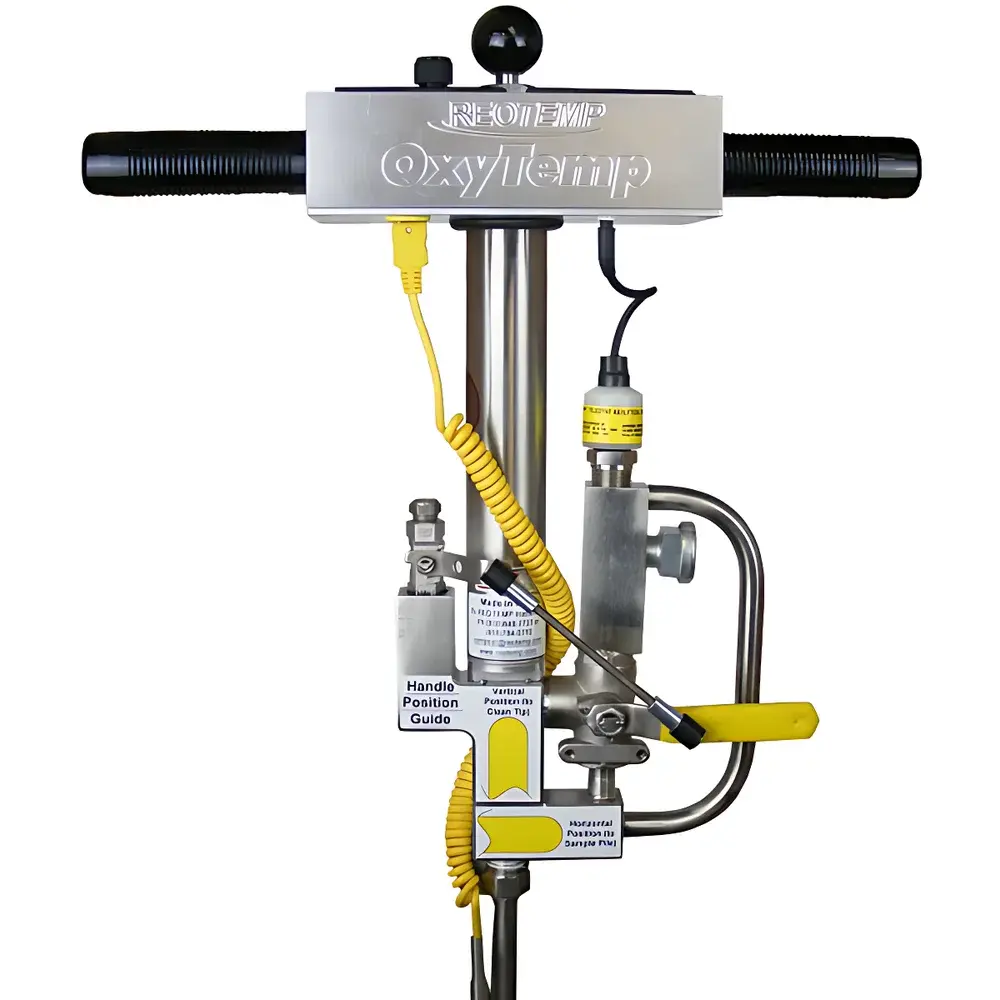
Oxytemp In-Situ Soil Oxygen and Temperature Analyzer
| Origin | USA |
|---|---|
| Manufacturer Type | Authorized Distributor |
| Origin Category | Imported |
| Model | Oxytemp |
| Instrument Type | Multifunctional Soil Analyzer |
| Oxygen Range | 0–100% vol |
| Oxygen Accuracy | ±2% FS |
| Temperature Range | 0–90°C (32–200°F) |
| Temperature Accuracy | ±1°C (±1.8°F) |
| Probe Insertion Depths | 60, 90, 120, 150, 180 cm (selectable) |
| Dimensions (with 90 cm probe) | 137 H × 43 W × 8.9 D cm |
| Weight | ~5.5 kg |
| Probe Material | Stainless Steel (316 SS) |
| Sensor Design | Integrated dual-parameter electrochemical O₂ + thermistor probe |
| Display | Dual-line digital LCD |
Overview
The Oxytemp In-Situ Soil Oxygen and Temperature Analyzer is an engineered field-deployable instrument designed for real-time, non-destructive measurement of gaseous oxygen concentration and temperature directly within soil pore spaces. It operates on the principle of galvanic or polarographic electrochemical oxygen sensing—where molecular oxygen diffuses through a gas-permeable membrane to react at a cathode, generating a current proportional to partial pressure—paired with a calibrated platinum resistance thermometer (PT100-class) or high-stability NTC thermistor for thermal profiling. Unlike laboratory-based gas chromatography or headspace analysis, the Oxytemp enables immediate in-situ quantification without sample excavation, preserving natural soil structure, moisture gradients, and redox microenvironments. Its design targets long-term monitoring integrity in dynamic biogeochemical systems where temporal resolution and spatial fidelity are critical—particularly in landfill leachate plumes, aerobic bioremediation zones, compost windrows, and agricultural root-zone studies.
Key Features
- Integrated dual-parameter probe: Simultaneous, time-synchronized acquisition of O₂ (vol%) and temperature (°C/°F) from a single insertion point.
- Patent-pending self-cleaning sensor architecture: Minimizes fouling-induced drift; clogged membranes can be restored via gentle mechanical cleaning—no recalibration required post-cleaning.
- Modular stainless-steel probe assembly (ASTM A276 Type 316): Chemically inert, corrosion-resistant, and rated for repeated insertion into saturated clays, organic-rich humus, and acidic landfill cover soils.
- Selectably extendable probe rods: Five standardized lengths (60–180 cm) allow stratified profiling across vadose zone, capillary fringe, and saturated zone interfaces.
- Dual-scale digital LCD display: High-contrast, sunlight-readable interface showing O₂ % and temperature concurrently—no menu navigation needed during rapid field deployment.
- Field-ruggedized housing: IP67-rated enclosure with reinforced cable strain relief and low-power consumption (<12 V DC), compatible with portable battery packs for multi-day unattended operation.
Sample Compatibility & Compliance
The Oxytemp is validated for use in heterogeneous, variably saturated soils—including sandy loams, peats, clayey till, and municipal solid waste (MSW) matrices. Its probe tip geometry and diffusion-limited sensor kinetics prevent artificial aeration artifacts common with auger-based sampling. The instrument complies with ASTM D5128–22 (Standard Test Method for Field Measurement of Dissolved Oxygen in Soils) and supports data traceability under ISO/IEC 17025:2017-accredited environmental testing workflows. While not FDA-regulated, its measurement uncertainty budget (±2% O₂, ±1°C) aligns with QA/QC requirements for EPA Method 9045D (Soil Redox Potential and Oxygen Profiling) and EU Standard EN 14735:2005 (Characterization of Waste—Determination of Oxygen Consumption Rate).
Software & Data Management
Data logging is supported via optional RS-232 or USB-C serial interface (firmware v3.2+), enabling direct integration with third-party SCADA platforms or custom Python/Matlab scripts. Logged datasets include timestamped O₂ %, temperature, depth marker, and sensor status flags (e.g., “membrane dry”, “thermal equilibrium achieved”). Export formats include CSV and XML, structured to meet FAIR (Findable, Accessible, Interoperable, Reusable) data principles. Audit trails—compliant with GLP and 21 CFR Part 11—can be enabled when paired with certified secure logging software (e.g., LabArchives ELN or DeltaTrak Validator Suite), ensuring electronic signature support and immutable record retention.
Applications
- Landfill post-closure monitoring: Tracking aerobic/anaerobic transition zones and methane oxidation efficiency in biocover systems.
- Bioremediation process control: Quantifying O₂ depletion rates in hydrocarbon-contaminated aquifers and determining optimal air injection intervals.
- Agricultural precision management: Correlating root-zone O₂ availability with crop respiration efficiency, nitrification inhibition, and denitrification hotspots.
- Compost science: Mapping thermal-oxygen coupling in static pile aerobiosis, validating turning schedules, and predicting maturity indices (e.g., C/N ratio stabilization).
- Geotechnical and paleoenvironmental research: Reconstructing paleo-redox conditions in sediment cores and assessing permafrost thaw dynamics via subsurface O₂ gradient inversion.
FAQ
Is calibration required before each use?
No—factory calibration is stable for ≥12 months under normal field conditions. A two-point O₂ verification (0% N₂ flush and ambient air check) is recommended before critical campaigns.
Can the probe be used in flooded or submerged soils?
Yes—the sealed 316 SS housing and hydrophobic membrane permit operation up to 5 m water column pressure (IP68-rated optional sleeve available).
Does the instrument store data internally?
Base model has no internal memory; data must be recorded externally via serial output. Optional SD-card logger module adds 32 GB capacity with time-stamped binary logging.
What maintenance is required beyond probe cleaning?
Annual verification of temperature sensor linearity against NIST-traceable dry-block calibrator and O₂ sensor response time (t₉₀ < 30 s) is advised per ISO/IEC 17025 quality protocols.
Is the Oxytemp suitable for regulatory reporting?
Yes—when operated per ASTM D5128 and documented with full chain-of-custody logs, its data meets evidentiary thresholds for EPA Region 9 landfill monitoring reports and EU Landfill Directive Annex II compliance submissions.
Related Products







