
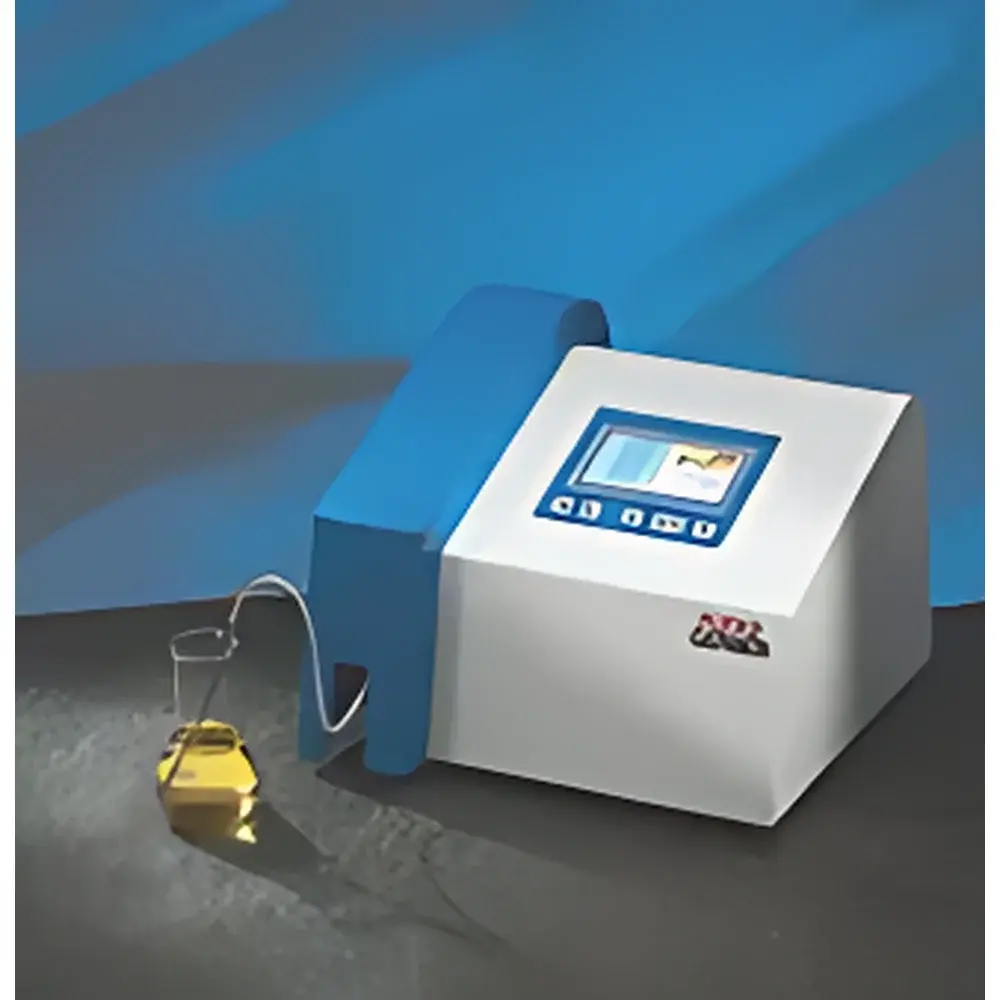
Funke Fermento Weet Automated Beer Analyzer
| Brand | Funke |
|---|---|
| Origin | Germany |
| Model | Weet |
| Instrument Type | Dedicated Beer Analyzer |
| Measurement Principle | Integrated Density and Refractive Index-Based Alcohol & Extract Quantification |
| Alcohol Range | 0–15 % v/v |
| Original Wort Extract (OE) | 0–20 °P |
| Real Extract (RE) | 0–10 °P |
| Apparent Extract (AE) | 0–10 °P |
| Density | 0.95–1.05 g/cm³ |
| Measurement Time | ~120 s (including sample introduction) |
| Sample Volume | 10–20 mL degassed beer |
| Throughput | up to 100 samples/h (rapid mode), 60 samples/h (precision mode) |
| Display | Backlit LCD with 5-key intuitive interface |
| Connectivity | RS-232 serial port, parallel printer interface (printer included) |
| Power Supply | 230/115 V AC, 50/60 Hz, 180 W |
| Dimensions | 30 × 24 × 33 cm (W × H × D) |
| Weight | ~5 kg |
Overview
The Funke Fermento Weet Automated Beer Analyzer is a purpose-built, benchtop analytical instrument engineered for rapid, standardized quantification of key physicochemical parameters in finished beer and wort. It operates on a dual-sensor principle combining high-precision oscillating U-tube density measurement with temperature-compensated refractive index detection—both traceably calibrated against certified reference materials. This hybrid methodology enables simultaneous derivation of alcohol by volume (ABV), original wort extract (°Plato), real extract (RE), apparent extract (AE), and specific gravity—all compliant with internationally recognized brewing standards including ASBC Methods of Analysis (Section 9), EBC Analytica (Chapter 9), and ISO 15212-1 (determination of alcohol in alcoholic beverages). Designed for routine QC/QA environments in breweries, contract labs, and beverage R&D facilities, the Weet delivers laboratory-grade reproducibility without requiring operator chromatography or distillation expertise.
Key Features
- Integrated dual-parameter measurement: Simultaneous determination of density and refractive index in a single 2-minute cycle, eliminating sequential testing and inter-method variability.
- Pre-configured reference library: Stores calibration profiles for up to 20 reference beers (e.g., Pilsner, Weizen, Bock, Stout), enabling matrix-matched calibration per beer type—critical for accurate ABV and extract reporting across diverse fermentation profiles.
- Automated degassing-compatible workflow: Accepts conventionally vacuum- or ultrasonically degassed samples; no inline degassing module required, reducing maintenance overhead and consumable costs.
- Dedicated brewing firmware: Embedded calculation algorithms apply standard conversion tables (e.g., Balling, ASBC Table 1, EBC Annex A) to raw sensor outputs—ensuring direct compliance with regulatory reporting formats used in EU labeling and US TTB submissions.
- Built-in thermal equilibration: Peltier-controlled sample chamber maintains measurement temperature at 20 °C ± 0.1 °C, meeting ISO 2474 and ASBC requirements for density-based alcohol calculation.
- Robust industrial enclosure: IP54-rated stainless-steel chassis suitable for humid, CO₂-rich brewery lab environments; EMI-shielded electronics ensure stable operation near pasteurizers and filling lines.
Sample Compatibility & Compliance
The Weet analyzer accepts filtered, degassed liquid samples across the full spectrum of traditional and craft beer styles—including lagers, ales, sour beers, dry-hopped NEIPAs, and non-alcoholic variants—without modification to hardware or method. Its calibration architecture accommodates variations in dissolved CO₂ residuals, hop oil content, and dextrin-to-fermentable ratios through adaptive baseline correction derived from reference beer metadata. All measurement outputs are traceable to NIST-traceable density standards and certified refractometer calibration fluids. The system supports GLP-compliant data integrity: audit trails record operator ID, calibration date, reference beer lot number, ambient temperature/humidity, and measurement timestamps. Data export conforms to ASTM E1382-22 (standard guide for electronic records in analytical laboratories) and facilitates integration into LIMS platforms via ASCII/CSV over RS-232.
Software & Data Management
No external PC is required for operation—the Weet features an embedded Linux-based controller with persistent flash memory for method storage, calibration history, and result logging (≥10,000 measurements). Results display in real time on the high-contrast monochrome LCD with customizable unit selection (°P, %w/w, %v/v, g/L, g/kg). All data can be printed directly via the integrated parallel port (IEEE 1284 compatible) or exported as timestamped, tab-delimited files via RS-232. Optional Funke LabLink software (Windows/macOS) enables remote configuration, batch report generation (PDF/Excel), statistical process control (SPC) charting (X-bar/R, Cp/Cpk), and FDA 21 CFR Part 11-compliant user access control with electronic signatures.
Applications
- Final product release testing: Verification of ABV and OE against label claims per TTB 27 CFR §7.29 and EU Regulation (EU) No 1169/2011.
- Fermentation monitoring: Tracking real attenuation and yeast performance via RE/AE differentials during conditioning and lagering.
- Raw material consistency: Screening malt extracts and adjunct syrups for extract yield and fermentability prior to brewhouse use.
- Contract brewing QA: Objective benchmarking of outsourced batches against in-house specifications using shared reference beer libraries.
- Research & development: High-throughput screening of novel yeast strains, fermentation temperatures, and adjunct formulations using extract kinetics profiling.
FAQ
Does the Weet require daily recalibration?
No—calibration is performed only when introducing a new reference beer type or after major maintenance. Stability verification using a control sample is recommended per shift.
Can the instrument measure non-beverage samples such as wort or cider?
Yes, provided the sample falls within the specified density and refractive index ranges; however, dedicated wort calibration curves must be loaded manually.
Is method validation documentation available for regulatory audits?
Yes—Funke provides IQ/OQ protocols, uncertainty budgets per GUM (JCGM 100:2008), and a complete validation package aligned with ISO/IEC 17025:2017 clause 7.2.2.
What maintenance is required beyond routine cleaning?
Annual verification of oscillator frequency stability and refractometer zero-point drift by authorized service engineers; no user-serviceable optical or mechanical components.
How does the Weet handle highly hazy or protein-rich samples?
The system includes automatic optical path compensation for turbidity up to 400 NTU; filtration is recommended only for samples exceeding this threshold to prevent flow cell fouling.






