
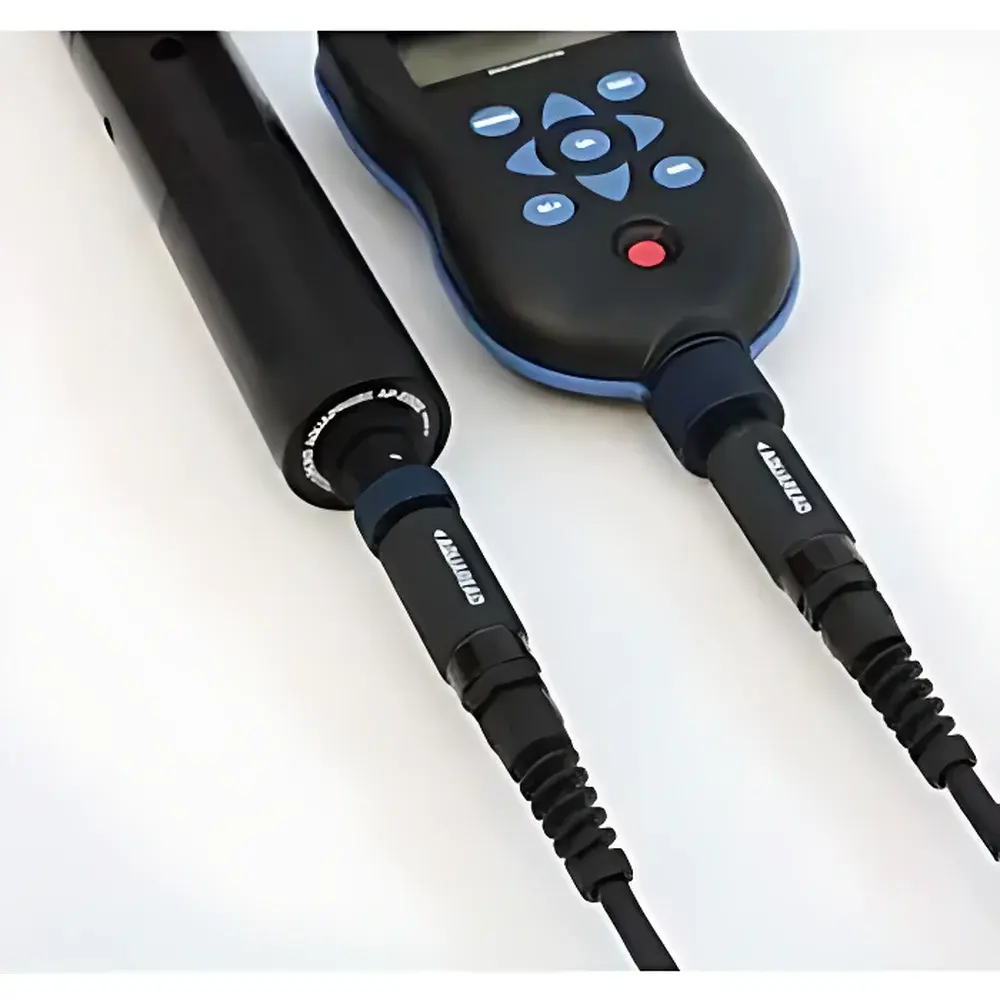
Aquaread AP-LITE-TURB Portable Turbidity Meter
| Brand | Aquaread |
|---|---|
| Origin | United Kingdom |
| Manufacturer Type | Authorized Distributor |
| Origin Category | Imported |
| Model | AP-LITE-TURB |
| Price | Upon Request |
| Display | Backlit 80-character LCD |
| Memory Capacity | 1900 data points |
| GPS | Built-in 12-channel antenna, ±10 m accuracy |
| Barometric Pressure Range | 150–1150 mbar (±1 mbar) |
| Operating Temperature | -20 to +70 °C |
| IP Rating | IP67 |
| Dimensions (Meter) | 90 × 180 × 39 mm |
| Weight (with batteries) | 450 g |
| Power Supply | 5 × AA alkaline or Ni-MH rechargeable batteries |
| Sensor Housing Diameter | 24 mm |
| Sensor Housing Length | 250 mm |
| Turbidity Measurement Range | 0–3000 NTU |
| Resolution | Dual auto-ranging: 0.0–99.9 NTU (0.1 NTU resolution), 100–3000 NTU (1 NTU resolution) |
| Repeatability | ±2% of reading |
Overview
The Aquaread AP-LITE-TURB is a field-deployable, battery-powered turbidity meter engineered for high-reliability in situ water quality assessment. It operates on the principle of nephelometric measurement—detecting scattered light at a 90° angle relative to the incident beam—as defined by ISO 7027 and EPA Method 180.1. This optical configuration ensures minimal interference from color, absorbance, or particle settling effects, delivering robust NTU (Nephelometric Turbidity Units) values across diverse aquatic environments—from oligotrophic lakes and drinking water distribution networks to estuarine mixing zones and wastewater effluent streams. The system comprises three interoperable components: the Aquameter handheld readout unit, the AP-LITE sensor housing, and the LITE-TURB optical sensor module. Its modular architecture enables rapid sensor interchangeability, supporting future expansion with complementary probes (e.g., pH, conductivity, dissolved oxygen) without hardware replacement.
Key Features
- IP67-rated Aquameter unit with ruggedized polycarbonate casing, certified for submersion up to 1 m for 30 minutes—suitable for wade-in, boat-based, or bridge-deployed sampling.
- Integrated 12-channel GPS with ±10 m positional accuracy, enabling georeferenced data logging essential for spatial trend analysis and regulatory reporting (e.g., EU Water Framework Directive monitoring programs).
- Dual-range nephelometric sensor with automatic range switching between 0.0–99.9 NTU (0.1 NTU resolution) and 100–3000 NTU (1 NTU resolution), eliminating manual gain adjustment during dynamic field conditions.
- On-device memory stores up to 1900 timestamped, location-tagged measurements—including turbidity, barometric pressure (150–1150 mbar, ±1 mbar), ambient temperature, and GPS coordinates.
- Backlit 80-character LCD display optimized for low-light or high-glare outdoor use, with intuitive menu navigation and real-time statistical feedback (min/max/avg over active session).
- Extended operational life via five AA cells (alkaline or Ni-MH), supporting >100 hours of continuous use; battery status indicator prevents mid-survey power loss.
Sample Compatibility & Compliance
The AP-LITE-TURB is validated for use with natural waters (freshwater, brackish, seawater), treated drinking water, surface runoff, and secondary-treated wastewater. Its optical path design minimizes fouling susceptibility, and the smooth-surface sensor housing resists biofilm accumulation during short-term immersion (<24 h). Calibration is traceable to NIST-certified formazin standards, and instrument performance conforms to ISO 7027:2016 (optical design), ASTM D6508-20 (field turbidimeters), and US EPA Method 180.1 (nephelometric turbidity). Data export supports CSV and Excel-compatible formats, facilitating integration into LIMS platforms compliant with 21 CFR Part 11 requirements when paired with Aquaread’s optional audit-trail-enabled software suite.
Software & Data Management
Data transfer occurs via USB-C connection to Windows/macOS systems using Aquaread’s free AquaSuite desktop application. AquaSuite provides batch calibration management, time-series visualization with overlay of GPS tracks, statistical summary reports (including coefficient of variation per sampling site), and automated compliance flagging against user-defined thresholds (e.g., WHO guideline value of 1 NTU for drinking water). All exported datasets include embedded metadata: instrument ID, firmware version, calibration date, operator ID, and environmental context (pressure, temperature, GPS fix quality). Audit logs record every configuration change, ensuring full traceability for GLP/GMP-aligned environmental monitoring programs.
Applications
- Routine compliance monitoring of raw intake and finished drinking water per national standards (e.g., UK DWI, US EPA Safe Drinking Water Act).
- Stormwater outfall characterization under NPDES permit requirements, including event-based turbidity profiling.
- Ecological baseline studies assessing sediment resuspension impacts in riverine and lacustrine ecosystems.
- Construction site erosion control verification, where turbidity spikes indicate inadequate silt fence performance.
- Wastewater treatment plant process control—tracking clarifier effluent quality and filter backwash efficiency.
- Academic field hydrology research requiring portable, GPS-synchronized multi-parameter acquisition.
FAQ
What calibration standards are recommended for field verification?
Formazin-based primary standards (e.g., 10 NTU, 100 NTU, 800 NTU) traceable to NIST SRM 2134 are required for initial calibration and periodic verification.
Can the AP-LITE-TURB be used in saline or high-sediment environments?
Yes—the optical design compensates for refractive index shifts up to 1.34 (typical of seawater), and the sensor housing geometry reduces abrasion risk from suspended sand particles.
Is the GPS signal usable indoors or under dense canopy?
GPS functionality requires open-sky visibility; however, position can be manually entered or imported from external GNSS receivers via CSV import in AquaSuite.
How often does the turbidity sensor require cleaning or maintenance?
For routine freshwater use, wipe the optical window with lint-free tissue after each deployment; in high-fouling environments, clean weekly with isopropyl alcohol and soft brush—no disassembly required.
Does the system support real-time telemetry or Bluetooth data streaming?
No—AP-LITE-TURB is designed for offline, secure field data capture; telemetry capability is available only on Aquaread’s AP-2000 series with optional cellular/GNSS modules.
Related Products







