
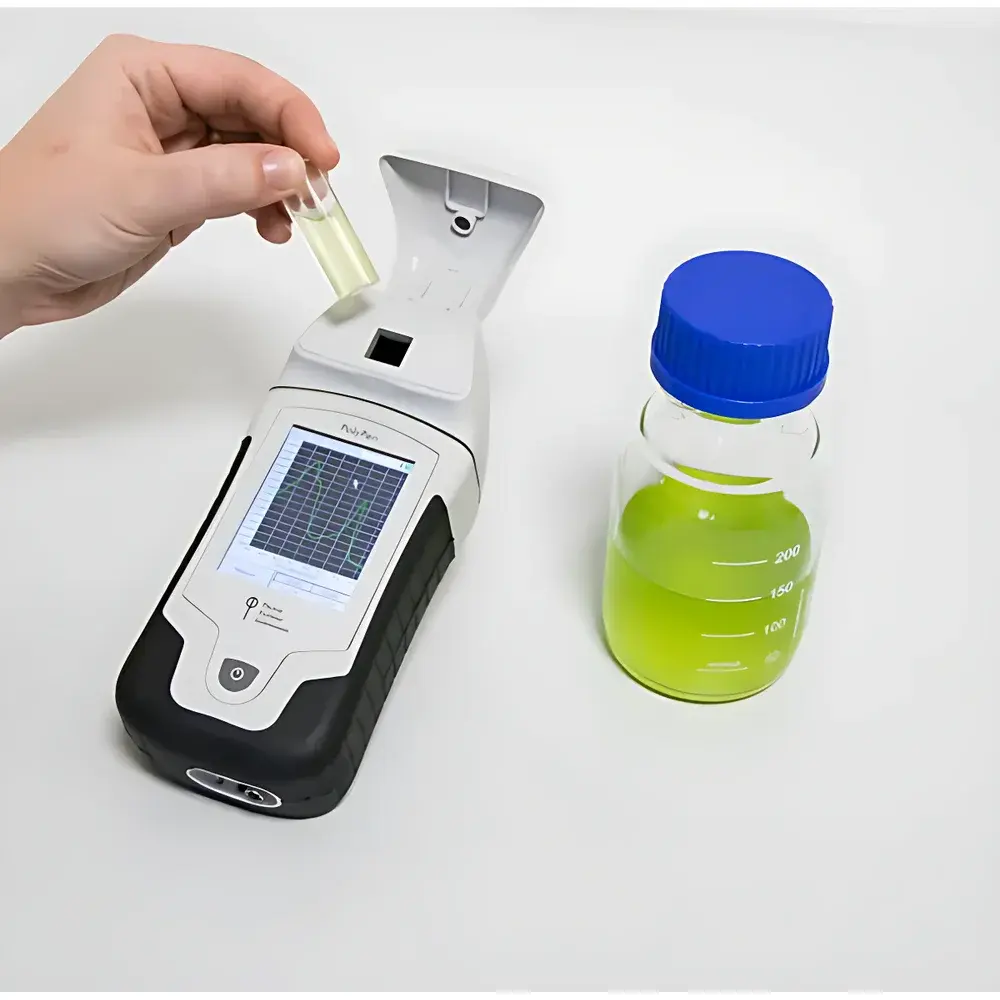
PolyPen Aqua Handheld Spectrophotometer for Solutions and Suspensions
| Brand | PSI (Photon Systems Instruments) |
|---|---|
| Origin | Czech Republic |
| Model | PolyPen Aqua PA210 |
| Power Supply | Rechargeable Li-ion Battery |
| Light Source | Pulsed Xenon Lamp |
| Spectral Range | 350–1000 nm |
| Optical Resolution | ~5 nm (FWHM) |
| Detector | Linear CCD array |
| Display | Integrated Touchscreen (≥4.3″) |
| Data Storage | Internal memory + USB export |
| Connectivity | USB 2.0, Bluetooth 4.2 |
| GPS | Built-in |
| Compliance | CE, RoHS |
| Measurement Modes | Transmittance, Absorbance, Reflectance, Optical Density (OD at 600, 680, 720, 750 nm) |
| Software Interface | PolyPen Control Suite (Windows/macOS compatible) |
| Data Output Formats | CSV, TXT, SPC |
Overview
The PolyPen Aqua PA210 is a handheld, battery-powered spectrophotometer engineered for rapid, field-deployable spectral characterization of liquid-phase samples—including aqueous solutions, microbial suspensions, algal cultures, protein dilutions, and pigment extracts. Unlike benchtop UV-Vis systems requiring cuvettes and external power, the PolyPen Aqua operates on the principle of single-beam, pulsed-xenon illumination coupled with a linear CCD detector to acquire full-range absorbance and transmittance spectra from 350 nm to 1000 nm in under 2 seconds. Its optical architecture is optimized for high signal-to-noise ratio in low-absorbance regimes typical of biological suspensions (e.g., OD600 0.05–2.5), while maintaining photometric linearity across dynamic ranges relevant to quantitative biomass estimation and pigment quantification. Designed for both laboratory validation and in situ environmental monitoring, it eliminates dependence on tethered computing—enabling real-time spectral acquisition, on-device computation, and georeferenced data logging without infrastructure support.
Key Features
- Integrated pulsed xenon light source delivering stable, broadband irradiance (350–1000 nm) with minimal thermal drift and no warm-up delay
- Onboard touchscreen interface (≥4.3″) supporting direct spectral visualization, real-time OD calculation, and user-defined parameter configuration
- Rechargeable lithium-ion battery providing ≥8 hours of continuous operation under typical measurement cycles (10–15 sec/sample)
- Built-in GPS module enabling geotagged spectral records—critical for limnological surveys, aquaculture site mapping, and ecological transect studies
- Dual communication protocol: USB 2.0 for bulk data transfer and firmware updates; Bluetooth 4.2 for wireless synchronization with mobile tablets or laptops running PolyPen Control Suite
- Optical path geometry calibrated for standard 10-mm pathlength equivalents, compatible with disposable cuvettes, microvolume cells, and flow-through adapters (optional)
Sample Compatibility & Compliance
The PolyPen Aqua PA210 accommodates a broad range of optically heterogeneous samples: turbid algal suspensions (e.g., Chlorella vulgaris, Synechocystis sp.), yeast cultures (Saccharomyces cerevisiae), bacterial growth media, purified protein solutions (BSA, lysozyme), chlorophyll- and carotenoid-rich extracts, and forensic dye solutions. Its optical design accounts for Mie scattering effects common in cellular suspensions through dual-mode normalization (reference-air and reference-solvent baselines). The instrument conforms to CE marking requirements for electromagnetic compatibility (EN 61326-1) and safety (EN 61010-1), and meets RoHS Directive 2011/65/EU restrictions on hazardous substances. While not certified for GMP-regulated production environments, its audit-ready data export (CSV/SPC), timestamped measurements, and optional GLP-compliant metadata tagging (via software) support method validation under ISO/IEC 17025 and ASTM E275–22 guidelines for spectrophotometric analysis.
Software & Data Management
The PolyPen Control Suite (v3.2+) provides cross-platform desktop analysis (Windows 10+, macOS 12+), supporting spectral overlay, baseline correction (Savitzky-Golay smoothing), peak integration, and custom calibration curve generation using NIST-traceable standards. All raw intensity data (Isample, Iref) are stored alongside computed parameters (Abs, %T, OD), enabling retrospective reprocessing without hardware dependency. Exported files include embedded metadata: GPS coordinates, UTC timestamps, operator ID, instrument serial number, and measurement mode—facilitating traceability in multi-site ecological studies or QC documentation. The software supports 21 CFR Part 11–compatible audit trails when deployed with network-authenticated user accounts and electronic signature modules (add-on license required).
Applications
- Real-time monitoring of phototrophic and heterotrophic microbial growth kinetics via OD600/OD680 time-series in bioreactors and outdoor ponds
- Non-destructive assessment of photosynthetic pigment composition (chlorophyll a/b, phycocyanin, phycoerythrin) in cyanobacterial blooms using spectral deconvolution algorithms
- Quantitative protein concentration determination in clarified lysates using 280 nm absorbance and extinction coefficient inputs
- In-field validation of water quality parameters (e.g., nitrate, phosphate, humic substances) via multivariate regression models trained on reference spectra
- Forensic document analysis—differentiation of ink formulations based on visible-NIR spectral fingerprints (400–900 nm)
FAQ
Does the PolyPen Aqua require external calibration with NIST standards?
No—factory calibration is performed using traceable tungsten-halogen and mercury-argon lamp references. Users may perform optional verification with air or deionized water blanks before each session.
Can it measure highly scattering samples like dense algal cultures?
Yes—the instrument’s pulsed illumination and optimized integration time mitigate saturation artifacts; however, OD values >3.0 should be confirmed via serial dilution per ISO 10993-12 recommendations.
Is spectral data export compliant with LIMS integration protocols?
CSV exports include structured headers and SI units; direct ODBC or REST API connectivity requires PolyPen Connect Gateway (sold separately).
What is the wavelength accuracy specification?
±1.5 nm across 350–1000 nm, verified during final QA against certified holmium oxide and didymium filters per ASTM E387.
How is temperature stability managed during extended field use?
The optical bench incorporates passive thermal mass design and internal temperature monitoring; spectral shifts remain within ±0.3 nm over 15–35°C ambient range, validated per IEC 60068-2-14.




