
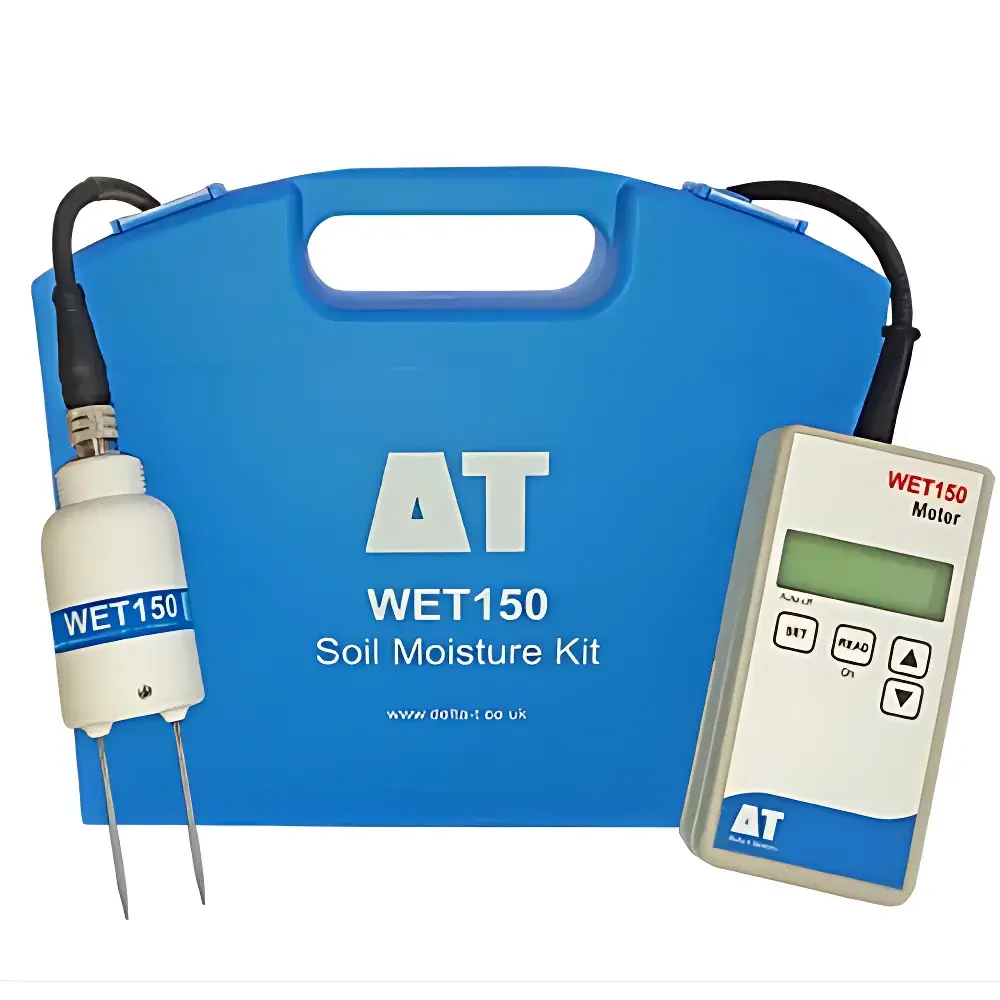
Delta-T WET150 Multi-Parameter Soil Sensor (SDI-12, IP68)
| Brand | Delta-T |
|---|---|
| Origin | UK |
| Model | WET150 |
| Instrument Type | Multi-parameter Soil Analyzer |
| Soil Moisture Range | 0–1.0 m³·m⁻³ |
| Resolution (Moisture) | 0.001 m³·m⁻³ |
| Accuracy (Moisture) | ±0.03 m³·m⁻³ (±3% @ 0.05–1.0 m³·m⁻³) |
| Bulk Electrical Conductivity (ECb) Range | 0–2000 mS·m⁻¹ |
| Resolution (ECb) | 0.1 mS·m⁻¹ |
| Accuracy (ECb) | ±(6% + 10 mS·m⁻¹) @ 0–1200 mS·m⁻¹ |
| Temperature Range | −20 to +60 °C |
| Resolution (Temp) | 0.1 °C |
| Accuracy (Temp) | ±1 °C @ −20 to +50 °C |
| Power Supply (Sensor) | 6–20 V DC |
| Active Current Draw | 22 mA avg. over 12 ms (peak 45 mA) |
| Idle Current | <0.5 mA |
| Sensor Dimensions | Ø40 mm × L143 mm |
| Needle | Ø2.5 mm × L55 mm |
| Measurement Volume | ~55 × 70 mm Ø |
| Weight (Sensor only) | 77 g |
| Enclosure Rating (Sensor) | IP68 |
| Cable Length | 5 m standard |
| Handheld Reader Interface | SDI-12 (1 sensor port) |
| Reader Power | 2 × AA alkaline batteries |
| Reader Battery Life | >2400 readings |
| Reader Enclosure Rating | IP65 |
| Reader Operating Temp. | 0–40 °C |
| Reader Display | 2 × 16-character LCD |
| Reader Dimensions | 130 × 66 × 25 mm |
Overview
The Delta-T WET150 is a rigorously engineered, digital multi-parameter soil sensor designed for rapid, in-situ measurement of volumetric water content (θv), bulk electrical conductivity (ECb), and soil temperature. Developed by Delta-T Devices Ltd.—a UK-based leader in environmental sensing with over four decades of sensor design heritage—the WET150 implements time-domain reflectometry (TDR)-derived dielectric permittivity analysis coupled with precision thermistor and four-electrode conductivity measurement. Its SDI-12 digital interface ensures compatibility with widely deployed dataloggers across agricultural research stations, irrigation management systems, horticultural facilities, and ecological monitoring networks. Unlike analog-only probes, the WET150 integrates on-board signal conditioning and digital calibration coefficients, eliminating external conversion errors and enabling direct θv output in m³·m⁻³—traceable to gravimetric validation protocols per ISO 11274 and ASTM D5859.
Key Features
- Triple-parameter simultaneous acquisition: calibrated volumetric water content (0–1.0 m³·m⁻³), bulk EC (0–2000 mS·m⁻¹), and temperature (−20 to +60 °C) in a single insertion.
- IP68-rated stainless-steel sensor body with epoxy-sealed electronics, validated for continuous burial in saturated mineral soils, organic substrates (peat, coir), and inert media (perlite, rockwool).
- Factory-applied, matrix-specific calibration sets—including separate algorithms for mineral soils, organic soils, and hydroponic growth media—reducing field recalibration needs and improving cross-substrate reproducibility.
- Low-power SDI-12 protocol compliance: active measurement cycle consumes <12 ms at 22 mA average current; idle draw <0.5 mA enables multi-year deployment on solar-recharged systems.
- Compact form factor (Ø40 mm × 143 mm) with 55 mm stainless-steel needles optimized for minimal soil disturbance and repeatable insertion depth control.
- Handheld reader (WET150 KIT) provides immediate field readout without requiring external power or software—displaying θv in % vol, ECb in mS·m⁻¹, and temperature in °C on a rugged 2×16 LCD.
Sample Compatibility & Compliance
The WET150 is validated for use in heterogeneous soil matrices where conventional TDR or capacitance sensors exhibit drift due to salinity or organic matter interference. Its four-electrode ECb configuration mitigates polarization effects in high-conductivity environments (e.g., greenhouse substrates, reclaimed soils), while its permittivity algorithm compensates for clay and organic carbon content using embedded dielectric mixing models. Calibration datasets align with FAO guidelines for soil water characterization and support compliance with ISO 10390 (soil pH and EC measurement), ISO 11274 (water retention curve determination), and USDA NRCS soil survey protocols. The sensor’s passive metal housing and non-corrosive needle material meet EN 60529 (IP68) for submersion up to 1 m for 30 days, and the handheld unit satisfies IP65 for dust-tight, low-pressure water jet resistance during field operation.
Software & Data Management
While the WET150 operates stand-alone via the SDI-12 interface, it is fully compatible with industry-standard environmental data acquisition platforms—including Campbell Scientific CR series, Onset HOBO RX3000, and Delta-T’s own GP2 logger—enabling automated time-series logging, threshold-triggered alerts, and integration into SCADA-based irrigation control systems. Raw SDI-12 commands are human-readable and ASCII-based, supporting custom Python, LabVIEW, or MATLAB parsing scripts. All factory calibrations are stored in non-volatile memory and persist through power cycles. For regulated environments, the sensor supports audit-trail-capable data loggers compliant with FDA 21 CFR Part 11 when paired with appropriate firmware and user access controls—though the handheld reader itself does not provide electronic record or signature functionality.
Applications
- Precision irrigation scheduling in open-field agriculture and protected cropping systems, using real-time θv and ECb to trigger drip events and prevent leaching.
- Soil health monitoring in long-term ecological research plots, tracking seasonal moisture dynamics and salinity accumulation trends across soil horizons.
- Substrate quality assurance in commercial nurseries and vertical farms, verifying consistency of peat-perlite blends prior to planting.
- Calibration reference for satellite-based soil moisture products (e.g., SMAP, Sentinel-1) at validation sites under ESA and NASA protocols.
- Educational field labs in university soil physics and environmental science curricula, offering hands-on exposure to dielectric sensing principles and matrix-specific calibration challenges.
FAQ
Does the WET150 require soil-specific recalibration in the field?
No—factory-installed calibrations for mineral soils, organic soils, and common horticultural substrates (coir, peat, perlite, rockwool) cover typical use cases. Field recalibration is only recommended if measuring in highly atypical media (e.g., volcanic ash, biochar-amended soils) or after prolonged exposure to extreme pH or redox conditions.
Can the WET150 be used in frozen soils?
The sensor’s temperature rating extends to −20 °C, but dielectric measurements become unreliable below 0 °C due to phase-change effects in pore water. It is not intended for active θv quantification in frozen ground.
What is the effective measurement volume, and how does it relate to spatial representativeness?
The sensor interrogates a cylindrical volume approximately 55 mm in diameter and 70 mm in height centered on the needle plane. This footprint balances resolution and averaging—sufficient to smooth micro-heterogeneity while remaining sensitive to localized irrigation or compaction effects.
Is the handheld reader capable of data storage or Bluetooth export?
No—the WET150 KIT reader is intentionally minimalist: it displays real-time values only and lacks internal memory, USB, or wireless interfaces. Its design prioritizes reliability, battery longevity (>2400 readings), and operational simplicity in remote settings.
How does the WET150 differ from legacy analog soil moisture probes?
Unlike voltage-output sensors requiring external datalogger excitation and analog-to-digital conversion, the WET150 delivers digitally compensated, temperature-corrected values via SDI-12—eliminating cable-length-induced noise, reference drift, and cross-talk between parameters.
Related Products







