
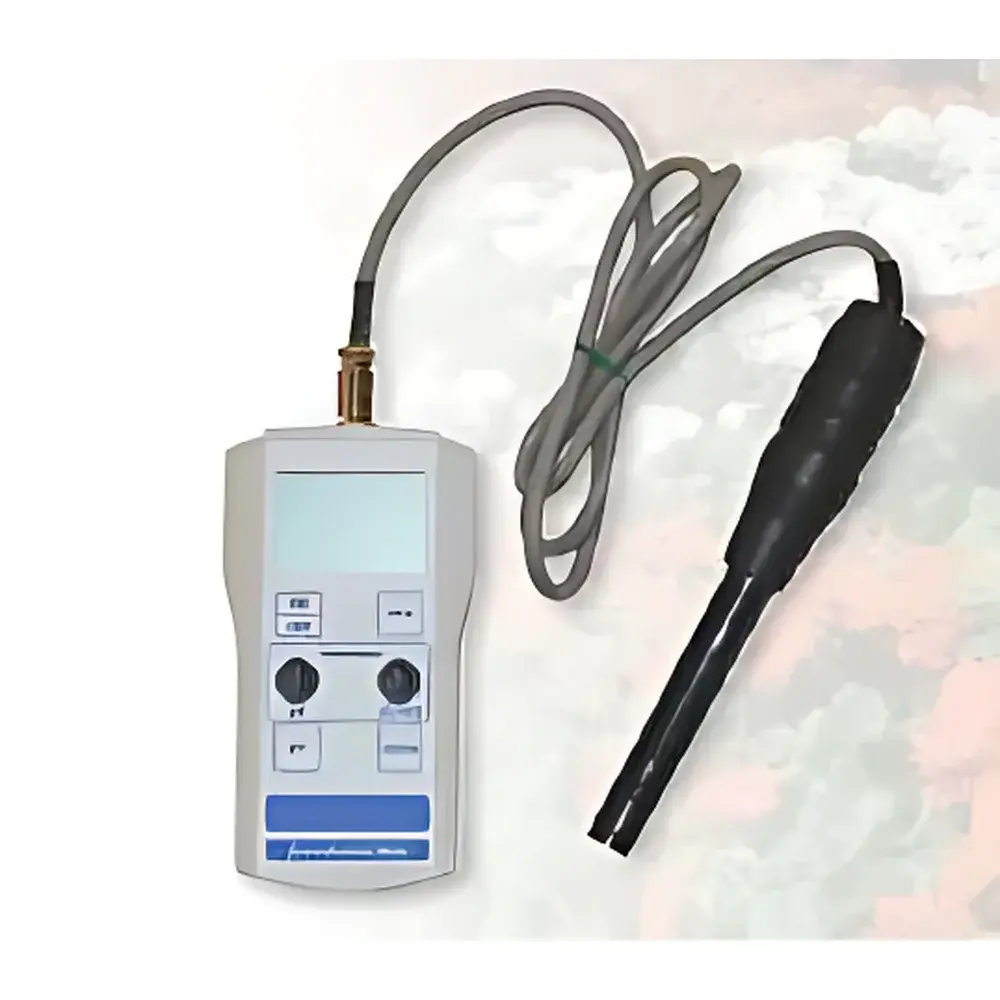
Horiba LAQUA 110PH Portable In-Situ Soil pH Meter
| Origin | USA |
|---|---|
| Manufacturer Type | Authorized Distributor |
| Origin Category | Imported |
| Model | 110PH |
| Price | USD 1,850 (FOB) |
Overview
The Horiba LAQUA 110PH Portable In-Situ Soil pH Meter is an engineered field instrument designed for direct, non-extractive measurement of soil acidity under ambient conditions. Unlike conventional lab-based pH meters requiring soil slurry preparation or extraction, the 110PH employs a robust electrochemical sensing architecture compatible with both standard glass combination electrodes and integrated tri-sensor stainless-steel probes—enabling simultaneous in-situ acquisition of pH, redox potential (mV), and temperature without sample homogenization or dilution. Its operational principle relies on Nernstian response kinetics across a hydrated glass membrane (for pH) and a platinum or Ag/AgCl reference system (for mV), calibrated against traceable buffer standards per ISO 7888 and ASTM D2730. The device is purpose-built for environmental field technicians, agronomists, and remediation professionals conducting rapid site assessments where spatial heterogeneity, moisture content variability, and minimal disturbance are critical constraints.
Key Features
- True in-situ capability: Measures pH, mV, and temperature directly in moist, semi-solid, or viscous soils—no suspension preparation required
- Dual-probe compatibility: Supports interchangeable use of standard BNC-compatible glass electrodes and ruggedized 3-in-1 stainless-steel probes with integrated temperature sensor
- IP67-rated rubberized housing: Provides dust-tight and immersion-resistant protection (up to 1 m for 30 min), suitable for outdoor deployment in rain, dust, or high-humidity environments
- High-resolution dual-range display: 3.5-digit LCD with selectable resolution (0.01/0.1 pH; 1/0.1 mV; 0.1 °C) and auto-ranging functionality
- Auto-buffer recognition: Identifies and validates seven NIST-traceable calibration buffers (pH 1.68, 4.00, 6.86, 7.00, 9.18, 10.01, 12.45) with real-time slope and offset diagnostics
- Stable electrochemical response: <14-second stabilization time for pH readings in soils with ≥15% volumetric water content (per Horiba Field Validation Protocol FVP-110PH-3)
Sample Compatibility & Compliance
The 110PH is validated for use across a broad spectrum of soil matrices—including sandy loam, clay-rich subsoils, organic peat, and contaminated industrial fill—provided minimum moisture content exceeds 12% v/v to ensure continuous electrolyte bridging between probe and matrix. It complies with ISO 10390:2022 (soil quality — determination of pH) for field-adapted measurements and supports GLP-aligned data integrity through timestamped calibration logs and electrode condition tracking. While not intended for regulatory submission as a primary compliance instrument under EPA Method 9045D (which mandates lab-based slurry analysis), the 110PH meets ASTM D4972-22 Annex A1 criteria for screening-level field pH estimation and is routinely deployed in pre-remediation reconnaissance, precision agriculture zoning, and landfill cover monitoring programs.
Software & Data Management
Data output is via RS-232 serial interface (cable included) to optional Horiba LAQUA Connect PC software (v3.2+), enabling batch export of CSV-formatted records with embedded metadata: date/time stamp, probe ID, calibration history, temperature-compensated pH value, mV reading, and user-defined site tags. Software supports audit trail generation compliant with FDA 21 CFR Part 11 requirements when configured with electronic signatures and role-based access control. Internal memory retains up to 500 measurement sets with automatic overwrite protection. No cloud connectivity or proprietary mobile app is provided—data sovereignty and offline operation are preserved by design.
Applications
- On-site assessment of acid sulfate soils prior to excavation or land development
- Rapid pH profiling across agricultural fields to inform lime application maps
- Monitoring pH shifts in bioremediation trenches or phytoremediation plots
- Verification of neutralization efficacy in treated mine tailings or dredged sediments
- Baseline characterization during Phase I Environmental Site Assessments (ESAs)
- Educational field labs requiring durable, student-safe instrumentation with minimal consumables
FAQ
Can the 110PH measure pH in dry or air-dried soil?
No. The instrument requires sufficient soil moisture (≥12% v/v) to establish ionic continuity between the electrode surface and soil solution. Dry soils must be pre-moistened to field capacity before measurement.
Is electrode calibration required before each use?
Calibration frequency follows ISO 10390:2022 recommendations: at minimum before first use of the day, after probe cleaning, and following exposure to extreme pH (11) or high-salinity soils.
Does the device support automatic temperature compensation (ATC)?
Yes. The integrated Pt1000 temperature sensor enables real-time ATC across the full 0–100 °C range, applying the standard Nernst equation correction factor per IUPAC guidelines.
What is the expected service life of the stainless-steel 3-in-1 probe?
Under typical field use (≤500 insertions/year in non-abrasive soils), the probe maintains specified accuracy for ≥24 months; replacement is recommended after visible pitting or >±0.03 pH deviation post-calibration.
Is the 110PH certified for hazardous location use (e.g., Class I Div 2)?
No. It is rated for general-purpose environmental field use only and is not intrinsically safe or explosion-proof.







