
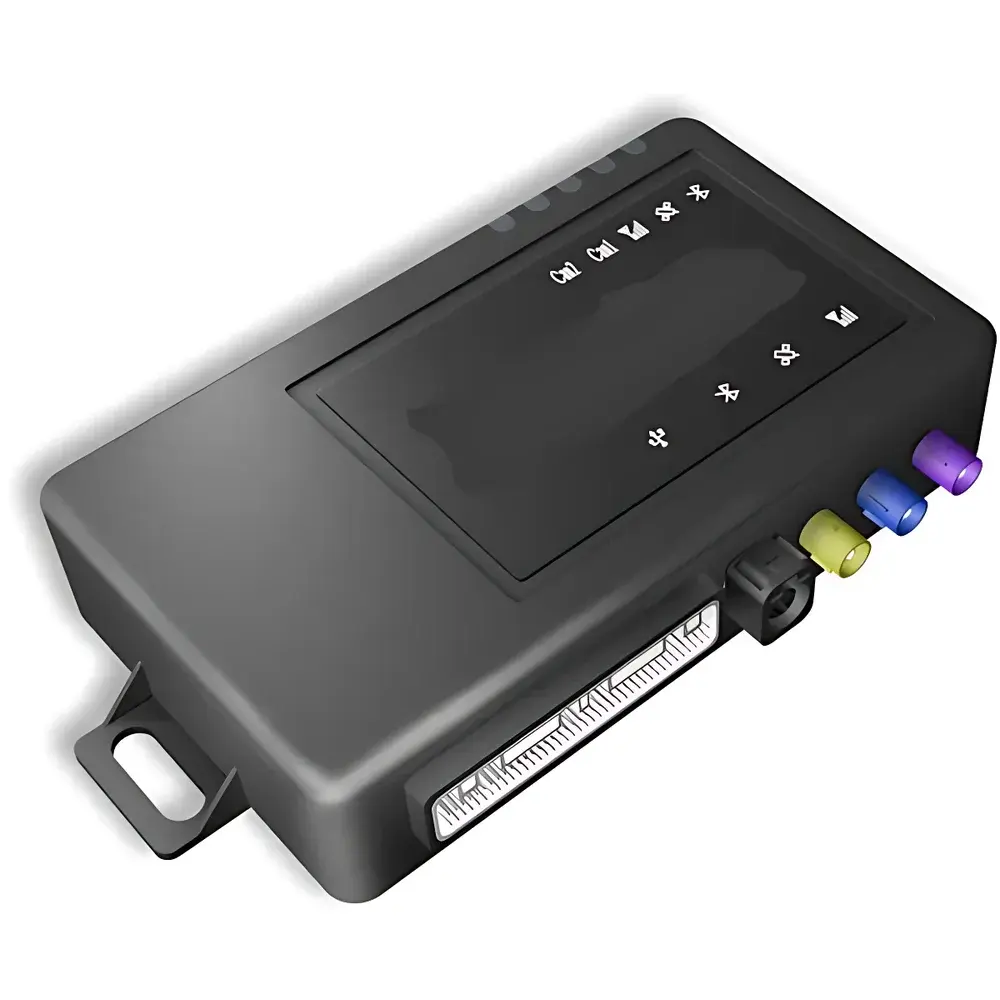
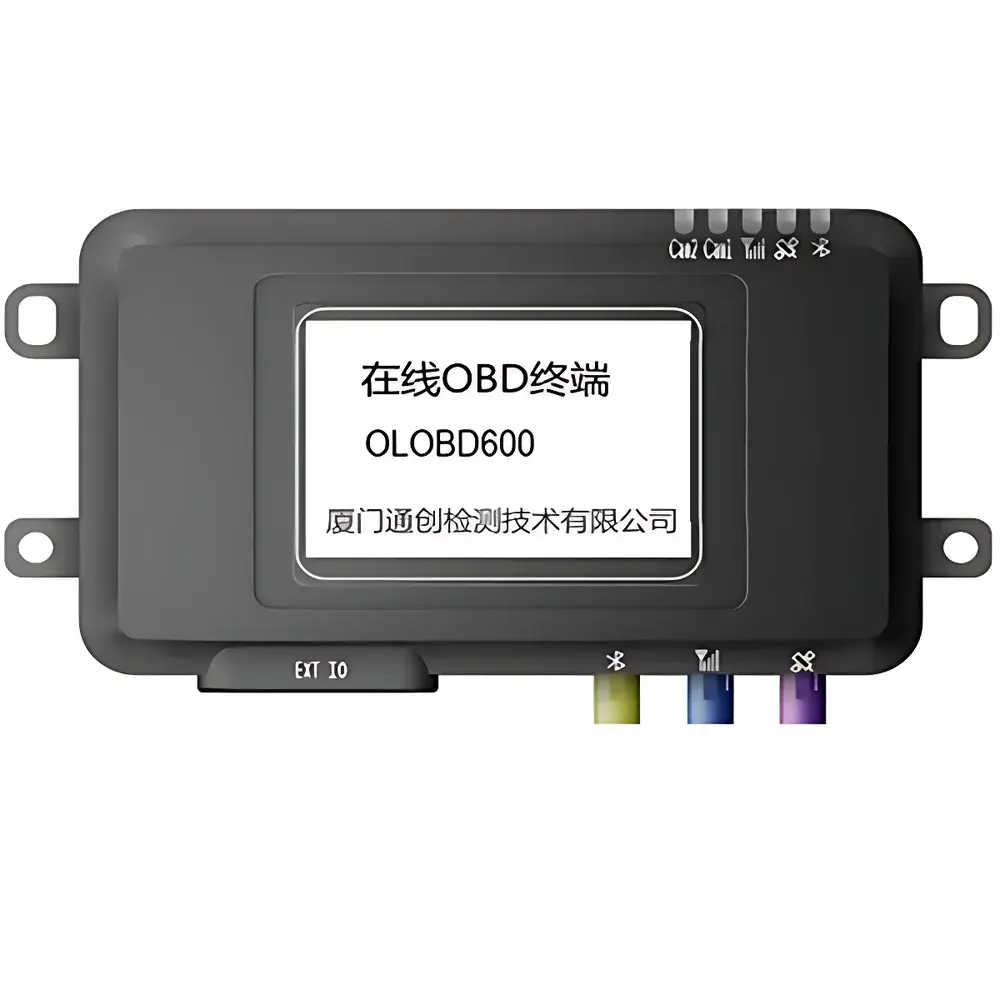
TCT OLOBD600 Automotive Remote Emission Monitoring T-BOX
| Brand | TCT |
|---|---|
| Model | OLOBD600 |
| Origin | Fujian, China |
| Type | Online Fixed-mount Telematics Control Unit (TCU) for Emission Compliance Monitoring |
| Supported Standards | GB 17691, GB 32960, DB11-1476, DB11-122 |
| Communication Protocols | SAE J1939, ISO 15765, ISO 27145, ISO 14229, ISO 15031 |
| Interfaces | 3× CAN, 1× K-Line, 1× L-Line, 1× RS232, 40-pin expansion header |
| Cellular Module | LTE FDD (B1/B3/B5/B8), LTE TDD (B38/B39/B40/B41), WCDMA (B1/B8), TD-SCDMA (B34/B39), CDMA (BC0), GSM (900/1800 MHz) |
| Max Data Throughput | LTE FDD up to 150 Mbps DL / 50 Mbps UL |
| GNSS | Dual-mode GPS + BeiDou, sensitivity −162 dBm, horizontal accuracy ≤10 m (open sky), cold start <38 s |
| Operating Voltage | DC 9–36 V |
| Standby Current | ≤1 mA @ 24 VDC |
| Active Average Current | ≤55 mA @ 24 VDC |
| Backup Battery Runtime | ≥1 h |
| Operating Temperature | −30 °C to +75 °C |
| Storage Temperature | −40 °C to +85 °C |
| Humidity | 5–95% RH (non-condensing) |
| IP Rating | IP54 |
| Dimensions | 152 × 80 × 30 mm |
| Weight | 220 g |
| Optional Sensor Integration | NOₓ (0–3000 ppm), PM concentration (0.01 mg/m³), opacity (0.1%), absorption coefficient (0.05 m⁻¹ @ 1.7 m⁻¹) |
Overview
The TCT OLOBD600 is an automotive-grade telematics control unit (T-BOX) engineered for regulatory-compliant remote emission monitoring of light-duty and heavy-duty vehicles in real time. Designed to meet China’s national and regional vehicle emissions supervision requirements—including GB 17691 (heavy-duty diesel vehicle emission limits), GB 32960 (electric vehicle monitoring platform technical specifications), and local standards such as DB11-1476 (Beijing diesel vehicle OBD monitoring)—the OLOBD600 functions as a certified edge device at the intersection of onboard diagnostics (OBD), powertrain data acquisition, and secure cloud telemetry. It interfaces directly with the vehicle’s ECU via high-speed CAN bus networks and supports multi-protocol decoding across SAE J1939 (commercial vehicles), ISO 15765 (OBD-II), ISO 27145 (WWH-OBD), ISO 14229 (UDS), and ISO 15031 (emission-related diagnostic services). Unlike generic telematics modules, the OLOBD600 integrates hardware-level electrical isolation, cryptographic authentication, and tamper-resistant firmware to ensure data integrity and compliance with automotive cybersecurity frameworks (e.g., UN R155 CSMS and ISO/SAE 21434 principles).
Key Features
- Dual-core automotive processor with AEC-Q100 qualified SoC, enabling deterministic real-time execution of emission-critical tasks
- Triple CAN interface (CAN 2.0B) with configurable baud rates up to 1 Mbps, supporting simultaneous monitoring of engine, chassis, and aftertreatment systems
- Integrated GNSS receiver with dual-band GPS + BeiDou support, delivering sub-10-meter positioning accuracy under open-sky conditions and fast TTFF (cold start <38 s)
- 4G LTE Cat-4 module compliant with global frequency bands, ensuring robust connectivity across urban, suburban, and highway environments
- Hardware-accelerated AES-256 encryption and secure boot chain to prevent unauthorized firmware modification or data exfiltration
- Configurable data upload intervals (default: 10 s), with local storage buffering (≥16 MB flash) to guarantee packet continuity during network outages
- Ultra-low-power design: standby current ≤1 mA @ 24 VDC; supports deep-sleep mode with wake-on-CAN or timer-triggered resumption
- Expandable architecture with 40-pin external interface for optional integration of NOₓ, PM, opacity, and exhaust gas temperature sensors
- Remote over-the-air (OTA) firmware updates with signature verification and rollback protection
- Comprehensive diagnostic logging—including DTCs, freeze frame data, MIL status, and post-processing parameters—formatted per ISO 27145-3 for seamless ingestion into environmental regulatory platforms
Sample Compatibility & Compliance
The OLOBD600 is validated for deployment across passenger cars, battery electric vehicles (BEVs), plug-in hybrid electric vehicles (PHEVs), and Class 3–5 commercial vehicles (light- and medium-duty trucks, buses). It complies with electromagnetic compatibility (EMC) requirements per GB/T 18655 and ISO 11452 series, vibration resistance per ISO 16750-3, and thermal cycling per ISO 16750-4. Its communication stack implements mandatory message structures defined in GB 32960-2016 Annex A and supports direct interoperability with provincial environmental monitoring platforms (e.g., Beijing Municipal Ecological Environment Bureau’s OBD Supervision System). All data transmissions adhere to TLS 1.2+ encrypted channels and conform to data schema requirements for national-level emission reporting under China’s “Blue Sky Defense Campaign” enforcement framework.
Software & Data Management
The OLOBD600 operates firmware compliant with AUTOSAR Classic R4.x architecture, enabling predictable timing behavior and ASIL-B compatible functional safety considerations. Configuration and calibration are managed via standardized UDS (ISO 14229) diagnostic sessions over CAN. Collected data—including engine speed, torque, SCR catalyst temperature, DPF differential pressure, NOₓ sensor output, and GPS-derived driving cycle metadata—is serialized using Protocol Buffers (protobuf) and transmitted to backend servers using MQTT over TLS. The device supports audit-ready logging with timestamped event records (e.g., ignition on/off, DTC set/clear, firmware update initiation), meeting GLP-aligned traceability expectations for regulatory audits. No proprietary cloud dependency: raw binary logs can be extracted via physical UART debug port for third-party validation.
Applications
- Real-time fleet-level emission compliance monitoring for municipal bus operators and logistics companies subject to local low-emission zone (LEZ) mandates
- Verification of aftertreatment system performance (e.g., urea dosing efficiency, DPF regeneration frequency) in field-deployed diesel vehicles
- Supporting type-approval testing and in-use conformity (IUC) assessments per GB 17691-2018 Annex IVA
- Enabling predictive maintenance analytics by correlating OBD fault codes with GPS-tracked route profiles and ambient temperature gradients
- Integration into municipal intelligent transportation systems (ITS) for traffic-emission co-modeling and dynamic congestion pricing schemes
- Providing auditable data streams for environmental impact reporting under corporate ESG disclosure frameworks (e.g., CDP, SASB)
FAQ
Does the OLOBD600 support remote firmware updates without physical access?
Yes. OTA updates are delivered via signed binary packages over MQTT/TLS, with dual-bank flash architecture enabling atomic rollback in case of corruption.
Is the device certified for use in extreme ambient temperatures?
It is rated for continuous operation from −30 °C to +75 °C and has passed thermal shock testing per ISO 16750-4, making it suitable for year-round deployment across northern and southern China.
Can the OLOBD600 interface with non-standard OEM protocols?
While pre-configured for major industry standards, its bootloader allows custom protocol parser injection via secure diagnostic session, subject to prior validation and signing by TCT engineering.
How is data security enforced during wireless transmission?
All cellular and GNSS data paths employ hardware-enforced TLS 1.2+ with certificate pinning; symmetric keys are stored in tamper-resistant eFuse memory, not software-accessible RAM.
What level of diagnostic depth does it provide beyond standard OBD-II PIDs?
It decodes extended powertrain parameters—including SCR inlet/outlet NOₓ concentrations, DPF soot load estimates, EGR valve position, and intake manifold pressure—mapped from manufacturer-specific CAN IDs per ISO 27145 Annex B.
Related Products







