
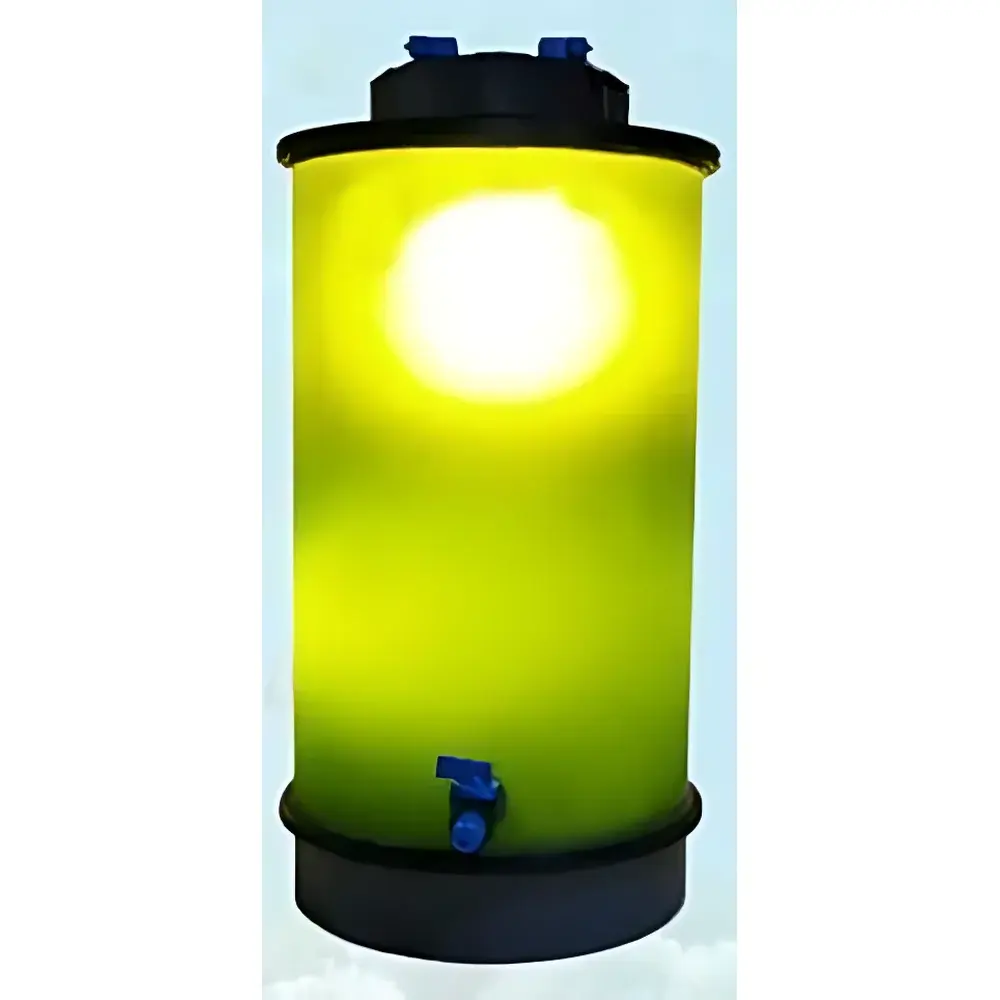
PB200 Large-Scale Algal Cultivation System
| Origin | Germany |
|---|---|
| Manufacturer Type | Authorized Distributor |
| Origin Category | Imported |
| Model | PB200 |
| Pricing | Available Upon Request |
| Volume | 12 L |
| Internal Diameter | 200 mm |
| Height | 520 mm |
| Controller Dimensions | 220 × 80 × 70 mm |
| Input Voltage/Power | 85–250 VAC / 5 W |
Overview
The PB200 Large-Scale Algal Cultivation System is an engineered photobioreactor platform designed for controlled, reproducible cultivation of microalgae and other photosynthetic phytoplankton under laboratory conditions. Built to ISO 9001-certified manufacturing standards in Germany, the system operates on a continuous or semi-continuous batch principle—enabling daily medium exchange of up to 30% of total culture volume (3.6 L) to maintain physiological stability, nutrient homeostasis, and prevent metabolic byproduct accumulation. Its cylindrical, optically transparent cultivation vessel (12 L working volume; 200 mm internal diameter × 520 mm height) ensures uniform light penetration and laminar flow dynamics when coupled with integrated magnetic stirring. The system leverages controlled photon flux density (PFD), regulated gas exchange (via sterile-filtered air or custom gas mixtures), and programmable diurnal lighting cycles to emulate natural photoperiods—critical for studies in algal physiology, carbon fixation kinetics, lipid induction, and bioprocess scalability assessment.
Key Features
- Robust borosilicate glass cultivation vessel with precision-ground螺纹 sealing interface—ensures leak-free operation, chemical resistance to common nutrient media (e.g., f/2, BG-11, ASN-III), and optical clarity across 400–700 nm photosynthetically active radiation (PAR) spectrum.
- Modular LED illumination unit with adjustable intensity (0–200 µmol·m⁻²·s⁻¹ PAR) and customizable photoperiod programming (e.g., 16:8, 12:12, or continuous light), calibrated using NIST-traceable quantum sensors.
- Integrated magnetic stirrer with variable speed control (0–300 rpm) and non-invasive coupling—minimizes shear stress while ensuring homogeneous suspension of non-motile or weakly motile strains (e.g., Chlorella vulgaris, Nannochloropsis oceanica).
- Dedicated PB200 Cultivation Controller (220 × 80 × 70 mm) featuring microprocessor-based logic, real-time clock, and relay-driven actuation for synchronized lighting, peristaltic nutrient dosing, and aerator timing—all configurable via front-panel membrane keypad or optional RS-232/USB interface.
- Gas supply path includes sterile 0.2 µm hydrophobic membrane filter and calibrated mass flow regulator—compatible with ambient air, CO₂-enriched air (up to 5% v/v), or nitrogen sparging for anaerobic preconditioning.
Sample Compatibility & Compliance
The PB200 supports cultivation of freshwater, marine, and brackish microalgal isolates—including but not limited to Dunaliella salina, Phaeodactylum tricornutum, and Scenedesmus obliquus. Its design adheres to GLP-relevant operational principles: all wetted components are autoclavable (121°C, 20 min); controller firmware supports timestamped event logging for audit readiness; and electrical architecture complies with IEC 61000-6-3 (EMC) and IEC 61010-1 (safety). While not certified for GMP production, the system meets prerequisite engineering controls referenced in USP (bacterial endotoxins) and ISO 14644-1 Class 8 cleanroom-compatible handling protocols when operated within laminar flow hoods.
Software & Data Management
The PB200 Cultivation Controller stores up to 30 days of operational history—including lighting ON/OFF timestamps, stirrer activation cycles, and pump duty cycles—with non-volatile memory retention during power loss. Optional firmware upgrade enables ASCII-formatted data export via serial terminal (baud rate 9600, 8N1) for integration into LabArchives ELN, MATLAB scripts, or Python-based process monitoring dashboards. All controller interactions comply with ALCOA+ data integrity principles: attributable, legible, contemporaneous, original, accurate, complete, consistent, enduring, and available—supporting traceability requirements under FDA 21 CFR Part 11 when paired with institutional electronic signature policies.
Applications
- Physiological response profiling under controlled abiotic stressors (light intensity, nutrient limitation, pH shift, temperature gradient).
- Preparative-scale biomass harvesting for downstream biochemical analysis (e.g., fatty acid methyl ester (FAME) profiling, pigment quantification via HPLC).
- Photobioreactor performance benchmarking against column, flat-panel, or tubular systems in comparative life-cycle assessments.
- Educational use in advanced biotechnology and environmental microbiology laboratories—providing hands-on training in aseptic technique, growth kinetics modeling (Monod, Droop), and closed-loop bioprocess control.
- Strain selection and acclimation studies prior to pilot-scale photobioreactor deployment.
FAQ
What is the maximum recommended operating temperature for the PB200 cultivation vessel?
The borosilicate glass tank is rated for continuous operation up to 50°C; however, optimal algal growth typically occurs between 20–28°C—temperature control requires external water jacket or incubator integration.
Can the PB200 be used for axenic cultures?
Yes—when sterilized via autoclaving and operated under laminar airflow with filtered gas input, it supports maintenance of axenic cultures; users must validate sterility through regular plating and microscopy.
Is remote monitoring or network connectivity supported?
The base controller lacks Ethernet/WiFi; however, analog voltage outputs (0–5 V) for light/stir status and optional TTL-level pulse signals enable integration with third-party SCADA or DAQ systems.
What maintenance intervals are recommended for the magnetic stirrer and LED unit?
LED lifetime exceeds 25,000 hours at nominal drive current; stirrer bearings require inspection every 12 months or after 2,000 operating hours—lubrication with food-grade silicone grease is advised.
Does the system include compliance documentation for import into the EU or USA?
CE Declaration of Conformity (2014/30/EU EMC Directive, 2014/35/EU LVD) and RoHS 2011/65/EU compliance certificates are supplied with each unit; FDA registration is not applicable as the PB200 is classified as research-use-only equipment.



