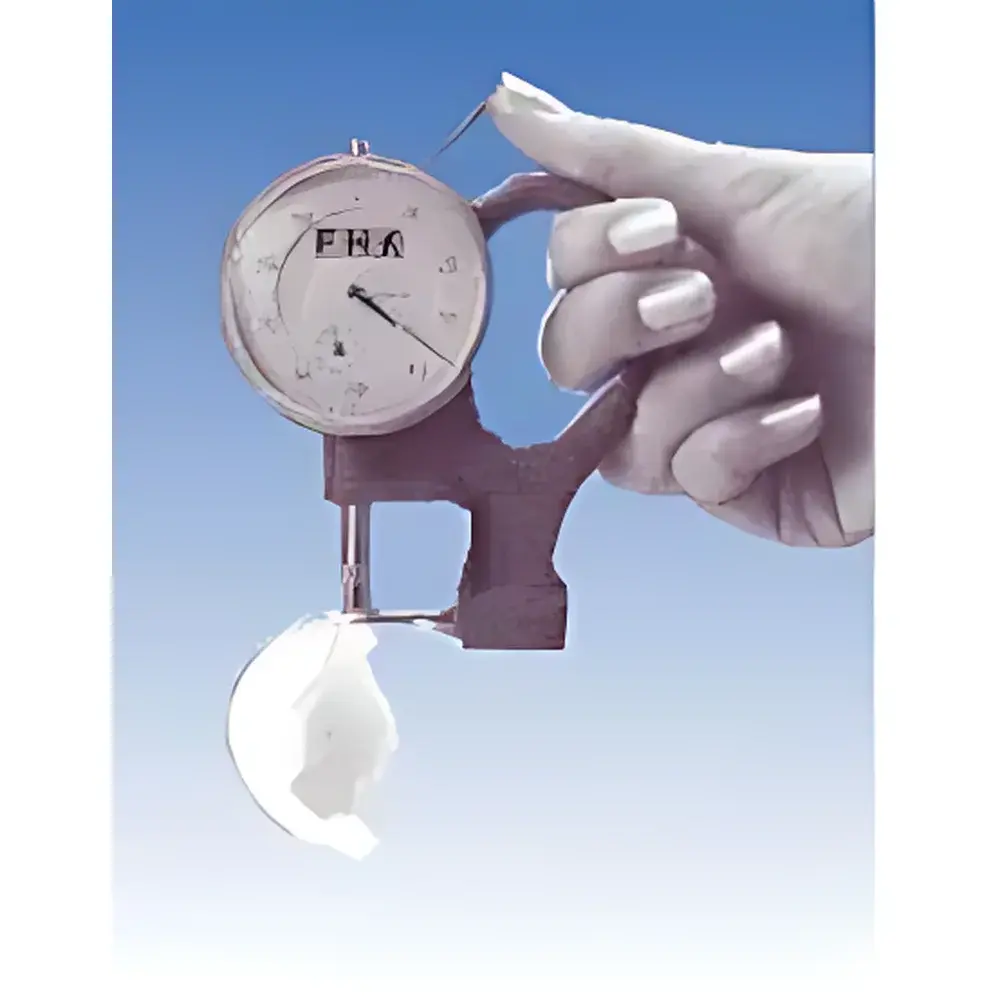
NFN380 Egg Shell Thickness Gauge
| Origin | Japan |
|---|---|
| Manufacturer Type | Authorized Distributor |
| Origin Category | Imported Instrument |
| Model | NFN380 |
| Pricing | Available Upon Request |
| Accuracy | 0.01 mm |
| Dimensions | 95 mm (L) |
| Weight | 120 g |
Overview
The NFN380 Egg Shell Thickness Gauge is a precision mechanical thickness measurement instrument engineered specifically for non-destructive, point-contact evaluation of avian eggshell thickness. It operates on the principle of calibrated mechanical displacement sensing—utilizing a hemispherical anvil and a matching spherical probe to maintain consistent contact geometry across curved surfaces. This design ensures minimal localized deformation and high reproducibility when measuring fragile, convex biological membranes with radii typical of chicken, duck, or quail eggs (≈20–45 mm). Unlike optical or ultrasonic methods requiring coupling media or surface preparation, the NFN380 delivers immediate analog readouts without power supply, software, or calibration drift concerns. Its metrological traceability aligns with ISO 9001-certified manufacturing processes, and its mechanical resolution of 0.01 mm meets routine quality control requirements specified in ISO 6579-1 (microbiological testing of eggs) and USDA Agricultural Handbook No. 75.
Key Features
- Specialized dual-spherical contact system: 3-mm radius anvil and complementary spherical probe ensure uniform pressure distribution and eliminate edge effects on curved shells.
- Mechanical vernier scale with 0.01 mm resolution—no batteries, no firmware updates, no sensor warm-up time.
- Compact handheld form factor (95 mm length, 120 g mass) optimized for field use in hatcheries, grading stations, and feed research laboratories.
- Robust stainless steel and hardened alloy construction resistant to humidity, egg residue, and repeated cleaning with food-grade sanitizers (e.g., peracetic acid, chlorine dioxide).
- Zero-adjustment screw allows periodic verification against certified gauge blocks (e.g., NIST-traceable 0.1 mm and 1.0 mm standards).
Sample Compatibility & Compliance
The NFN380 is validated for direct measurement of intact, uncracked eggshells from Gallus gallus domesticus (chicken), Anas platyrhynchos (duck), Coturnix japonica (quail), and other commercially relevant avian species. It accommodates shell curvature radii between 18 mm and 50 mm without adapter modification. The instrument complies with Good Laboratory Practice (GLP) documentation requirements for manual measurement devices: each unit bears a unique serial number engraved on the body; calibration history logs (date, technician, reference standard ID, deviation) are maintained per ISO/IEC 17025 Annex A.3. While not an electronic data capture device, its analog output satisfies FDA 21 CFR Part 11 “non-electronic records” provisions when paired with controlled paper-based recording protocols.
Software & Data Management
The NFN380 operates independently of software or digital interfaces. All measurements are recorded manually into laboratory notebooks, QC checklists, or LIMS-compatible spreadsheets. For traceability, users are advised to document: sample ID, measurement location (e.g., “equatorial zone, 3 o’clock position”), operator initials, date/time, and environmental conditions (temperature/humidity per ASTM E145-22 Annex A1). Optional accessories include a dedicated logbook template compliant with ISO 10012:2003 (measurement management systems) and a set of NIST-traceable calibration check standards (Cat. No. CAL-NFN-SET-01).
Applications
- Quality assurance in commercial egg production: monitoring shell thickness trends across flock age, diet formulation (calcium/phosphorus/vitamin D3 ratios), and seasonal stressors.
- Genetic selection programs: objective phenotyping of shell robustness traits in breeding stock evaluation.
- Feed additive efficacy trials: quantifying changes in shell thickness pre- and post-intervention (e.g., nano-calcium, phytase supplementation).
- Regulatory compliance audits: supporting claims related to shell integrity under EU Regulation (EC) No 589/2008 and US FDA Egg Safety Rule (21 CFR Part 118).
- Educational use in poultry science curricula: hands-on demonstration of biomechanical property measurement principles.
FAQ
Is the NFN380 suitable for measuring cracked or fragmented shells?
No. The instrument requires intact, load-bearing curvature to achieve stable contact geometry. Cracks compromise structural continuity and invalidate thickness interpretation.
Does it require annual recalibration by an accredited lab?
Not mandated—but recommended every 12 months or after 5,000 measurement cycles. Users may perform in-house verification using certified gauge blocks; full recalibration is available through the manufacturer’s authorized service center in Yokohama.
Can it measure shell thickness through the cuticle or bloom layer?
Yes. The 3-mm spherical probe contacts the outermost surface; therefore, readings include the cuticle (if present), making it suitable for studies evaluating cuticle deposition efficacy.
What is the minimum measurable thickness?
The lower limit is defined by mechanical stability—not instrument resolution. Practically, reliable measurement begins at ≈0.25 mm, typical of late-lay hen shells; sub-0.20 mm readings may exhibit increased variability due to probe sink-in on ultra-thin specimens.
Related Products