
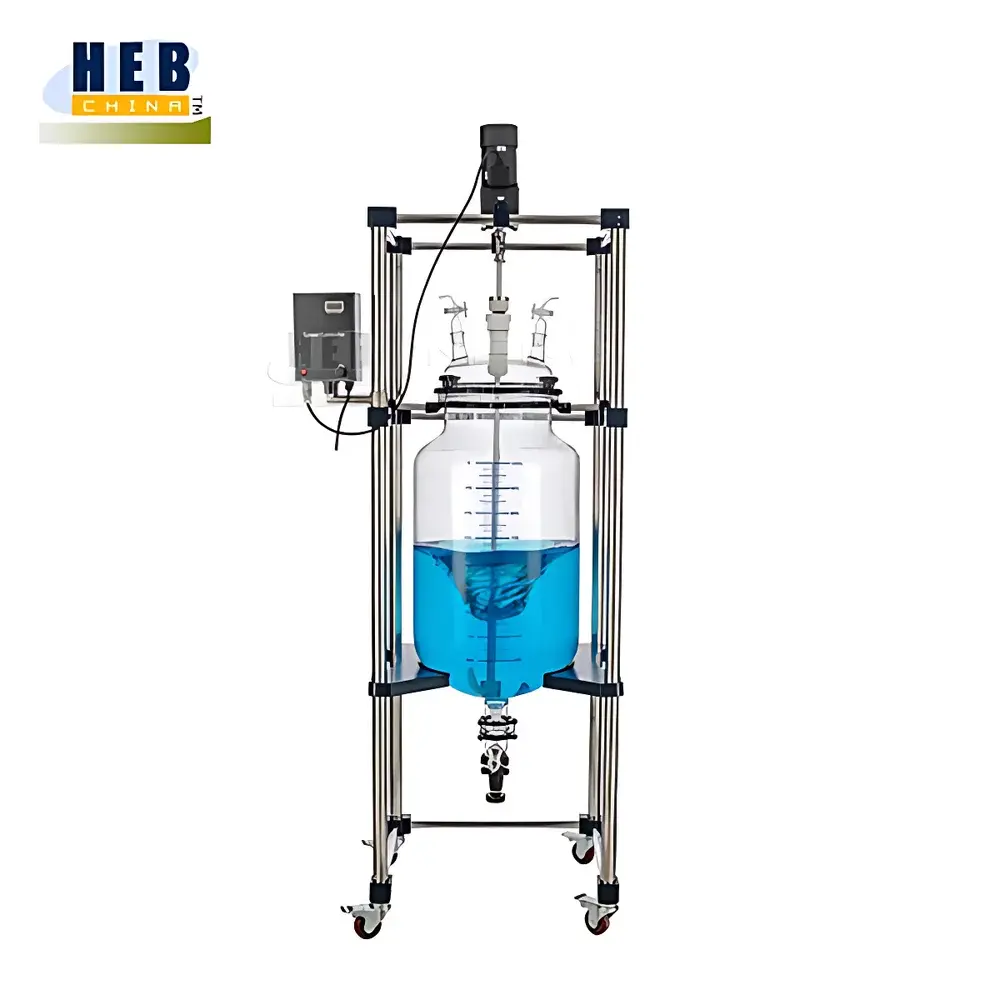
Jihepu FY-100L Cylindrical Glass Separatory Reactor
| Brand | Jihepu |
|---|---|
| Origin | Shandong, China |
| Model | FY-100L Cylindrical |
| Capacity | 100 L |
| Vessel Material | High-borosilicate glass (3.3 expansion coefficient) + PTFE |
| Working Pressure | Low-pressure operation |
| Vacuum Level | 0.098 MPa |
| Stirring Speed Range | 0–450 rpm |
| Motor Power | 200 W |
| Voltage/Frequency | 220 V / 50 Hz |
| Overall Dimensions (W×D×H) | 750 × 800 × 2100 mm |
| Net Weight | 67 kg |
| Packing Dimensions | 1920 × 720 × 760 mm (wooden crate) |
| Gross Weight | 115 kg |
Overview
The Jihepu FY-100L Cylindrical Glass Separatory Reactor is a bench-to-pilot-scale laboratory reactor engineered for controlled liquid–liquid separation, phase-dependent reaction monitoring, and post-reaction stratification handling. Designed around the principle of gravity-driven density-based phase separation within a transparent, chemically inert cylindrical vessel, it integrates motorized constant-speed stirring with precise vacuum and pressure compatibility to support multi-step synthesis, extraction, and purification workflows. Its all-glass (borosilicate 3.3) and PTFE-wetted construction ensures minimal catalytic interference, high thermal shock resistance (up to 200 °C), and full visual process observation—critical for optimizing reaction endpoints, identifying emulsion formation, or verifying interfacial clarity prior to layer withdrawal. The reactor operates under low-pressure conditions and achieves a stable vacuum level of 0.098 MPa, enabling solvent removal, degassing, or reduced-boiling-point distillations without compromising structural integrity.
Key Features
- Chemically inert wetted path: High-borosilicate glass (DIN ISO 3585 compliant) and virgin PTFE components ensure compatibility with aggressive reagents including strong acids, alkalis, halogenated solvents, and organometallics.
- Modular three-neck lid configuration: Includes one 60 mm stirring port (with ceramic bearing and mechanical seal), two standard 34/40 ground-glass joints (for addition funnel, condenser, or inert gas inlet), and dedicated vacuum/vent ports with PTFE-coated stopcocks.
- Low-speed, high-torque stirring system: 200 W variable-frequency motor with digital RPM display and manual knob adjustment (0–450 rpm); equipped with a crescent-shaped agitator blade (304 stainless steel core + PTFE coating) and 1200 mm shaft (PTFE-sleeved 304 SS).
- Side-mounted, zero-dead-volume discharge: 80 mm flanged bottom outlet with angled PTFE/glass valve enables sequential, layer-specific drainage without cross-contamination—ideal for biphasic workups in API synthesis or natural product isolation.
- Mobile robust frame: Anodized aluminum and stainless-steel support structure with locking casters (load-rated ≥120 kg) allows safe relocation between fume hoods, rotary evaporators, and filtration stations.
- Safety-integrated design: Built-in thermal fuse protection, grounded chassis, and IP20-rated electrical enclosure meet IEC 61010-1 requirements for laboratory electrical equipment.
Sample Compatibility & Compliance
The FY-100L reactor accommodates heterogeneous mixtures up to 100 L volume, supporting both batch and semi-continuous operations involving aqueous–organic, immiscible polymer solutions, or viscous reaction slurries (viscosity range: <5,000 mPa·s under agitation). All glass components conform to ASTM E438 Type I, Class A specifications for chemical resistance and dimensional accuracy. PTFE parts comply with FDA 21 CFR §177.1550 for indirect food additives. While not certified for GMP manufacturing, its traceable material documentation, non-porous surfaces, and cleanability support GLP-aligned lab practices—including audit-ready maintenance logs and calibration records for stirrer speed verification per ISO/IEC 17025 guidelines.
Software & Data Management
This is a manually operated, analog-controlled reactor with no embedded firmware or digital interface. RPM is monitored via integrated LED digital tachometer; no data logging, remote control, or USB/RS-232 connectivity is provided. Users are advised to record operational parameters (time, speed, temperature, vacuum level) externally using validated electronic lab notebooks (ELN) compliant with 21 CFR Part 11 when employed in regulated environments. Optional third-party integration with standalone vacuum controllers or temperature probes (e.g., PT100) is feasible via standard 0–10 V or 4–20 mA analog inputs on compatible ancillary units.
Applications
- Multi-phase organic synthesis requiring real-time visual assessment of phase separation (e.g., Suzuki couplings, hydrolysis, esterifications).
- Extraction protocols: Acid–base workups, back-extractions, and partition coefficient (log P) determination studies.
- Pilot-scale catalyst recovery: Sedimentation-assisted separation of heterogeneous catalysts from reaction media.
- Phytochemical processing: Maceration, percolation, and sequential solvent fractionation of botanical extracts.
- Teaching laboratories: Demonstrating Le Chatelier’s principle, density gradients, interfacial tension effects, and mass transfer limitations in unit operations courses.
FAQ
Is the reactor suitable for pressurized reactions?
No. It is rated exclusively for low-pressure and vacuum service (max. 0.098 MPa vacuum; not designed for positive pressure above ambient).
Can the glass vessel be autoclaved?
Borosilicate 3.3 glass is autoclavable at 121 °C for ≤20 minutes; however, PTFE seals and motor components must be removed prior to sterilization.
What maintenance is required for the mechanical seal and ceramic bearing?
Inspect annually for wear or leakage; replace PTFE lip seals every 500 operating hours under continuous use; ceramic bearings require no lubrication but must remain free of particulate ingress.
Does the unit include temperature control capability?
No built-in heating or cooling jacket is provided; external circulation mantles or immersion coolers may be clamped to the vessel body following manufacturer clearance guidelines.
Is technical documentation available in English?
Yes—fully translated user manual, dimensional drawings, material compliance certificates (glass, PTFE), and CE-conformity statement (for EU export variants) are supplied upon request with purchase confirmation.



