
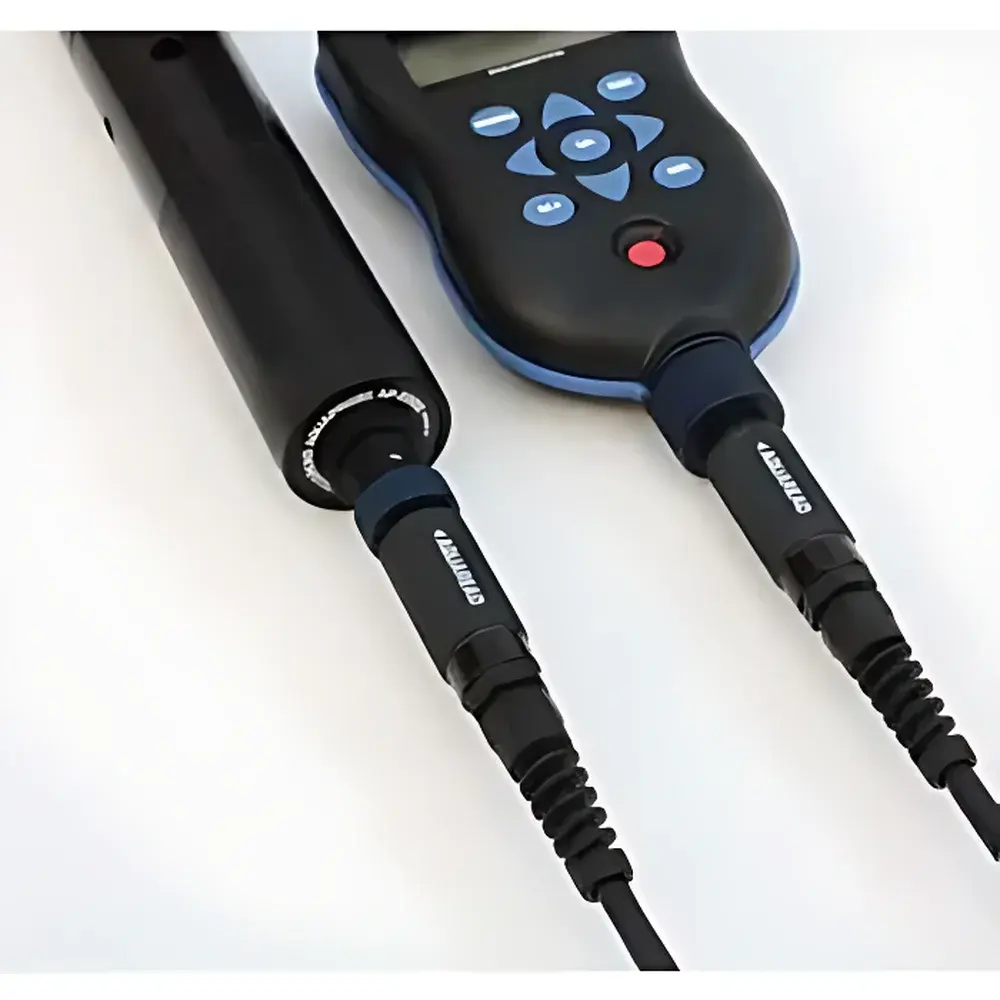
AQUAREAD AP-LITE-BGAPE Portable Phycocyanin (Blue-Green Algae) Fluorometer
| Brand | AQUAREAD |
|---|---|
| Origin | United Kingdom |
| Model | AP-LITE-BGAPE |
| Instrument Type | Portable/Handheld Water Quality Analyzer |
| Sensor Principle | In-situ Phycocyanin Fluorescence Detection |
| Measurement Range | 0–200,000 cells/mL |
| Resolution | 1 cell/mL |
| Repeatability | ±2% of reading |
| Probe Dimensions | Ø24 mm × 250 mm |
| Aquameter Dimensions | 90 × 180 × 39 mm |
| Aquameter Weight (with batteries) | 450 g |
| Display | Backlit 80-character LCD |
| Data Storage | 1900 samples |
| GPS | Built-in 12-channel antenna, accuracy ±10 m |
| Barometric Pressure Range | 150–1150 mbar (±1 mbar) |
| Power Supply | 5× AA alkaline or Ni-MH rechargeable batteries |
| Operating Temperature | −20 to +70 °C |
| Enclosure Rating | IP67 |
| Interchangeable Sensor Platform | Yes (supports turbidity, chlorophyll-a, phycocyanin, phycoerythrin, rhodamine WT, hydrocarbons, CDOM) |
Overview
The AQUAREAD AP-LITE-BGAPE is a field-deployable, optical fluorometric instrument engineered for the rapid, in-situ quantification of phycocyanin—a pigment specific to cyanobacteria (blue-green algae)—in freshwater systems. Unlike broad-spectrum chlorophyll-a measurements, phycocyanin detection enables selective identification and enumeration of potentially toxic cyanobacterial blooms, supporting early-warning decision-making for drinking water intake protection, reservoir management, and ecological risk assessment. The system operates on the principle of excitation-emission fluorescence spectroscopy: an integrated LED source emits light at 590 nm to selectively excite phycocyanin; emitted fluorescence at ~650 nm is captured by a precision photodiode and converted into cell concentration via factory-calibrated algorithms traceable to NIST-traceable reference standards. Its modular architecture—comprising the AP-LITE sensor housing, LITE-BGAPE phycocyanin-specific optical module, and Aquameter handheld display/logger—ensures operational flexibility without compromising measurement integrity under variable field conditions.
Key Features
- True in-situ measurement: Real-time, non-destructive quantification of cyanobacterial biomass directly in water, eliminating sample transport delays and preservation artifacts.
- High specificity: Optimized optical path and narrow-band interference filters minimize cross-sensitivity to chlorophyll-a, turbidity, and dissolved organic matter (CDOM).
- Modular sensor platform: The AP-LITE housing accepts interchangeable optical modules—including turbidity, chlorophyll-a, phycoerythrin, rhodamine WT, hydrocarbon, and CDOM sensors—enabling multi-parameter profiling with a single readout unit.
- Ruggedized field design: IP67-rated enclosure withstands immersion up to 1 m for 30 minutes; operating temperature range spans −20 to +70 °C, suitable for arctic lakes and tropical reservoirs alike.
- Integrated georeferencing: Built-in 12-channel GPS logs position metadata with every measurement, enabling spatial mapping of bloom dynamics and compliance with ISO 5667-3 and EPA Method 445.0 reporting requirements.
- Regulatory-ready data handling: Timestamped, GPS-tagged readings stored locally with audit-trail capability; export formats include CSV and XML compatible with LIMS and EPA STORET databases.
Sample Compatibility & Compliance
The AP-LITE-BGAPE is validated for use in natural and engineered freshwater environments including lakes, rivers, canals, drinking water reservoirs, and wastewater stabilization ponds. It meets the optical performance criteria outlined in ISO 10260:2021 (Water quality — Determination of cyanobacterial phycocyanin by fluorescence) and aligns with U.S. EPA guidance for cyanotoxin risk management (EPA 822-R-15-001). Its calibration protocol follows GLP principles, with documented traceability to certified reference materials. The instrument’s pressure-compensated design ensures stable operation across elevation gradients—from sea-level estuaries to high-altitude alpine lakes—without manual barometric correction. All firmware and calibration files are digitally signed and version-controlled to support FDA 21 CFR Part 11-compliant workflows when deployed in regulated utility monitoring programs.
Software & Data Management
Data acquisition and configuration are managed via the Aquameter’s onboard interface and the optional Aquaread Logger PC software (Windows/macOS). The software supports batch download, spectral validation review, linear and non-linear calibration curve management, and automated report generation compliant with ISO/IEC 17025 documentation standards. Raw fluorescence intensity values, temperature, conductivity (when paired with optional conductivity module), GPS coordinates, and operator ID are logged with microsecond timestamp resolution. Exported datasets include embedded metadata headers required for submission to national water quality portals such as the EU Water Framework Directive WISE database and the U.S. USGS NWIS.
Applications
- Early detection and spatial tracking of Microcystis, Anabaena, and Planktothrix blooms in raw water sources.
- Validation of satellite-based cyanobacterial index (CI) products through ground-truthing campaigns.
- Long-term trend analysis of eutrophication drivers in catchment-scale monitoring networks.
- Emergency response during suspected cyanotoxin events—supporting rapid go/no-go decisions for treatment plant intake switching.
- Educational fieldwork and citizen science initiatives requiring robust, low-training-threshold instrumentation.
- Research-grade validation of laboratory flow cytometry and qPCR assays for cyanobacterial enumeration.
FAQ
Is the AP-LITE-BGAPE suitable for saline or brackish water?
The sensor is calibrated for freshwater matrices (conductivity 5 mS/cm) may require matrix-specific recalibration due to ionic strength effects on fluorescence quantum yield.
Can the instrument be used for regulatory compliance reporting?
Yes—when operated per manufacturer’s SOPs and maintained with documented calibration records, it satisfies data quality objectives (DQOs) for Tier 1 monitoring under WFD and EPA ambient water quality standards.
What maintenance is required between deployments?
Rinsing with deionized water and gentle wiping of the optical window with lint-free tissue; annual verification against certified reference standards is recommended for GLP/GMP applications.
Does the system support remote telemetry?
Not natively—but the Aquameter’s USB/Bluetooth interface allows integration with third-party telemetry gateways (e.g., Campbell Scientific CR1000X, Teledyne ISCO) using ASCII serial output protocols.
How is sensor fouling mitigated during long-term deployment?
The AP-LITE housing is compatible with optional anti-fouling wipers and copper-alloy sleeves; for unattended use, periodic cleaning intervals should be determined based on site-specific biofouling rates observed in pilot studies.







