
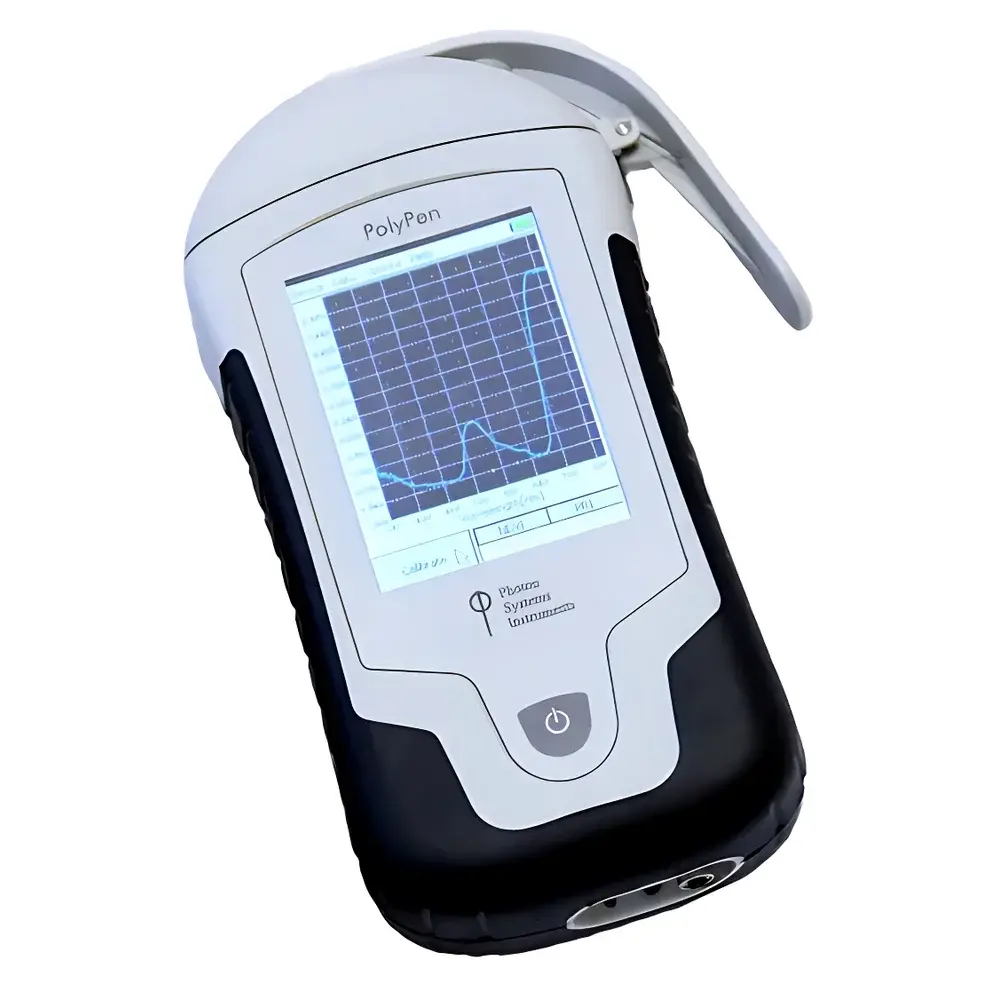
PolyPen RP-410 Handheld Plant Reflectance Spectrometer by PSI
| Brand | PSI (Photon Systems Instruments) |
|---|---|
| Origin | Czech Republic |
| Model | PolyPen RP-410 |
| Spectral Range (UVIS) | 380–790 nm |
| Spectral Range (NIR) | 640–1050 nm |
| Light Source | Pulsed Xenon Lamp |
| Detector | Linear CCD Array |
| Display | Full-color Touchscreen |
| Power | Rechargeable Li-ion Battery |
| Connectivity | USB + Bluetooth |
| Sample Interface | Non-destructive Leaf Clip with Integrated Calibration Reference |
| Onboard Storage | Internal Flash Memory |
| Preloaded Indices | >20 Vegetation Indices (e.g., NDVI, PRI, NDGI, OSAVI, MCARI, TCARI, SRPI, NPQI, SIPI, GM1/GM2) |
| Compliance | CE, RoHS |
Overview
The PolyPen RP-410 Handheld Plant Reflectance Spectrometer is an engineered field-deployable instrument designed for rapid, non-invasive acquisition of leaf-level spectral reflectance data across the visible and near-infrared (VIS-NIR) domains. Operating on the principle of contact-based diffuse reflectance spectroscopy, the device integrates a pulsed xenon light source (380–1050 nm), a high-stability linear CCD array detector, and a precision-engineered leaf clip that ensures consistent optical geometry and pressure-independent sample contact. Unlike benchtop spectroradiometers requiring fiber-optic coupling or external illumination, the PolyPen RP-410 performs self-contained measurements—eliminating ambient light dependency and enabling reproducible in situ quantification under variable field conditions. Its dual-spectral configuration (UVIS: 380–790 nm; NIR: 640–1050 nm) supports both pigment-related diagnostics (chlorophyll, carotenoids, anthocyanins) and structural/biophysical parameter estimation (leaf water content, canopy density, nitrogen status). The system adheres to fundamental radiometric traceability principles, with factory-calibrated reference standards embedded directly within the leaf clip assembly—ensuring daily operational calibration without external hardware.
Key Features
- True handheld operation powered by integrated rechargeable Li-ion battery—enabling >8 hours of continuous field measurement without external power or laptop dependency
- Full-color capacitive touchscreen interface with real-time spectral plot rendering and index value overlay—optimized for gloved operation and sunlight-readable contrast
- Dual-mode spectral acquisition: selectable UVIS (380–790 nm) or NIR (640–1050 nm) channel configurations, each with pre-aligned optical path and wavelength-specific calibration
- On-device computation of 20+ standardized vegetation indices—including NDVI, PRI, NDGI, OSAVI, TCARI/OSAVI, SRPI, NPQI, SIPI, and GM1/GM2—with support for user-defined index scripting via ASCII formula input
- Integrated GPS module (±2.5 m CEP) geotagging all spectral records at point-of-measurement—critical for spatially explicit phenotyping trials and longitudinal monitoring
- Non-destructive leaf clip featuring built-in Spectralon®-equivalent reference tile for automatic dark/light calibration prior to each measurement cycle
Sample Compatibility & Compliance
The PolyPen RP-410 is validated for direct contact measurement on intact, flattened leaves of herbaceous and woody angiosperms and gymnosperms (lamina thickness ≤ 1.2 mm). It accommodates leaf morphologies ranging from narrow grass blades (≥ 5 mm width) to broad dicot leaves (up to 40 mm width) via adjustable clip aperture. No sample preparation—such as coating, pressing, or solvent extraction—is required. The instrument complies with EU Directive 2014/53/EU (Radio Equipment Directive) and 2011/65/EU (RoHS II), carries CE marking for electromagnetic compatibility and safety, and meets IEC 60529 IP54 rating for dust and water resistance during field use. All onboard data logging conforms to FAIR principles (Findable, Accessible, Interoperable, Reusable), with timestamped, georeferenced spectra exported in standard .csv and .spc formats compatible with ENVI, R (hyperSpec), Python (SpectroChemPy), and MATLAB workflows.
Software & Data Management
Data acquisition, visualization, and export are managed through the native PolyPen Control Suite (v3.2+), available for Windows and macOS. The software supports batch spectral averaging, outlier rejection based on signal-to-noise ratio (SNR > 150:1 typical at 550 nm), and automated index validation against internal calibration references. Raw spectra include embedded metadata: GPS coordinates, UTC timestamp, instrument serial number, lamp pulse count, and clip contact pressure status. Exported datasets include full audit trails compliant with GLP-aligned documentation requirements. While the device operates autonomously, optional integration with cloud-based platforms (e.g., FieldBook, BreedBase) enables synchronized data ingestion for multi-site trial management. Firmware updates preserve backward compatibility with legacy spectral libraries and maintain alignment with ISO 17025-accredited calibration protocols.
Applications
- High-throughput phenotyping in controlled environment and field-based breeding programs—particularly for drought, heat, and nutrient stress screening
- Chlorophyll-a/b ratio estimation and carotenoid dynamics tracking during senescence or photoinhibitory events
- In-season nitrogen status assessment for precision fertilization decisions—correlated with Kjeldahl and LECO CN analyzer validation studies
- Early detection of biotic stress (e.g., fungal infection, aphid infestation) via spectral shift analysis in the 500–550 nm and 700–750 nm regions
- Validation of satellite- and UAV-derived vegetation indices through ground-truth spectral anchoring
- Ecophysiological research on light-use efficiency (LUE), photochemical reflectance (PRI), and non-photochemical quenching (NPQ) proxies
FAQ
What spectral resolution does the PolyPen RP-410 achieve?
The device delivers effective spectral sampling intervals of ≤ 3.3 nm (UVIS) and ≤ 4.1 nm (NIR), optimized for vegetation index fidelity rather than ultra-high-resolution molecular absorption profiling.
Can the instrument be calibrated in the field without returning to the lab?
Yes—each measurement cycle initiates an automatic dark current subtraction followed by reference tile illumination, ensuring traceable radiometric stability across temperature gradients (10–40 °C operating range).
Is raw spectral data accessible for custom algorithm development?
Absolutely—the full 1024-channel intensity vector per scan is stored and exportable in open-format ASCII, enabling third-party modeling in R, Python, or MATLAB without proprietary lock-in.
Does the PolyPen RP-410 meet regulatory requirements for agricultural monitoring data?
It supports ALP (Agricultural Laboratory Proficiency) reporting structures and generates metadata compliant with ISO 20412:2021 (Plant phenotyping—data exchange standards) and ASTM E2940-22 (Standard Guide for Spectral Data Acquisition in Plant Science).
How is measurement repeatability ensured across operators and sites?
The leaf clip’s mechanical stop limits compression force to 1.2 ± 0.1 N, while the fixed 1.5 mm source-detector separation eliminates operator-induced geometry variance—demonstrating CV < 2.3% for NDVI across 50 replicate scans on uniform maize leaves.





