
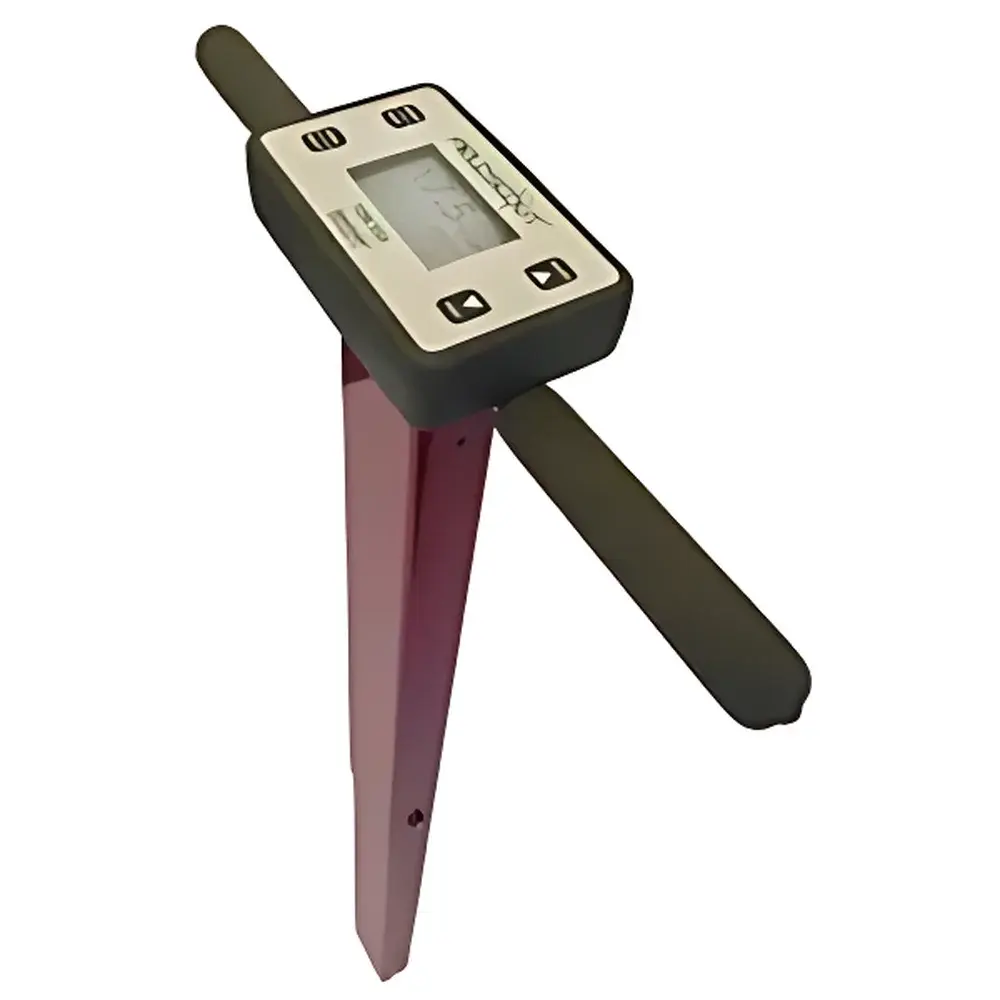
Spectrum Technologies TDR-350 Portable Soil Moisture, Temperature & EC Analyzer
| Brand | Spectrum Technologies |
|---|---|
| Origin | USA |
| Model | TDR-350 |
| Instrument Type | Soil Moisture / Water Potential Analyzer |
| Measurement Principle | Time-Domain Reflectometry (TDR) |
| Moisture Range | 0–saturation (volumetric water content, VWC) |
| Moisture Resolution | 0.1% VWC |
| Moisture Accuracy | ±3.0% VWC (at EC < 2 mS/cm) |
| EC Range | 0–5 mS/cm |
| EC Resolution | 0.01 mS/cm |
| EC Accuracy | ±0.1 mS/cm |
| Temperature Range | −30°C to +60°C |
| Temperature Resolution | 0.1°C |
| Temperature Accuracy | ±1°C |
| Probe Diameters | 0.5 cm |
| Probe Spacing | 3.3 cm |
| Probe Length Options | 3.8 cm, 7.5 cm, 12 cm, 20 cm |
| Data Storage Capacity | 50,000 GPS-tagged measurements |
| Power Supply | 4 × AA alkaline batteries |
| Integrated Modules | Bluetooth 4.2, GPS receiver, optional IR surface temperature sensor |
Overview
The Spectrum Technologies TDR-350 is a field-deployable, multi-parameter soil analyzer engineered for high-reproducibility measurement of volumetric water content (VWC), bulk electrical conductivity (EC), and soil or surface temperature in situ. It employs time-domain reflectometry (TDR), a well-established electromagnetic technique standardized under ASTM D5778 and ISO 11276, wherein a fast-rise step pulse is propagated along parallel probe rods inserted into the soil; the travel time of the reflected signal correlates directly with the dielectric permittivity of the surrounding medium — a property dominantly governed by water content. Unlike capacitance-based sensors, TDR is minimally affected by soil salinity, texture, or density variations, enabling robust VWC quantification across heterogeneous field conditions. The TDR-350 further integrates real-time EC measurement to support salinity correction of moisture readings and inform irrigation management decisions in saline-prone or fertilized systems.
Key Features
- Triple-parameter acquisition (VWC, EC, temperature) in a single insertion cycle — no sequential sensor swaps or recalibration between measurements.
- Four interchangeable probe lengths (3.8 cm, 7.5 cm, 12 cm, 20 cm) with standardized 0.5 cm diameter rods and 3.3 cm inter-rod spacing — optimized for shallow-rooted turfgrass, deep-rooted row crops, and layered soil profile analysis.
- Integrated GPS module (WAAS-enabled) geotags every measurement with latitude, longitude, altitude, and timestamp — essential for spatial mapping, change detection, and compliance with USDA NRCS or FAO monitoring protocols.
- Bluetooth 4.2 wireless interface supports secure, low-power data streaming to iOS/Android field tablets or ruggedized laptops running Spectrum’s FieldScout™ Mobile app — eliminating manual transcription errors and enabling real-time dashboard visualization.
- Ergonomic telescoping handle with thumb-actuated depth lock allows standing operation without bending — reducing operator fatigue during large-area surveys (e.g., golf course fairways or vineyard blocks).
- Optional infrared (IR) temperature sensor (8–14 µm spectral band, ±0.5°C accuracy) enables non-contact surface or canopy temperature acquisition — critical for calculating crop water stress index (CWSI) and detecting early-stage drought-induced stomatal closure.
Sample Compatibility & Compliance
The TDR-350 is validated for use in mineral soils, organic substrates (e.g., peat-based greenhouse media), sod, and compacted turf systems. Its TDR circuitry compensates for frequency-dependent dielectric dispersion in clay-rich or high-OM soils per IEEE Std 1188 recommendations. All firmware and data logging routines comply with GLP-aligned audit trail requirements: each stored record includes immutable metadata (probe ID, calibration epoch, battery voltage, GPS HDOP), supporting traceability in regulatory or research-grade applications. Device firmware adheres to FCC Part 15 and CE RED directives for radio-emitting equipment; GPS functionality meets ICAO Annex 10 standards for civil aviation-compatible positioning.
Software & Data Management
Data export is supported via USB-C or Bluetooth to Spectrum’s FieldScout Cloud platform — a secure, ISO 27001-certified SaaS environment. Raw .CSV files contain calibrated VWC (%), EC (mS/cm), temperature (°C), GPS coordinates (WGS84), and IR surface temperature (°C) where equipped. Batch processing tools enable spatial interpolation (IDW, kriging), time-series trend analysis, and automated alert generation when VWC falls below user-defined thresholds (e.g., 12% VWC for Kentucky bluegrass). Audit logs retain full edit history, satisfying FDA 21 CFR Part 11 requirements for electronic records in GxP environments.
Applications
- Agricultural irrigation scheduling — dynamic adjustment based on real-time root-zone VWC and salinity status.
- Turfgrass and landscape management — precision watering of golf greens, sports fields, and municipal parks to minimize runoff and nutrient leaching.
- Ecological research — long-term monitoring of soil moisture dynamics in restoration sites, riparian buffers, or climate transects.
- Greenhouse and nursery operations — substrate moisture profiling across propagation trays, container stock, and hydroponic support media.
- Soil physics validation — ground-truthing of satellite-derived soil moisture products (e.g., SMAP, Sentinel-1) at field scale.
FAQ
What calibration is required before first use?
The TDR-350 ships pre-calibrated using NIST-traceable standards. Field verification against gravimetric samples is recommended for site-specific mineralogy but not mandatory for routine monitoring.
Can the device measure frozen soil?
No. TDR signal propagation ceases below 0°C due to phase transition of pore water; measurements are invalid in frozen or partially frozen matrices.
Is the GPS module usable indoors or under dense canopy?
GPS reception requires unobstructed sky view. Under forest canopy or inside greenhouses, positional accuracy degrades; users should rely on manual waypoint tagging or post-processing differential correction.
How does EC correction improve VWC accuracy?
At EC > 2 mS/cm, ionic conduction contributes to apparent dielectric loss — the TDR-350 applies an empirically derived correction algorithm (based on Roth et al., 1992) to isolate true water-related permittivity.
What is the expected battery life under typical field use?
With 4 × AA alkaline cells, continuous operation lasts ≥120 hours; sleep-mode current draw is <10 µA, extending shelf life to 18 months.







