
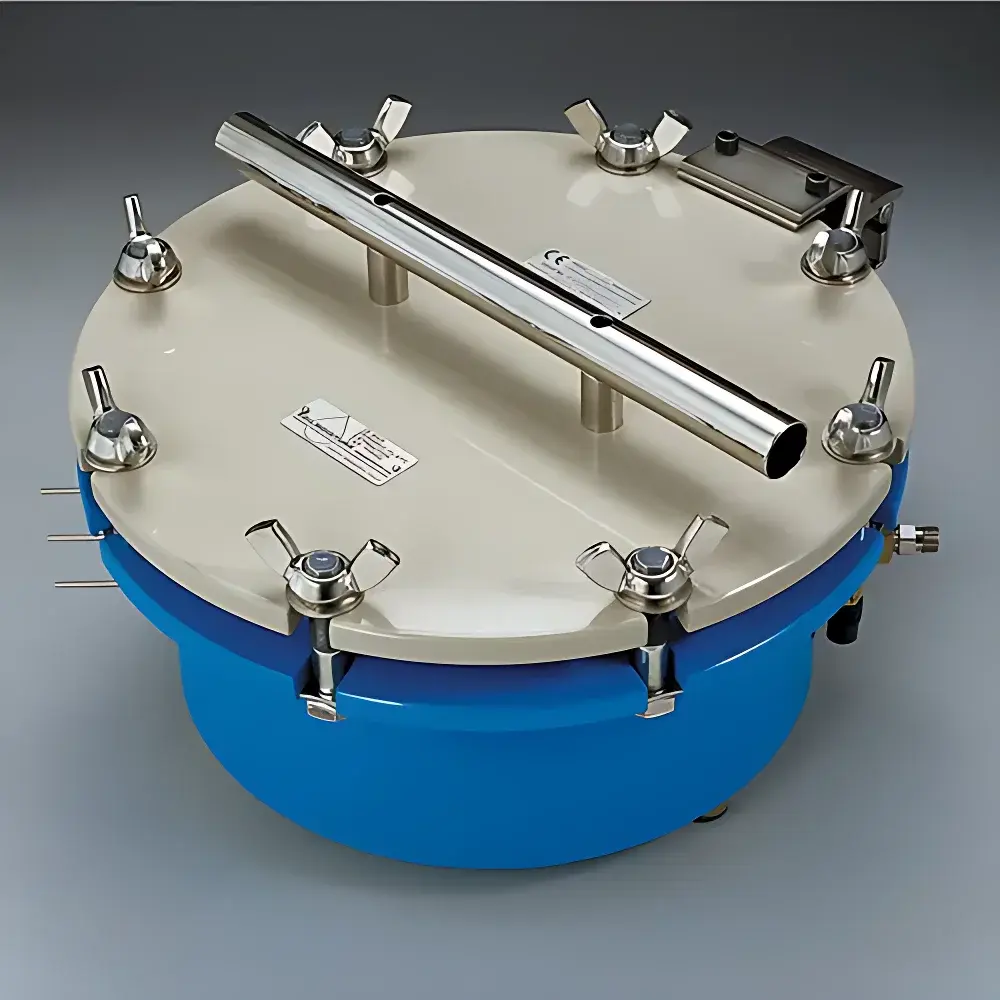
METER Group 1500F2 Soil Water Characteristic Curve Analyzer (Pressure Membrane Extractor)
| Origin | USA |
|---|---|
| Manufacturer Type | Authorized Distributor |
| Origin Category | Imported |
| Model | 1500F2 |
| Instrument Type | Soil Water Potential & Moisture Analyzer |
| Operating Voltage | 110–120 V AC, 60 Hz / 220–230 V AC, 50 Hz |
| Water Potential Range | 0 to −15 bar (0 to −1.5 MPa) |
| Accuracy | ±0.1 kPa (±0.001 bar) |
| Relative Humidity Range | 0–90% RH, non-condensing |
| 15-bar Chamber Dimensions | Depth 10 cm, Diameter 30 cm, Capacity: 4 ceramic plates, up to 48 soil cores (5.7 cm diameter) |
| 15-bar Chamber Weight | 36.1 kg |
| 5-bar Chamber Dimensions | Depth 22 cm, Diameter 30 cm, Capacity: 4 ceramic plates, up to 48 soil cores (5.7 cm diameter) |
| 5-bar Chamber Weight | 20.4 kg |
Overview
The METER Group 1500F2 Soil Water Characteristic Curve Analyzer is a precision pressure membrane extractor engineered for the laboratory determination of soil water retention curves (SWRCs) — also known as soil moisture characteristic curves. It operates on the fundamental principle of thermodynamic equilibrium between soil matrix potential and applied gas pressure across a semi-permeable ceramic membrane. When a saturated soil sample is placed on a porous ceramic plate inside a sealed pressure chamber and subjected to controlled overpressure, water is extracted from the soil matrix until hydraulic equilibrium is reached. At equilibrium, the applied air pressure equals the negative soil water potential (ψm) in bar (or MPa), while gravimetric or volumetric moisture content is measured independently — enabling construction of the ψm–θ relationship across a defined suction range. The 1500F2 supports dual-pressure configurations (5 bar and 15 bar chambers), permitting characterization of both unsaturated and drier soil states — critical for modeling infiltration, drainage, root water uptake, and vadose zone transport.
Key Features
- Dual-chamber architecture: Interchangeable 5-bar and 15-bar pressure vessels optimized for distinct soil textural classes — coarse-textured soils (e.g., sands) tested at 5 bar; fine-textured soils (e.g., clays, silts) requiring higher suctions up to 15 bar.
- High-precision pressure regulation: Digital pressure control system with ±0.1 kPa accuracy ensures repeatable application and maintenance of target matric potentials during equilibration.
- Standardized ceramic plate configuration: Each chamber accommodates four high-porosity, 5.7 cm-diameter METER Group ceramic plates (model 1500CC), enabling parallel processing of up to 48 replicate soil cores per run — significantly improving statistical robustness and throughput.
- Thermally stable chamber design: Aluminum alloy construction with insulated lid minimizes temperature fluctuations during extended equilibration periods (typically 24–72 h per pressure step), preserving measurement integrity.
- Universal power compatibility: Dual-voltage operation (110–120 V / 60 Hz and 220–230 V / 50 Hz) facilitates deployment in global laboratory environments without external transformers.
- Ergonomic engineering: Modular chamber design with integrated handles and calibrated leveling feet ensures safe handling and precise horizontal alignment — essential for uniform pressure transmission across ceramic surfaces.
Sample Compatibility & Compliance
The 1500F2 accepts intact or repacked soil cores (5.7 cm diameter × ≤2.5 cm height) collected using standard ring samplers or custom coring tools. It is compatible with mineral soils ranging from gravelly sands to heavy clays, provided samples are pre-saturated and carefully seated on ceramic plates to eliminate air gaps. The instrument conforms to ASTM D4546 (“Standard Test Methods for One-Dimensional Consolidation Properties of Soils Using Controlled-Strain Loading”) and ISO 11274 (“Soil Quality — Determination of Field-Water Capacity and Available Water Capacity”). Data generated support GLP-compliant workflows when paired with validated weighing protocols (e.g., Mettler Toledo XP series balances) and documented equilibration logs. While not inherently FDA 21 CFR Part 11–compliant, raw pressure and time-stamped equilibrium records can be exported for integration into validated LIMS or electronic lab notebook (ELN) systems meeting regulatory audit requirements.
Software & Data Management
The 1500F2 operates as a standalone hardware platform and does not include embedded software or touchscreen interface. Pressure setpoints, dwell times, and chamber status are managed manually via front-panel controls and analog pressure gauges. Users record equilibrium times, mass loss, and environmental conditions (room temperature, RH) in standardized laboratory notebooks or digital spreadsheets. METER Group provides complimentary Excel-based SWRC calculation templates aligned with van Genuchten and Brooks-Corey parameterization methods. For automated data capture, the 1500F2 may be integrated with third-party digital pressure transducers (e.g., Validyne DP15) and data loggers compliant with IEEE 1451.2 standards — enabling time-series logging, remote monitoring, and export to CSV/Excel formats suitable for import into MATLAB, R, HYDRUS, or STANMOD.
Applications
- Calibration of pedotransfer functions (PTFs) used in hydrological modeling (e.g., SWAT, MODFLOW-NWT, HYDRUS-1D).
- Validation of in situ tensiometer and gypsum block sensor calibrations across soil horizons.
- Characterization of biochar-amended soils and engineered growth media for green infrastructure projects.
- Supporting USDA-NRCS soil survey laboratories in developing regional soil hydraulic property databases.
- Research on soil structural stability under drought stress and rewetting cycles.
- Quality assurance for commercial soil testing labs serving agriculture, remediation, and civil engineering sectors.
FAQ
What soil types are best suited for analysis with the 1500F2?
Sandy and loamy soils are routinely analyzed at 5 bar; clay-rich and organic soils require the 15-bar chamber to fully characterize the dry end of the retention curve.
How long does a typical SWRC measurement take?
Each pressure step requires 24–72 hours for full equilibration, depending on soil texture and initial saturation state — a complete curve across 5–7 pressures typically takes 7–14 days.
Is the 1500F2 compatible with automated data logging?
Yes — optional analog pressure output (0–5 V or 4–20 mA) enables connection to programmable logic controllers (PLCs) or industrial data acquisition systems.
Do ceramic plates require recalibration?
Ceramic plates are factory-calibrated and do not require periodic recalibration; however, they must be cleaned with dilute HCl and thoroughly rinsed before reuse to prevent pore clogging.
Can the 1500F2 be used for salinity-affected soils?
Yes — but osmotic potential contributions must be accounted for separately, as the 1500F2 measures only matric potential; users should pair measurements with ECe or solution extraction data.
Related Products







