
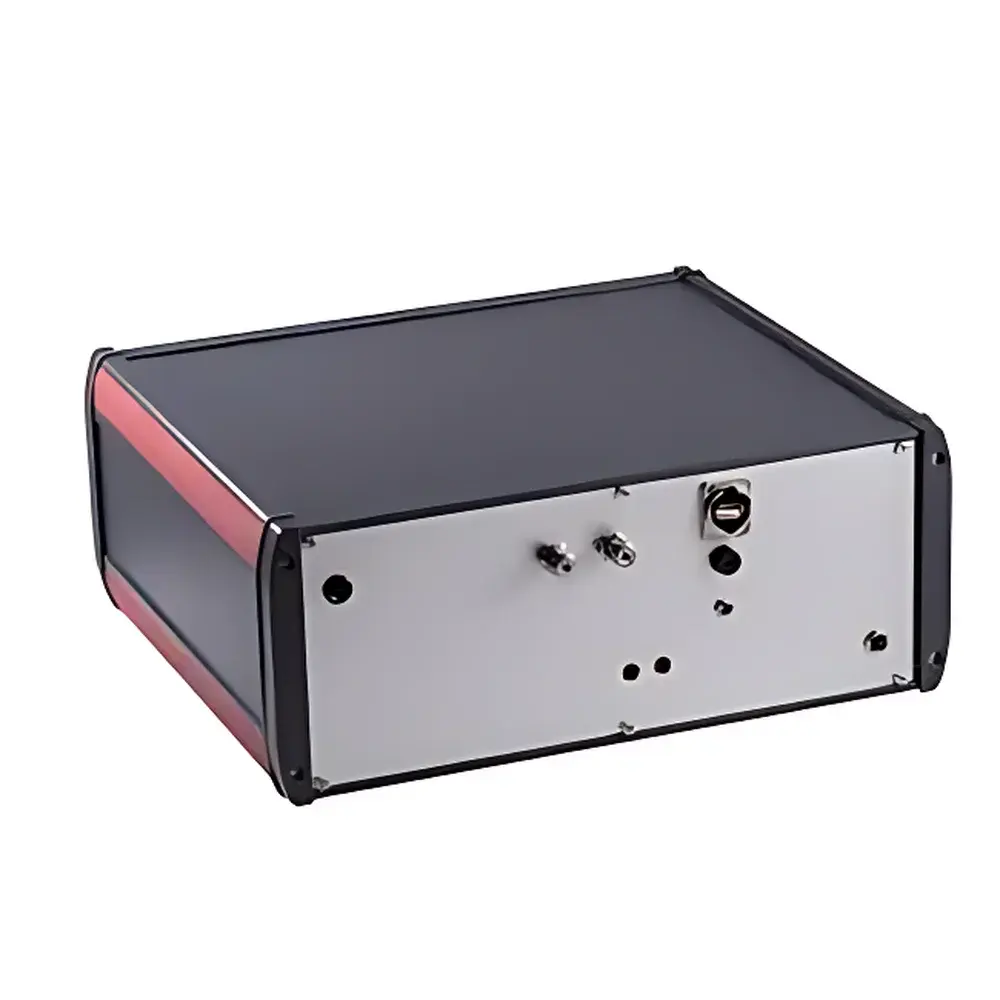
Masa PAIMS Portable Ion Mobility Spectrometer
| Brand | Masa |
|---|---|
| Origin | Slovakia |
| Model | PAIMS |
| Sample Introduction | Direct sampling |
| Sensitivity | ng–pg level |
| Library | Trace gases, explosives, chemical hazards |
| Operating Pressure | 600–1200 mbar |
| Operating Temperature | 30–100 °C |
| Resolution (N₂/Air) | 70 FWHM |
| Detection Limit | Sub-ppb |
| Drift Gas Flow Rate | 5–500 mL/min |
| Drift Field Strength | 200–560 V/cm |
| Power Supply | 24 V DC |
| Polarity | Positive/Negative |
| Ionization Source | Corona discharge |
| Communication Interface | USB 2.0 |
| Dimensions | 352 × 305 × 142 mm |
Overview
The Masa PAIMS Portable Ion Mobility Spectrometer is an integrated, field-deployable analytical platform engineered for real-time, high-sensitivity detection of volatile organic compounds (VOCs), trace gases, explosives, and chemical warfare agents under ambient or controlled pressure conditions. Based on atmospheric-pressure ion mobility spectrometry (IMS), the system separates gas-phase ions according to their collision cross-section (CCS) and charge-to-mass ratio in a uniform electric drift field—without requiring vacuum infrastructure. Unlike mass spectrometry, IMS achieves sub-millisecond separation times with minimal sample preparation, making it ideal for rapid screening in security, environmental monitoring, and industrial process control. The PAIMS employs a non-radioactive corona discharge ion source, enabling safe, regulatory-compliant operation in laboratories, mobile labs, and unshielded field environments. Its compact monolithic architecture integrates the IMS drift tube, control electronics, dual digital mass flow controllers, and pressure regulation into a single ruggedized chassis—eliminating external gas manifolds and reducing calibration drift.
Key Features
- Non-radioactive corona discharge ionization—compliant with IEC 61000-4-3 and EU Directive 2013/59/Euratom for radiation-free instrumentation
- Adjustable drift field strength (200–560 V/cm) and operating pressure (600–1200 mbar), supporting both atmospheric and sub-atmospheric IMS modes
- Temperature-controlled drift region (30–100 °C) for optimized ion stability and reproducible CCS calibration
- High-resolution separation (70 FWHM in N₂/air) enabled by precision-machined electrode geometry and low-noise HV supply
- Sub-ppb detection limits for target analytes including nitroaromatics, organophosphates, and aldehydes—validated per ASTM E2781-22 for explosive vapor detection
- Positive/negative polarity switching in <100 ms, facilitating structural characterization of protonated, deprotonated, and adducted ions
- USB 2.0 interface with deterministic latency (<5 ms) for synchronized data acquisition in time-resolved applications
Sample Compatibility & Compliance
The PAIMS accepts direct gas-phase samples without pre-concentration or derivatization. It interfaces natively with multi-capillary GC columns and Agilent GC systems via heated transfer lines (up to 150 °C), enabling orthogonal 2D GC-IMS separation for isomer-resolved analysis—particularly valuable in food authenticity, pharmaceutical impurity profiling, and environmental VOC speciation. The instrument meets ISO/IEC 17025:2017 requirements for analytical method validation when operated within defined environmental envelopes (20–30 °C ambient, <70% RH). Its firmware supports audit-trail logging per FDA 21 CFR Part 11 when deployed in GLP/GMP-regulated environments. All spectral libraries—including trace gas, explosives, and toxic industrial chemicals—are curated against NIST SRM 2270a and EU CBRN reference standards.
Software & Data Management
PAIMS Control Suite v4.x provides full parameter scripting, real-time drift time alignment, and CCS calibration using internal standards (e.g., acetone, chloroform). Raw IMS spectra are stored in vendor-neutral HDF5 format with embedded metadata (pressure, temperature, flow, HV). Batch processing supports peak deconvolution via modified asymmetric Gaussian fitting and library matching using cosine similarity and retention index correlation. Export modules generate CSV, mzML, and IMS-JSON compliant with HUPO-PSI specifications. For regulated workflows, optional software modules provide electronic signatures, user role-based access control, and change history tracking aligned with Annex 11 and ALCOA+ principles.
Applications
- Rapid standoff detection of explosives (TNT, RDX, PETN) and precursors in baggage, cargo, and vehicle screening
- Real-time indoor/outdoor air quality monitoring—quantification of formaldehyde, acetaldehyde, benzene, and terpenes at µg/m³ levels
- GC-IMS hyphenation for chiral and conformational analysis of flavor compounds, metabolites, and isomeric drug degradation products
- In-line process monitoring of reactor off-gas streams in fine chemical synthesis and polymer manufacturing
- Fundamental studies of ion–molecule reactions, hydration thermodynamics, and proton affinity–driven clustering behavior—validated via DFT-calculated PA and hydration enthalpies
FAQ
Can PAIMS be used as a GC detector?
Yes—its 100-ms duty cycle and heated inlet (up to 150 °C) support seamless coupling with Agilent and other commercial GC systems for comprehensive 2D separation.
Does it require radioactive sources?
No—the corona discharge ion source eliminates regulatory licensing, transport restrictions, and disposal liabilities associated with ⁶³Ni or ²⁴¹Am sources.
How is resolution affected by humidity?
Drift gas humidity is actively controlled via integrated mass flow controllers; resolution remains stable across 10–80% RH when operated within specified temperature/pressure windows.
Is CCS calibration supported?
Yes—built-in calibration routines use polyatomic reference ions (e.g., acetone–H⁺, chloroform–H⁺) to establish drift time–CCS relationships traceable to NIST SRM 2270a.
What maintenance is required?
Annual verification of HV stability, flow controller linearity, and ion gate timing accuracy—no consumables or routine source cleaning required under normal operation.





