
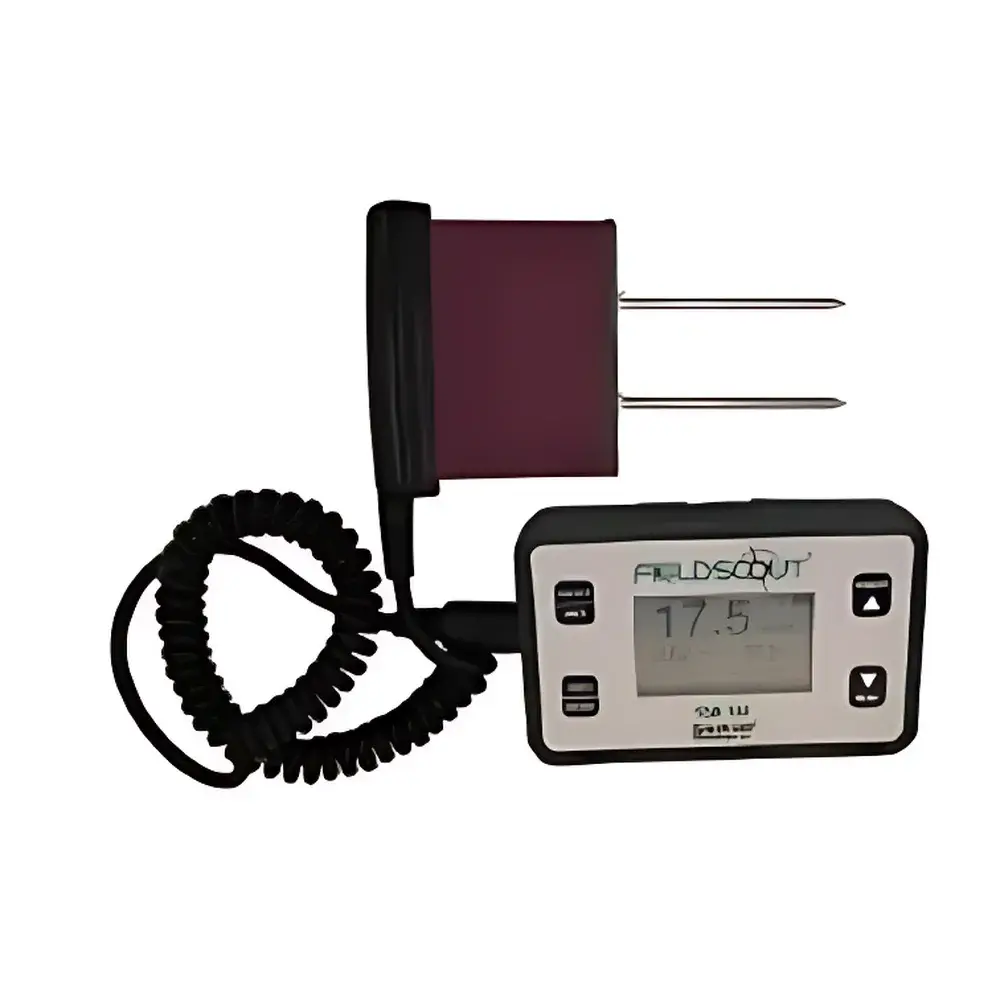
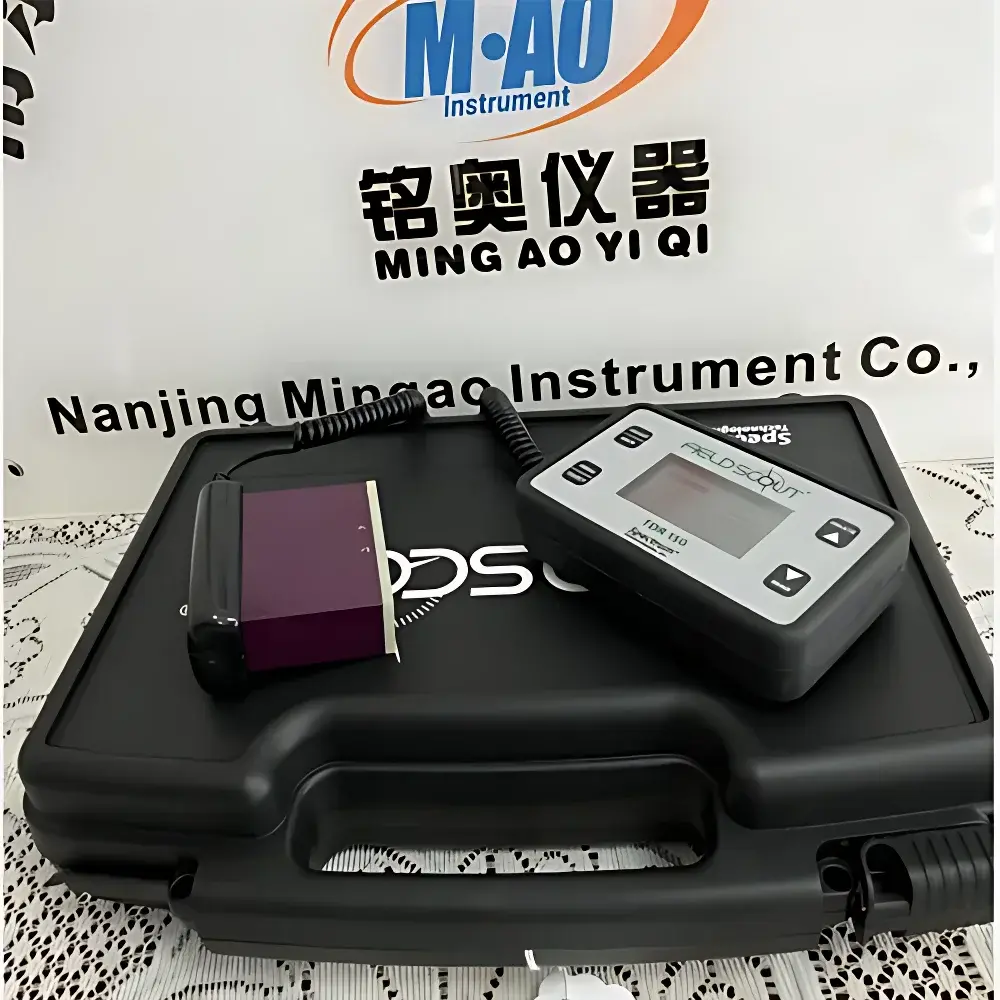
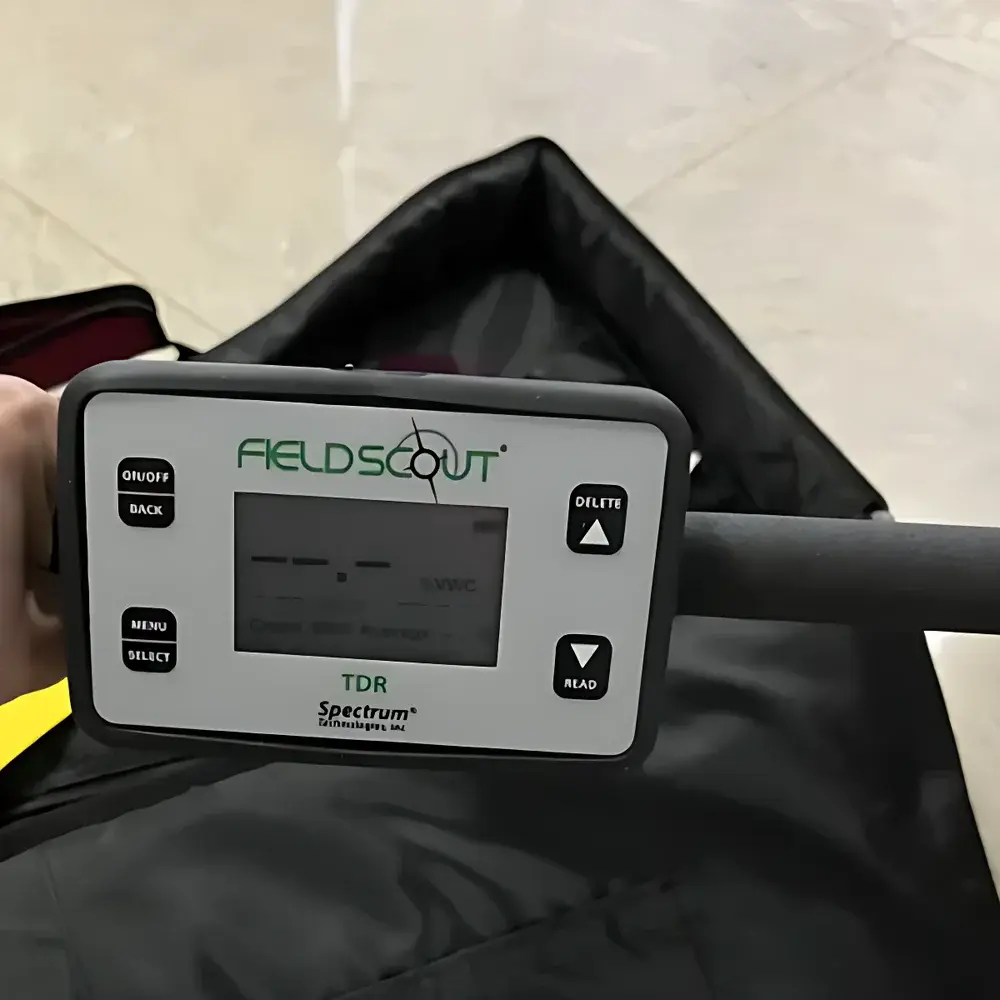
Spectrum Technologies TDR150 Portable Soil Moisture/Temperature/EC Meter
| Brand | Spectrum Technologies |
|---|---|
| Origin | USA |
| Model | TDR150 |
| Instrument Type | Multi-parameter Soil Analyzer |
| Measurement Principle | Time-Domain Reflectometry (TDR) |
| Moisture Range | 0–saturation (volumetric water content, VWC) |
| Moisture Resolution | 0.1% VWC |
| Moisture Accuracy | ±3.0% VWC (at EC < 2 mS/cm) |
| EC Range | 0–5 mS/cm |
| EC Resolution | 0.01 mS/cm |
| EC Accuracy | ±0.1 mS/cm |
| Temperature Range | −30°C to +60°C |
| Temperature Resolution | 0.1°C |
| Temperature Accuracy | ±1.0°C |
| Probe Diameters | 0.5 cm |
| Probe Spacing | 3.3 cm |
| Probe Length Options | 3.8 cm, 7.5 cm, 12 cm, 20 cm |
| Display | Backlit LCD |
| Optional Accessory | Integrated Infrared Surface Temperature Sensor |
Overview
The Spectrum Technologies TDR150 Portable Soil Moisture/Temperature/EC Meter is an integrated field instrument engineered for rapid, in-situ quantification of three critical soil physical parameters: volumetric water content (VWC), bulk electrical conductivity (EC), and soil temperature. It operates on the well-established time-domain reflectometry (TDR) principle—where a high-frequency electromagnetic pulse is transmitted along parallel probe rods embedded in soil; the travel time of the reflected signal correlates directly with the dielectric permittivity of the medium, enabling robust and calibration-stable VWC determination across the full range from air-dry to saturation. Simultaneously, the device measures bulk EC via four-terminal (Kelvin) sensing to minimize contact resistance errors, and corrects VWC readings for salinity-induced dielectric interference—ensuring accuracy under variable soil salinity conditions. Designed for agronomic decision support, the TDR150 delivers traceable, field-deployable data without requiring lab-based sample extraction or gravimetric drying, making it suitable for real-time irrigation scheduling, drought stress assessment, and soil health monitoring.
Key Features
- True multi-parameter acquisition: simultaneous VWC, bulk EC, and soil temperature measurement in a single insertion event
- TDR-based VWC measurement with proven repeatability and minimal hysteresis—no empirical calibration required for standard mineral soils
- Bulk EC compensation algorithm integrated into firmware to adjust VWC output when EC exceeds 2 mS/cm
- Ergonomic handheld design with intuitive one-button operation and backlit LCD display for low-light field use
- Modular probe system with four standardized lengths (3.8 cm, 7.5 cm, 12 cm, 20 cm) to match target root zones—from turfgrass shallow profiles to deep agricultural horizons
- Optional infrared surface temperature sensor (sold separately) enables non-contact measurement of canopy or bare-soil surface temperature—critical for calculating crop water stress index (CWSI) and evapotranspiration modeling
- Ruggedized housing rated for outdoor environmental exposure; operational temperature range spans −30°C to +60°C
Sample Compatibility & Compliance
The TDR150 is validated for use in mineral soils, sandy loams, clay loams, and organic-rich topsoils with bulk EC up to 5 mS/cm. It is not intended for saturated clay suspensions or highly conductive hydroponic solutions. Probe geometry (0.5 cm diameter, 3.3 cm inter-rod spacing) ensures minimal soil disturbance and representative sampling volume (~150–300 cm³ depending on probe length). The instrument complies with ASTM D5084–22 (Standard Test Methods for Measurement of Hydraulic Conductivity of Saturated Porous Materials) for indirect moisture correlation and supports GLP-aligned field data collection workflows. While not FDA 21 CFR Part 11–certified as a standalone unit, raw measurement logs exported via USB can be imported into validated LIMS or farm management platforms meeting audit-trail requirements.
Software & Data Management
Data are stored internally (up to 10,000 records) with timestamp, GPS coordinates (when paired with external Bluetooth GNSS receiver), probe ID, and measurement mode metadata. Export is supported via micro-USB to CSV format for post-processing in Excel, R, Python (pandas), or GIS platforms such as QGIS and ArcGIS Pro. Spectrum’s free PC software (TDR Utility Suite v3.2+) enables batch calibration offset application, spatial interpolation mapping, and trend visualization across time-series deployments. All firmware updates are distributed through Spectrum’s secure customer portal—no third-party drivers or cloud dependencies required.
Applications
- Irrigation scheduling in precision agriculture, vineyards, orchards, and nursery production
- Soil moisture monitoring for turfgrass management on golf courses, sports fields, and municipal landscapes
- Field validation of satellite- or drone-derived soil moisture products (e.g., SMAP, Sentinel-1)
- Salinity mapping and drainage evaluation in reclaimed or coastal farmland
- Ecophysiological studies linking root-zone water status with plant transpiration and stomatal conductance
- Long-term climate resilience monitoring in rangeland and forest understory ecosystems
FAQ
How does the TDR150 compensate for soil salinity during moisture measurement?
The instrument applies an empirically derived correction factor based on concurrent bulk EC readings; when EC exceeds 2 mS/cm, firmware adjusts the dielectric constant-to-VWC conversion to maintain accuracy within ±3.0% VWC.
Can the infrared temperature sensor measure both canopy and soil surface temperature?
Yes—the optional IR module has a 12:1 distance-to-spot ratio and emissivity adjustment (0.90–0.99), supporting reliable measurements of both green canopy surfaces and exposed mineral soil.
Is probe calibration required before each use?
No—factory calibration is stable over time; however, users may perform field verification using known reference media (e.g., dry sand, distilled water-saturated quartz sand) per ASTM D5084 Annex A3.
What is the minimum soil bulk density for reliable TDR150 readings?
The probe is optimized for densities between 1.1 g/cm³ and 1.6 g/cm³; below 1.0 g/cm³ (e.g., peat moss), air gaps may cause signal scattering—use with caution and validate against gravimetric samples.
Does the device meet ISO/IEC 17025 traceability requirements?
While the TDR150 itself is not accredited, its factory calibration certificates reference NIST-traceable standards for time-domain electronics and thermistor response curves—enabling laboratories to establish internal metrological traceability.







