
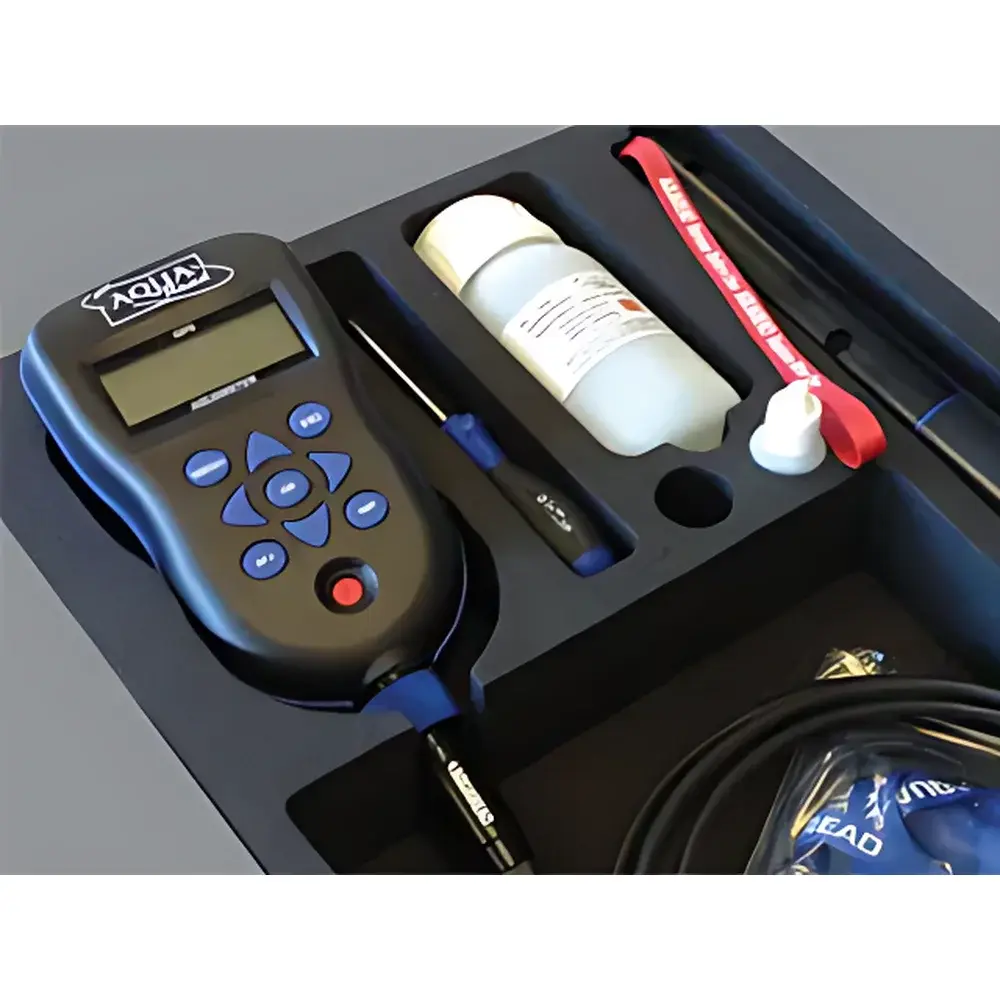
AQ5000 Portable Multi-Parameter Water Quality Analyzer
| Origin | United Kingdom |
|---|---|
| Manufacturer Type | Authorized Distributor |
| Origin Category | Imported |
| Model | AQ5000 |
| Instrument Type | Portable / Handheld Water Quality Analyzer |
Overview
The AQ5000 Portable Multi-Parameter Water Quality Analyzer is an integrated, field-deployable platform engineered for high-reliability in-situ measurement of critical physical, chemical, and biological water quality parameters. Built upon a modular sensor architecture and calibrated electrochemical/optical detection principles, the system enables simultaneous acquisition of temperature, depth, pH, oxidation-reduction potential (ORP), dissolved oxygen (DO), conductivity, total dissolved solids (TDS), salinity, resistivity, and seawater density (sigma-t). Its design adheres to fundamental metrological requirements for environmental monitoring—leveraging temperature-compensated amperometric DO sensing, dual-range conductivity cells with automatic range switching, and NIST-traceable pH/ORP electrode calibration protocols. The AQ5000 is purpose-built for regulatory field surveys, limnological research, wastewater effluent verification, and drinking water source assessment where real-time, location-tagged data integrity is essential.
Key Features
- Modular sensor interface supporting up to two interchangeable ISE probes (e.g., NH₄⁺, NO₃⁻, Cl⁻, F⁻, Ca²⁺) and one multi-channel optical probe (Chlorophyll-a, phycocyanin-based cyanobacteria enumeration, turbidity, hydrocarbon fluorescence)
- Integrated GPS module and time-stamped logging (UTC-synchronized) compliant with ISO 17025 documentation traceability requirements
- Ruggedized IP67-rated housing with shock-absorbing polymer casing and corrosion-resistant 316 stainless steel sensor shaft
- Onboard memory storing ≥10,000 data records with metadata (GPS coordinates, timestamp, operator ID, sensor configuration)
- Auto-ranging conductivity and resistivity measurements across dual scales (0–9999 µS/cm & 10.0–1000.0 mS/cm; 5–9999 Ω·cm & 10.0–1000.0 kΩ·cm) with ±1% full-scale accuracy
- Temperature compensation algorithms aligned with ASTM D1125 (conductivity), ASTM D888 (DO), and ISO 7888 (pH)
Sample Compatibility & Compliance
The AQ5000 is validated for use in freshwater, estuarine, and marine environments—including rivers, reservoirs, aquaculture ponds, stormwater outfalls, and coastal monitoring stations. Sensor configurations meet EPA Method 180.1 (turbidity), USP (particulate matter in purified water), and ISO 10260 (cyanobacterial cell enumeration via phycocyanin fluorescence). All electrochemical sensors comply with GLP-compliant calibration workflows, including multi-point standardization and drift verification logs. Data export formats (CSV, XML) support audit-ready reporting under FDA 21 CFR Part 11 when used with optional secure authentication modules.
Software & Data Management
The AQ5000 interfaces with AquaLink Desktop v4.2 software (Windows/macOS), enabling sensor configuration, firmware updates, spectral analysis of optical channels, and automated report generation per ISO 5725 precision guidelines. Raw datasets include embedded calibration certificates, sensor serial numbers, and environmental context tags. Cloud synchronization (via encrypted HTTPS) supports centralized dashboard visualization across multi-site deployments. Audit trails record all user actions—including parameter edits, calibration events, and data exports—with immutable timestamps and operator credentials.
Applications
- Regulatory compliance monitoring for NPDES permits and EU WFD (Water Framework Directive) status classification
- Algal bloom early-warning systems using real-time Chlorophyll-a and cyanobacteria cell density thresholds
- Wastewater treatment plant influent/effluent profiling with simultaneous NH₄⁺, NO₃⁻, and DO trending
- Drinking water distribution system integrity assessment via conductivity anomaly detection and ORP stability analysis
- Marine ecological studies requiring sigma-t density correction for thermohaline stratification modeling
- Post-remediation site verification for hydrocarbon contamination using rhodamine WT and refined oil fluorescence channels
FAQ
Does the AQ5000 support GLP-compliant calibration logging?
Yes—each calibration event is time-stamped, digitally signed, and stored with reference standard IDs, ambient conditions, and operator credentials. Calibration history is exportable as PDF or CSV with cryptographic hash verification.
Can optical sensors be recalibrated in the field?
Optical modules (chlorophyll, cyanobacteria, turbidity) are factory-calibrated against NIST-traceable standards. Field validation uses certified reference suspensions (e.g., AMCO AEPA-1 for turbidity); full recalibration requires return to authorized service centers.
Is GPS data geotagged to individual sensor readings?
Yes—every recorded parameter set includes latitude, longitude, altitude (from barometric altimeter), and UTC timestamp at sub-second resolution, synchronized via internal RTC and GNSS receiver.
What is the battery life under continuous logging mode?
With alkaline AA batteries, the unit operates ≥16 hours at 15-second sampling intervals; lithium AA batteries extend this to ≥24 hours. Battery voltage and remaining capacity are displayed in real time and logged with each dataset.
Are firmware updates backward-compatible with legacy sensor modules?
Firmware v3.1+ maintains full compatibility with all AQ-series ISE and optical probes manufactured since 2019. A compatibility matrix is provided in the Firmware Release Notes document included with each update package.







