
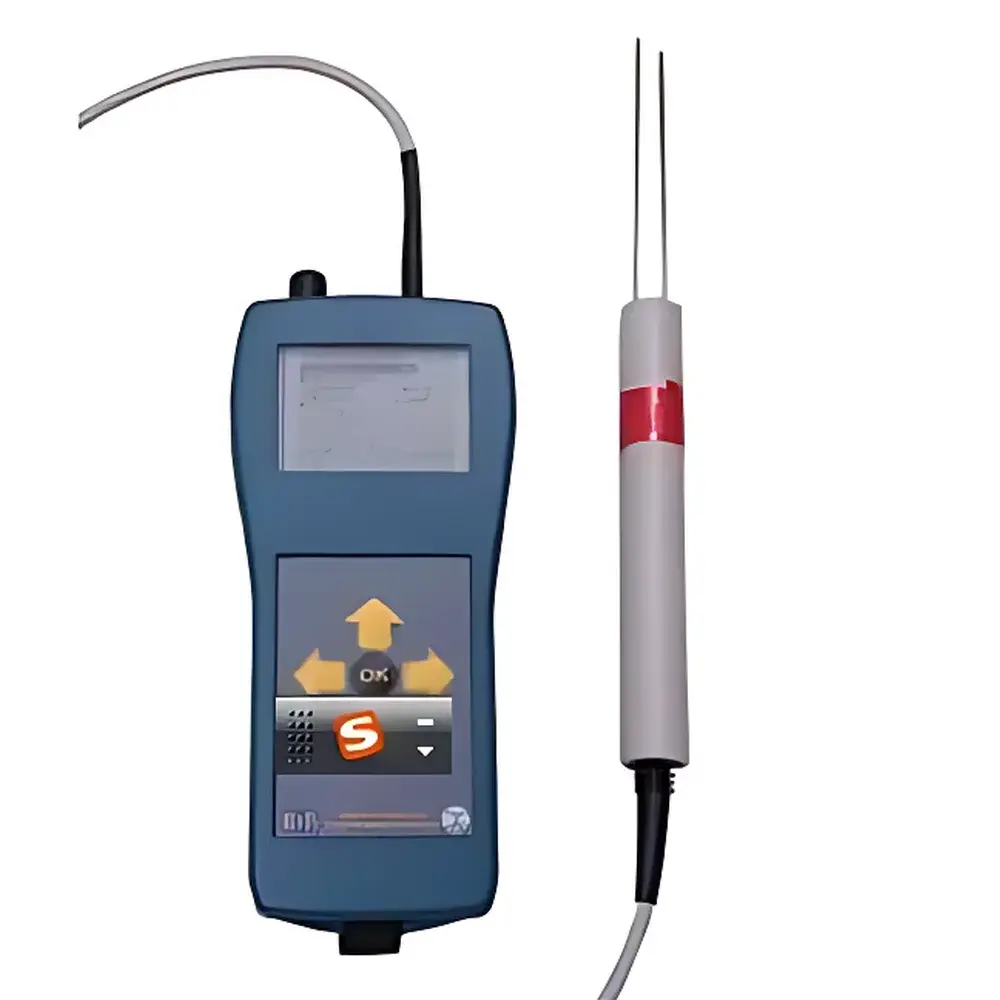
TDR Malicki Portable Soil Moisture, Temperature & Electrical Conductivity Analyzer
| Origin | Poland |
|---|---|
| Manufacturer Type | Authorized Distributor |
| Origin Category | Imported |
| Model | TDR Malicki |
| Instrument Type | Soil Moisture / Water Potential Analyzer |
| Moisture Range | 0–100% vol |
| Moisture Accuracy | ±2% of reading |
| Moisture Resolution | 0.1% vol |
| Temperature Range | −20 to +50 °C |
| Temperature Accuracy | < ±0.5 °C |
| Temperature Resolution | 0.1 °C |
| EC Range | 0.000–1 S/m |
| EC Accuracy | < ±10% |
| EC Resolution | 0.001 S/m |
| Measurement Time | < 20 s |
| Pulse Rise Time | 200 ps |
| Data Storage | 1,000 records |
| Display | 160 × 128 LCD |
| Interface | USB |
| Operating Temp. | 0–50 °C |
| Storage Temp. | −20–50 °C |
| Dimensions (H×W×D) | 180 × 85 × 58 mm |
| Weight (with battery) | 0.35 kg |
| Battery | Rechargeable Li-ion with overcharge protection |
| Probe Type | 2-pin |
| Probe Length | 100 mm (field-shortenable to 50 mm, with accuracy degradation) |
| Cable Length | 6 m |
| Sensing Radius | ~5 cm |
| Optional GPS Module | 5 m positional accuracy |
Overview
The TDR Malicki Portable Soil Moisture, Temperature & Electrical Conductivity Analyzer is a field-deployable, microprocessor-controlled instrument engineered for in situ, real-time characterization of soil physical and electrochemical properties using Time-Domain Reflectometry (TDR). TDR operates on the principle that the propagation velocity and attenuation of a high-frequency electromagnetic pulse along a waveguide (e.g., parallel metal rods inserted into soil) are directly correlated with the soil’s apparent dielectric permittivity (εa), which—under controlled calibration conditions—serves as a robust proxy for volumetric water content (θv). Simultaneously, the integrated thermistor and four-electrode conductivity circuit enable concurrent measurement of soil temperature and bulk electrical conductivity (EC), facilitating salinity assessment and temperature compensation of dielectric readings. Designed for environmental monitoring, agronomic research, hydrological modeling, and land restoration projects, this analyzer adheres to the foundational calibration framework established by Malicki et al. (Eur. J. Soil Sci., 64, 1996), enabling traceable conversion from εa to θv across diverse soil textures and organic matter contents.
Key Features
- Integrated triple-parameter sensing: simultaneous acquisition of volumetric water content, soil temperature, and bulk electrical conductivity using a single 2-pin probe assembly.
- Onboard 160 × 128 graphical LCD display supporting real-time visualization of TDR waveform traces—including incident pulse, reflection peak, and signal decay—enabling immediate verification of probe-soil contact quality and cable integrity.
- Field-configurable output modes: direct readout of either calibrated volumetric water content (% vol) or raw apparent dielectric permittivity (unitless εa), per user-defined calibration parameters.
- Low-power architecture powered by a rechargeable lithium-ion battery with built-in overcharge protection; operational autonomy exceeds 12 hours under typical intermittent measurement cycles.
- Compact, ruggedized handheld unit (180 × 85 × 58 mm; 0.35 kg) optimized for extended field use, with IP54-rated enclosure for dust and splash resistance.
- Probe flexibility: supports both portable spot measurements and long-term buried deployment; standard probe length is 100 mm (optionally shortened to 50 mm for shallow-root-zone profiling, with documented reduction in measurement fidelity).
Sample Compatibility & Compliance
The TDR Malicki analyzer is validated for use across mineral soils, loams, sandy clays, and organic-rich topsoils, provided probe installation achieves consistent mechanical coupling without air gaps. Its 5 cm effective sensing radius ensures representative sampling within the probe’s vicinity, minimizing edge effects in heterogeneous profiles. While not certified to ISO/IEC 17025 for accredited testing laboratories, the instrument conforms to fundamental metrological principles outlined in ASTM D5778 (Standard Test Method for Determining the Dielectric Constant of Soils Using Time Domain Reflectometry) and supports data traceability required under GLP-compliant environmental monitoring protocols. Calibration stability is maintained across the full operating temperature range (−20 to +50 °C), with automatic temperature compensation applied to both dielectric and conductivity calculations.
Software & Data Management
Data acquisition and post-processing are supported via native USB interface, enabling direct transfer of timestamped records—including θv, T, EC, εa, and raw waveform metadata—to Windows-based desktop software (provided with device). Each record contains measurement time, probe ID, ambient temperature, and diagnostic flags (e.g., low signal-to-noise ratio, impedance mismatch). The embedded 1,000-record memory buffer permits unattended logging in remote locations; data export formats include CSV and XML for integration with GIS platforms, LIMS systems, or statistical analysis tools such as R or Python pandas. Optional GPS module (5 m CEP accuracy) appends georeferenced coordinates to each measurement, supporting spatial interpolation and digital soil mapping workflows.
Applications
- Irrigation scheduling and precision agriculture: quantifying root-zone moisture deficits and salinity stress thresholds to optimize water use efficiency.
- Soil hydrology studies: validating infiltration models, estimating unsaturated hydraulic conductivity, and monitoring wetting front progression.
- Landfill and contaminated site monitoring: tracking leachate migration through vadose zone via anomalous EC and moisture anomalies.
- Climatic flux networks: contributing to eddy covariance or lysimeter-based evapotranspiration budgets through high-temporal-resolution soil water storage estimates.
- Ecosystem restoration: assessing re-vegetation success by correlating moisture retention capacity with plant-available water and microbial activity indicators.
FAQ
What calibration method does the TDR Malicki use?
It implements the empirical dielectric mixing model published by Malicki et al. (1996), which relates apparent permittivity to volumetric water content while accounting for soil texture and bulk density effects. Users may apply default factory calibrations or input site-specific coefficients.
Can the probe be permanently installed for continuous monitoring?
Yes—the 2-pin probe is compatible with permanent burial at depths up to 1 m, provided the 6 m shielded cable is routed to a weatherproof junction box and connected to a datalogger or the handheld unit in periodic retrieval mode.
Does the instrument compensate for temperature effects on EC and permittivity readings?
Yes—temperature is measured in situ at the probe tip and used dynamically to correct both electrical conductivity (using linear temperature coefficient) and dielectric permittivity (via temperature-dependent polarization relaxation models).
Is the waveform trace exportable for advanced signal analysis?
Yes—raw TDR waveform data (voltage vs. time, 100 ps resolution) can be exported via USB for offline analysis in MATLAB, Python, or specialized TDR processing software to extract additional parameters such as reflection coefficient or characteristic impedance.
What is the minimum recommended soil bulk density for reliable measurements?
The instrument performs reliably across bulk densities from 1.0 to 1.8 g/cm³; below 1.0 g/cm³ (e.g., highly organic peats), dielectric calibration requires empirical adjustment due to elevated bound-water contributions to εa.
Related Products







