
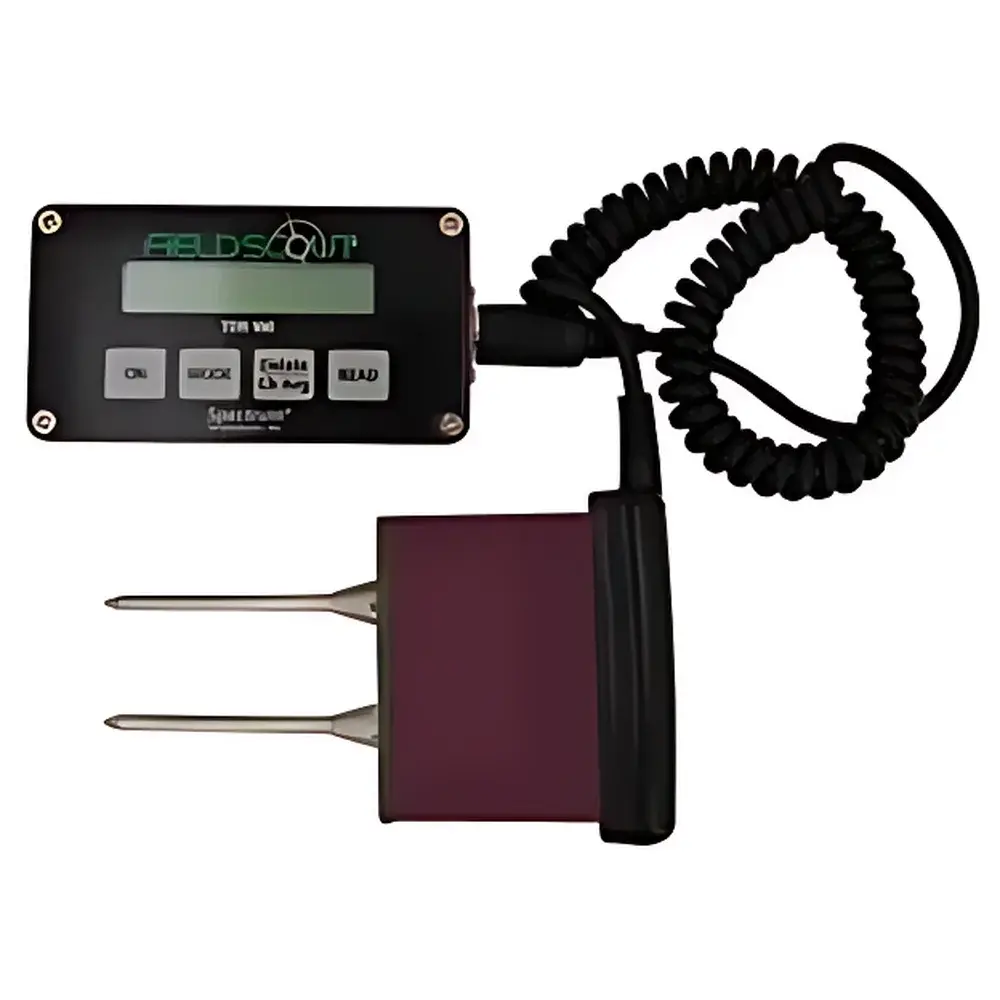
Spectrum TDR100 Portable Time-Domain Reflectometry Soil Moisture Analyzer
| Origin | USA |
|---|---|
| Manufacturer Type | Authorized Distributor |
| Origin Category | Imported |
| Model | TDR100 |
| Instrument Type | Volumetric Water Content (VWC) and Relative Water Content (RWC) Analyzer |
| Measurement Principle | Time-Domain Reflectometry (TDR) |
| Range | 0–Saturation (v/v) |
| Accuracy | ±3.0% (for EC < 2 dS/m and clay content < 30%) |
| Resolution | 1.0% |
| Probe Length Options | 3.8 cm, 7.5 cm, 12 cm, 20 cm |
| Power Source | Replaceable AA batteries (typical operational life: ~12 months) |
| Data Storage | None (real-time readout only) |
| Communication Interface | RS-232 serial port |
Overview
The Spectrum TDR100 Portable Time-Domain Reflectometry Soil Moisture Analyzer is a field-deployable, microprocessor-controlled instrument engineered for rapid, non-destructive quantification of volumetric water content (VWC) in mineral soils. It operates on the fundamental principle of time-domain reflectometry (TDR), wherein a fast-rise electromagnetic pulse is transmitted along parallel stainless-steel waveguide rods embedded in the soil matrix. The travel time of the reflected signal is directly correlated to the dielectric permittivity of the surrounding medium—primarily governed by water content—enabling robust, physics-based estimation of VWC without calibration dependency on soil texture under defined salinity and clay constraints. Designed for agronomic, hydrological, and ecological field studies, the TDR100 delivers repeatable measurements across heterogeneous soil profiles when used with standardized probe configurations and proper insertion technique.
Key Features
- True TDR-based measurement architecture—no capacitance or frequency-domain approximation—ensuring high reproducibility in controlled and semi-controlled field environments.
- Four interchangeable stainless-steel probe lengths (3.8 cm, 7.5 cm, 12 cm, and 20 cm) enabling depth-resolved sampling from surface crusts to root-zone profiling, with minimal disturbance during insertion.
- Integrated real-time display showing both volumetric water content (VWC, % v/v) and relative water content (RWC, % of field capacity) simultaneously—supporting immediate interpretation without post-processing.
- RS-232 serial interface compliant with industry-standard voltage levels and timing protocols, allowing direct connection to data loggers (e.g., Campbell Scientific CR1000X), PCs, or custom acquisition systems for automated survey workflows.
- Ruggedized housing rated for IP65 environmental protection, with operating temperature range of –20 °C to +50 °C, suitable for year-round deployment across temperate and arid climates.
- Low-power design powered by standard AA alkaline batteries; typical field duty cycle yields ≥12 months of intermittent operation without battery replacement under normal usage conditions.
Sample Compatibility & Compliance
The TDR100 is validated for use in mineral soils with electrical conductivity (EC) below 2 dS/m and clay content less than 30% by mass—conditions commonly met in agricultural topsoils, sandy loams, and silty substrates. Accuracy degrades predictably outside this envelope due to ionic conduction effects on pulse propagation velocity and dispersion; users are advised to perform site-specific empirical calibration where high-salinity or high-clay conditions prevail. While not certified to ISO/IEC 17025 or ASTM D5084, the instrument adheres to core metrological principles outlined in ASTM D6923 (Standard Test Method for Determining the Dielectric Constant of Soils Using TDR) and supports data collection practices aligned with FAO-recommended soil moisture monitoring frameworks. Its design meets general requirements for field-portable instrumentation referenced in USDA-NRCS Technical Note No. 27 and EU Joint Research Centre’s Soil Monitoring Protocols.
Software & Data Management
The TDR100 functions as a stand-alone measurement terminal with no internal memory or onboard logging capability. All readings are displayed in real time and may be captured externally via its RS-232 interface using third-party terminal emulation software (e.g., PuTTY, Tera Term) or integrated into larger environmental monitoring networks via programmable data loggers. Output format is ASCII-encoded, including timestamp (when provided by host system), probe ID, VWC (%), RWC (%), and diagnostic flags. For regulatory traceability, users deploying the device in GLP or GMP-aligned research must implement external audit trails—such as timestamped CSV exports with operator ID and location metadata—to satisfy documentation requirements under 21 CFR Part 11 if electronic records are generated.
Applications
- Irrigation scheduling and precision agriculture decision support systems.
- Soil water balance modeling and evapotranspiration (ET) estimation in watershed-scale hydrology.
- Long-term ecological research plots requiring consistent, low-maintenance VWC time series.
- Calibration and validation of remote sensing-derived soil moisture products (e.g., SMAP, Sentinel-1).
- Educational field labs in soil physics, environmental science, and agronomy curricula.
- Post-construction soil moisture verification in civil engineering and land reclamation projects.
FAQ
Does the TDR100 require factory calibration before first use?
No—each unit is pre-calibrated at the manufacturer against NIST-traceable reference standards. However, users should verify performance annually using known-dielectric test media (e.g., distilled water, dry sand) per the operator manual.
Can the TDR100 measure frozen soil moisture?
No. TDR signal propagation is significantly attenuated in ice-phase matrices; measurements are valid only for unfrozen, liquid-dominated pore water conditions.
Is probe insertion depth critical for accuracy?
Yes. Probes must be fully inserted to their rated length and surrounded by undisturbed soil contact. Air gaps or bent rods introduce systematic error exceeding ±5% VWC.
What maintenance is required between field deployments?
Clean probe rods with isopropyl alcohol after each use to remove soil residues and salts; inspect for corrosion or mechanical damage. Store in dry, ambient conditions with batteries removed if idle >30 days.
Related Products







