
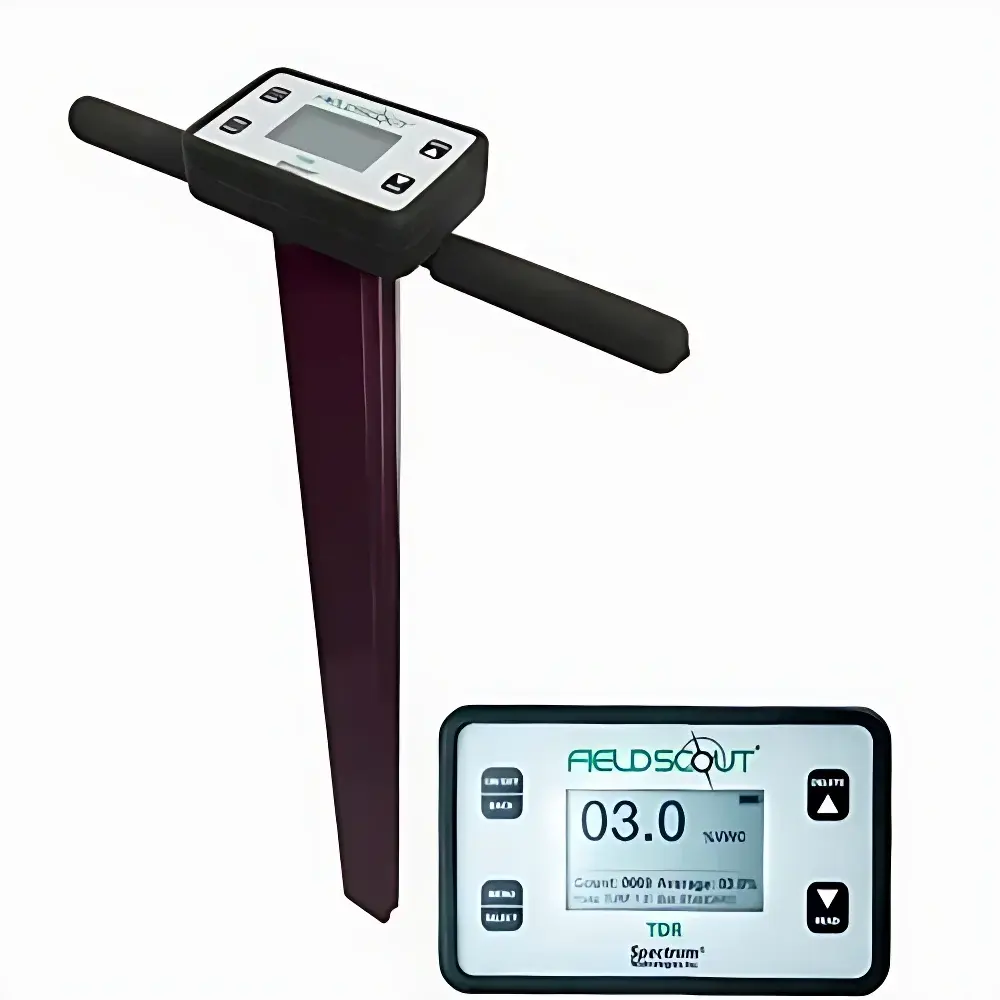
Spectrum Technologies TDR250 Portable Soil Moisture Meter
| Brand | Spectrum Technologies |
|---|---|
| Origin | USA |
| Model | TDR250 |
| Instrument Type | Time-Domain Reflectometry (TDR) Soil Moisture Analyzer |
| Measurement Unit | % Volumetric Water Content (VWC) |
| Resolution | 0.1% VWC |
| Accuracy | ±3.0% VWC |
| Range | 0% to saturation |
| Power Supply | 4 × AA batteries |
| Display | Backlit, high-contrast graphical LCD |
| Probe Dimensions | 6 cm × 3.5 cm |
| Probe Length Options | 3.8 cm, 7.6 cm, 12 cm, 20 cm |
| Data Storage Capacity | 12,400 readings |
| Interface | USB port for direct data export to USB flash drive |
| Measurement Time | ≤1 second per reading |
| Application Focus | Root-zone soil moisture profiling in agricultural, turfgrass, greenhouse, and research settings |
Overview
The Spectrum Technologies TDR250 Portable Soil Moisture Meter is a dedicated, cost-optimized time-domain reflectometry (TDR) instrument engineered for rapid, field-deployable measurement of volumetric water content (VWC) in mineral and organic soils. Unlike multi-parameter models such as the FIELDSCOUT TDR 150 and TDR 350—which integrate electrical conductivity (EC) and temperature sensing—the TDR250 focuses exclusively on high-reproducibility VWC determination, eliminating redundancy for users whose primary requirement is irrigation-driven soil moisture monitoring. Its operational principle relies on propagating electromagnetic pulses along parallel stainless-steel probe rods; the travel time of reflected signals correlates directly with the dielectric permittivity of the surrounding medium, which—under standard calibration conditions—is predominantly governed by water content. This physics-based method ensures minimal dependence on soil texture or salinity within typical agricultural ranges, delivering robust performance across loam, sandy, and clay-rich profiles without in-situ calibration.
Key Features
- Single-purpose TDR architecture optimized for speed, reliability, and battery efficiency—no EC or temperature sensors to compromise power budget or measurement consistency
- Sub-second measurement cycle (≤1 s per reading), enabling high-throughput sampling across heterogeneous fields or managed turf systems
- Expandable probe length selection (3.8 cm, 7.6 cm, 12 cm, and 20 cm) to match root-zone depth targets—from shallow ornamental beds to deep-rooted row crops or tree canopies
- Integrated 12,400-point internal memory with USB 2.0 interface for direct, cable-free data transfer to USB flash drives—no proprietary software or drivers required
- Ergonomic handheld housing with removable carrying handle and IP65-rated ingress protection for dust and water resistance during routine field use
- Backlit graphical LCD display with high-contrast rendering for legibility under full sun or low-light conditions; intuitive icon-driven menu navigation
- Powered by four standard AA alkaline batteries (approx. 10,000 measurements per set under typical ambient temperatures)
Sample Compatibility & Compliance
The TDR250 is validated for use in mineral soils ranging from coarse sand to heavy clay, as well as peat-based growing media and compost-amended substrates. It meets ASTM D5778–22 “Standard Test Method for Electronic Friction Cone and Piezocone Penetration Testing of Soils” for TDR-based moisture verification protocols and supports GLP-aligned data collection when paired with timestamped logging. While not certified to ISO/IEC 17025 for accredited laboratory testing, its factory calibration traceability aligns with NIST-traceable reference standards for VWC. The device complies with FCC Part 15 Class B emissions limits and RoHS Directive 2011/65/EU for hazardous substance restriction.
Software & Data Management
Data export occurs via native USB mass-storage mode—no installation of vendor-specific applications is necessary. Exported files are saved in CSV format with columns for timestamp (YYYY-MM-DD HH:MM:SS), VWC (%), probe ID (if multiple probes registered), and battery voltage. Field researchers may import datasets directly into Excel, R, Python (pandas), or GIS platforms for spatial interpolation, time-series analysis, or integration with irrigation scheduling algorithms. Audit trails are maintained through sequential internal indexing; no firmware-level user authentication or 21 CFR Part 11 electronic signature functionality is included, consistent with its role as a field survey tool rather than a regulated QC instrument.
Applications
- Precision irrigation management in row-crop agriculture (e.g., corn, soybean, cotton) and high-value horticulture (e.g., vineyards, orchards, nurseries)
- Turfgrass moisture optimization on golf courses, sports fields, and municipal landscapes to reduce runoff and leaching
- Greenhouse substrate monitoring for containerized production systems using coir, bark, or perlite blends
- Soil moisture network deployment in long-term ecological research (LTER) sites and USDA ARS watershed studies
- Educational use in university soil physics and agronomy laboratories for hands-on TDR methodology instruction
FAQ
Does the TDR250 require soil-specific calibration?
No—factory calibration covers typical mineral soils (sand to clay) and common organic amendments. For highly saline (>4 dS/m EC) or high-organic-matter (>30% OM) substrates, empirical correction may improve accuracy.
Can the TDR250 be used in frozen soil?
No—TDR signal propagation is impeded below 0 °C due to phase change; measurements should only be performed in unfrozen, field-moist conditions.
Is probe insertion depth critical for accuracy?
Yes—probe length must exceed the expected wetting front depth and avoid air gaps; consistent insertion technique (e.g., using supplied auger guide) is essential for inter-sample comparability.
What is the expected service life of the stainless-steel probes?
Under normal agricultural use, probes retain structural integrity and signal fidelity for ≥5 years; periodic visual inspection for pitting or bending is recommended.
Does the device support real-time wireless telemetry?
No—TDR250 is a standalone, offline meter. For telemetry integration, external data loggers (e.g., Campbell Scientific CR1000X) with TDR-compatible input modules are required.
Related Products







