
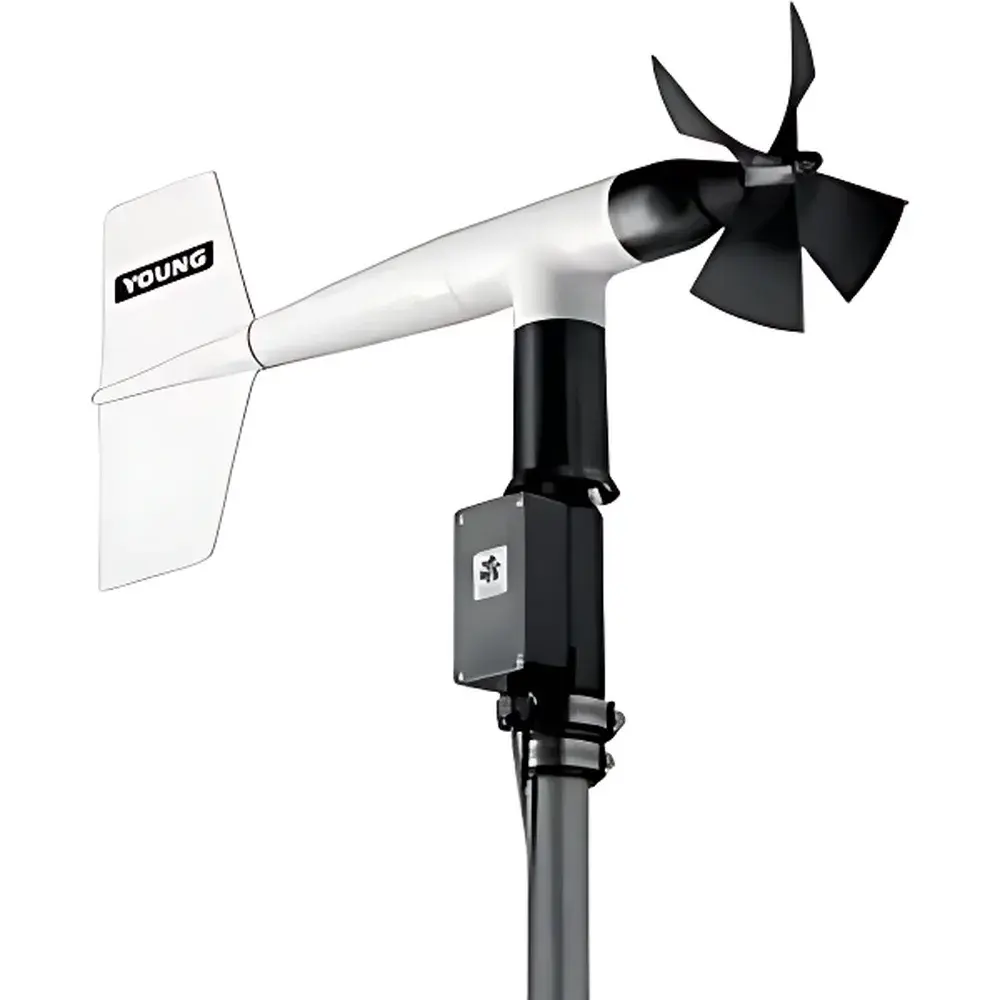
RW 804-1005 Precision Digital Anemometer & Wind Vane Sensor System
| Origin | USA |
|---|---|
| Manufacturer Type | Authorized Distributor |
| Origin Category | Imported |
| Model | 804-1005 |
| Output Options | RS232 digital interface |
| Optional analog outputs | 4–20 mA or 0–1 V |
| Wind Speed Range | 0–68 m/s |
| Wind Speed Accuracy | ±3% of reading |
| Wind Direction Range | 0–360° |
| Wind Direction Accuracy | ±3° |
| Data Logging Capacity | Up to 8 years (non-volatile memory) |
| Sampling Interval | Programmable from 1 to 60 minutes |
| Power Supply | Rechargeable battery pack (solar charging option available) |
| Software | PC-based data visualization and time-series analysis suite |
Overview
The RW 804-1005 Precision Digital Anemometer & Wind Vane Sensor System is an industrial-grade, dual-parameter environmental monitoring instrument engineered for long-term, unattended operation in demanding outdoor and structural monitoring applications. Based on robust mechanical cup-and-vane sensing principles—compliant with IEC 61000-4 electromagnetic immunity standards and designed to withstand prolonged UV exposure—the system delivers traceable wind speed and direction measurements under dynamic atmospheric conditions. Its core architecture integrates a calibrated three-cup anemometer for rotational velocity conversion and a precision potentiometric wind vane with sealed bearing assembly, ensuring mechanical stability across temperature gradients from –30 °C to +70 °C. Unlike ultrasonic or thermal anemometers, this mechanical design eliminates sensitivity to precipitation, dust accumulation, and acoustic interference—making it particularly suitable for infrastructure health monitoring where signal continuity and physical durability are critical.
Key Features
- Dual-sensor fusion architecture: Simultaneous acquisition of wind speed (0–68 m/s) and wind direction (0–360°) with independent calibration certificates traceable to NIST standards.
- High-capacity non-volatile data logger: Stores up to 8 years of timestamped measurements at user-defined intervals (1–60 minutes), retaining integrity during power interruption or extended deployment cycles.
- Flexible output configuration: Standard RS232 serial interface for direct PC connection; optional analog outputs (4–20 mA or 0–1 V) compatible with SCADA, PLC, and building management systems.
- Field-deployable power architecture: Integrated rechargeable battery system with low-power sleep mode; solar panel integration kit available for remote, off-grid installations.
- Real-time parameter display: On-device LCD shows instantaneous wind speed, wind direction, 10-minute moving averages, and gust peak detection—enabling rapid field verification without external hardware.
- Compliance-ready firmware: Supports audit-trail logging and time-stamped metadata (UTC synchronization via optional GPS module), aligning with GLP/GMP documentation requirements for environmental validation studies.
Sample Compatibility & Compliance
The RW 804-1005 is certified for continuous outdoor operation per IP65 ingress protection rating and meets ASTM D5096-18 (Standard Practice for Calibration of Anemometers) for field-deployed wind instrumentation. It complies with EN 61326-1:2013 for electromagnetic compatibility in industrial environments and carries CE marking for conformity with EU environmental monitoring directives. The sensor housing is constructed from UV-stabilized acrylonitrile butadiene styrene (ABS) and marine-grade stainless steel fasteners, ensuring corrosion resistance in coastal, port, and industrial zones. No sample preparation or consumables are required—measurements are performed directly on ambient airflow without flow conditioning or inlet filtering.
Software & Data Management
The included Windows-compatible software provides secure, encrypted local data retrieval via USB-to-RS232 adapter or direct serial connection. Users can configure logging parameters, export CSV/Excel-formatted datasets with ISO 8601 timestamps, and generate time-series plots—including overlaid wind rose diagrams, vector-averaged directional histograms, and gust factor analysis. All data files include embedded metadata (sensor ID, firmware version, calibration date, sampling interval), supporting 21 CFR Part 11-compliant electronic recordkeeping when deployed with password-protected user roles and change logs. Raw binary logs are also accessible for third-party integration into MATLAB, Python (pandas), or custom IoT platforms via documented ASCII protocol.
Applications
- Bridges & tall structures: Structural wind load assessment and fatigue monitoring per AASHTO LRFD Bridge Design Specifications.
- Airports & helipads: Real-time crosswind component calculation for aviation safety compliance (ICAO Annex 3).
- Ports & offshore terminals: Stack emission dispersion modeling input and crane operation wind restriction enforcement.
- Renewable energy sites: Pre-construction wind resource assessment and turbine wake characterization.
- Forestry & wildfire management: Spot fire behavior prediction using near-ground wind vector trends.
- Urban canopy studies: Microclimate mapping in smart city infrastructure projects requiring spatially distributed, synchronized sensor networks.
FAQ
What is the recommended recalibration interval for the RW 804-1005?
Annual calibration is advised for applications requiring ISO/IEC 17025 traceability; biennial verification suffices for routine environmental surveillance where ±3% uncertainty remains acceptable.
Can the data logger be accessed remotely?
No built-in cellular or Ethernet connectivity is provided; however, the RS232 output supports integration with third-party telemetry gateways (e.g., LTE-enabled RTUs) for cloud-based data ingestion.
Is the sensor compatible with existing weather station networks?
Yes—its RS232 ASCII protocol and analog outputs conform to WMO observational coding standards and integrate seamlessly with Campbell Scientific CR series, Vaisala WXT530, and Davis Vantage Pro2 ecosystems.
Does the system support NTP or GPS time synchronization?
GPS time sync is available as an add-on module (part #804-GPS); NTP is not supported due to lack of onboard Ethernet/Wi-Fi interface.
How is measurement uncertainty quantified across the full wind speed range?
Uncertainty is specified as ±3% of reading per ISO 17025-accredited calibration report, validated at 5, 15, and 45 m/s reference points using NIST-traceable wind tunnel facilities.
Related Products







