
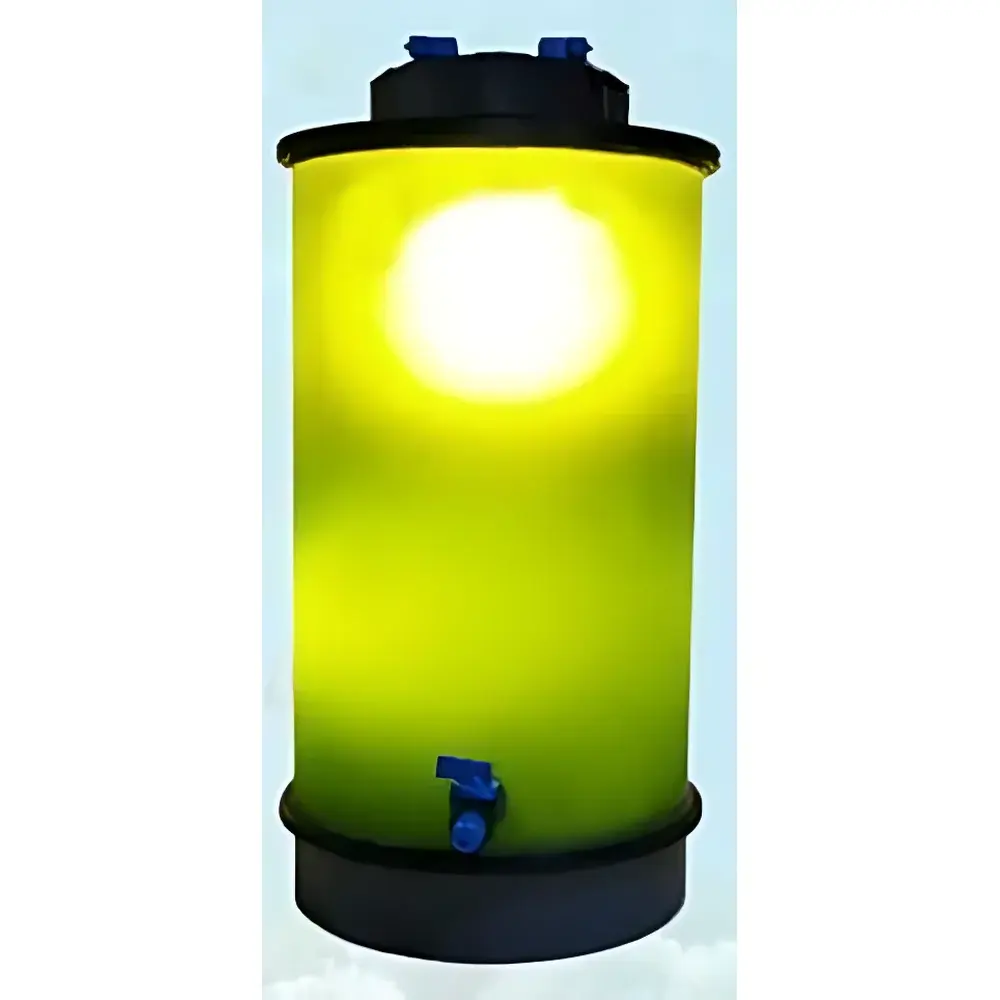
PB200 Algal Cultivation System for Research Laboratories
| Origin | Germany |
|---|---|
| Manufacturer Type | Authorized Distributor |
| Origin Category | Imported |
| Model | PB200 |
| Pricing | Upon Request |
| Volume | 12 L |
| Inner Diameter | 200 mm |
| Height | 520 mm |
| Controller Dimensions | 220 mm × 80 mm × 70 mm |
| Input Voltage/Power | 85–250 VAC / 5 W |
Overview
The PB200 Algal Cultivation System for Research Laboratories is a purpose-engineered, benchtop photobioreactor platform designed to support reproducible, controlled cultivation of unicellular and colonial microalgae—including Chlamydomonas, Dunaliella, Scenedesmus, and Phaeodactylum—under defined photoautotrophic or mixotrophic conditions. Built upon a robust glass vessel architecture with precise geometric dimensions (200 mm inner diameter × 520 mm height), the system implements continuous culture principles via daily 30% medium exchange—a protocol aligned with steady-state growth modeling in physiological and biotechnological studies. Its core operational principle integrates regulated photon flux delivery (via integrated LED lighting), gas-phase mass transfer control (via calibrated air/oxygen sparging), and magnetic stirring-induced hydrodynamic homogeneity to minimize shear stress while ensuring uniform nutrient distribution and CO2 dissolution. Designed and manufactured in Germany, the PB200 meets stringent European engineering standards for laboratory-scale bioreactor reliability and long-term operational stability.
Key Features
- Optically transparent borosilicate glass cultivation vessel (12 L working volume) enabling real-time visual monitoring and compatibility with spectrophotometric biomass assessment (e.g., OD750).
- Integrated high-efficiency LED illumination unit with adjustable spectral output (default 620–700 nm peak range) and programmable on/off cycles to simulate diurnal light regimes or test photoperiod-dependent phenotypes.
- Threaded, leak-resistant top cap design facilitating rapid, tool-free access for sampling, inoculation, or sensor insertion without compromising sterility.
- Low-shear magnetic stirrer (external drive, sealed coupling) maintaining laminar-to-moderate turbulent flow (Re ≈ 2,000–5,000) suitable for delicate phytoplankton strains.
- Dedicated PB200 Cultivation Controller: compact embedded unit (220 × 80 × 70 mm) providing synchronized timing logic for lighting, peristaltic nutrient dosing (optional add-on), and air pump activation; operates on universal AC input (85–250 VAC) with minimal power draw (5 W typical).
- Modular pneumatic interface supporting connection to external CO2 regulators or gas mixing manifolds for carbon enrichment experiments.
Sample Compatibility & Compliance
The PB200 supports cultivation of freshwater, marine, and halotolerant algal isolates across diverse taxonomic groups. Its inert glass surface and non-leaching components ensure chemical compatibility with standard f/2, BG-11, and ASN-III media formulations. The system conforms to DIN EN ISO 9001-certified manufacturing practices at its German production site. While not a GMP-grade device, its controller firmware incorporates timestamped event logging (light activation, pump cycles), supporting GLP-aligned experimental documentation. All electrical components comply with CE marking requirements (EMC Directive 2014/30/EU and Low Voltage Directive 2014/35/EU). No biological safety certification (e.g., NSF/ANSI 49) is claimed, as the system is intended for non-pathogenic research organisms only.
Software & Data Management
The PB200 operates in standalone mode without proprietary software dependency. All scheduling parameters (light duration, pump intervals) are configured via intuitive rotary encoder and LCD interface on the controller unit. Event logs—including cumulative runtime, number of illumination cycles, and total pump actuations—are retained in non-volatile memory for post-experiment audit. For integration into automated lab environments, the controller provides TTL-level trigger outputs (open-collector) compatible with third-party data acquisition systems (e.g., LabVIEW, Python-based DAQ scripts) to log environmental timestamps alongside parallel measurements (pH, dissolved O2, temperature via optional sensors). Audit trails meet minimum requirements for traceability under ISO/IEC 17025 Clause 7.7 (result reporting) when used in accredited testing laboratories.
Applications
- Physiological studies of photosynthetic efficiency, nutrient limitation responses (N/P/Si), and photoinhibition thresholds.
- Strain selection and acclimation trials for biofuel feedstock development (e.g., lipid induction under nitrogen starvation).
- Toxicity screening of nanomaterials or emerging contaminants using algal growth inhibition assays (OECD 201 compliance achievable with standardized protocols).
- Production of high-value metabolites (astaxanthin, EPA, phycocyanin) under controlled stress regimens.
- Education and training in microbial physiology, bioreactor engineering, and sustainable biotechnology principles.
FAQ
Is the PB200 suitable for axenic cultures?
Yes—when operated with sterile filtration of inlet gases and aseptic handling protocols, the sealed vessel and autoclavable glass components support maintenance of axenic algal cultures.
Can I integrate external pH or dissolved oxygen probes?
The system includes a dedicated 12-mm port with silicone gasket; users may install commercially available sterilizable probes (e.g., Hamilton, Mettler Toledo) with appropriate signal conditioning.
Does the controller support remote monitoring or Ethernet connectivity?
No—the PB200 controller is intentionally designed as a local, low-complexity timing module. Remote functionality requires interfacing via its TTL trigger outputs to external IoT or DAQ hardware.
What maintenance is required for long-term operation?
Annual inspection of O-rings, verification of stir bar magnet integrity, and periodic recalibration of external gas flow meters (if used) are recommended. Glass vessel cleaning follows standard alkaline detergent protocols.
Is custom lighting spectrum configuration available?
Standard units ship with red-blue dominant LEDs optimized for chlorophyll absorption; OEM spectral reconfiguration (e.g., white + far-red) is available under separate engineering agreement with the German manufacturer.



