
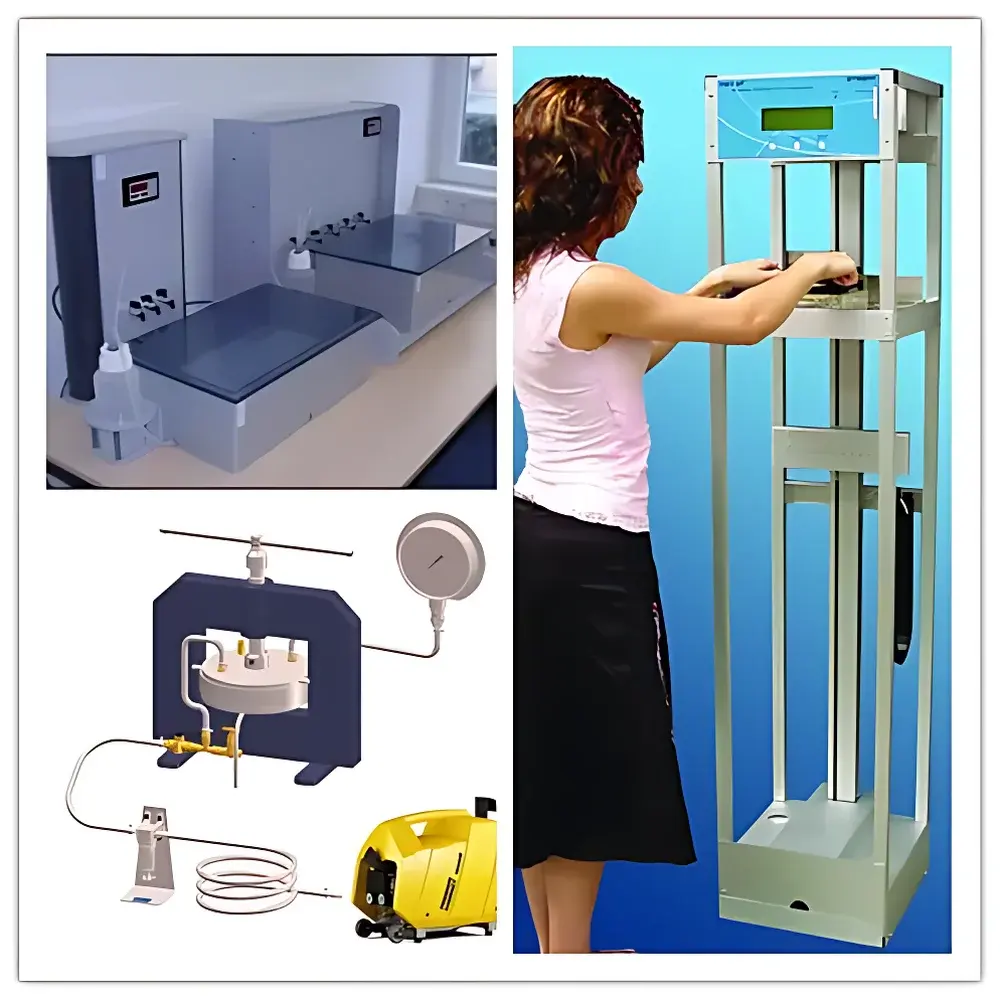
AZ-pF Soil Hydraulic Parameter Measurement Kit
| Brand | AZ (Beijing Aozuo) |
|---|---|
| Origin | Beijing, China (System Components Sourced from Germany) |
| Manufacturer Type | Direct Manufacturer |
| Instrument Category | Multi-Function Soil Hydraulic Analyzer |
| Model | AZ-pF |
| Measurement Principles | Pressure Plate Method (pF Curve), Tensiometric Method (Unsaturated Hydraulic Conductivity), Constant/Variable Head Permeametry (Saturated Hydraulic Conductivity) |
| Sample Ring Dimensions | Ø53 mm (up to 40 units), Ø60 mm (up to 30 units) |
| Pressure Control Range | 0–1000 hPa (vacuum), with 50-step programmable gradient resolution (1 mm water column increment per step) |
| Water Volume Resolution | 0.1 mL |
| Wet-Dry Cycles | 1–4 programmable cycles |
| Saturated Hydraulic Conductivity (Ksat) Unit | Column height 100 cm, reservoir volume 1 L, pressure sensor accuracy ±15 psi, constant-head and falling-head modes supported |
| Unsaturated Hydraulic Conductivity Unit | Matric potential range 0–850 cm H₂O (pF 0–2.93), measurement accuracy ±0.3 kPa, mass resolution 0.01 g |
| Data Logger | LCD interface, 2000-sample internal storage, sampling interval 1–100 s, default 1 s |
| Measurement Chamber Diameters | Ø16 cm and Ø24 cm |
| Tensiometer Range | –25 to +25 cm H₂O |
| Software | Windows-based visualization platform with automated Ksat calculation, real-time curve plotting (θ–h, K(h), C(h)), raw data export (CSV), GLP-compliant metadata tagging |
Overview
The AZ-pF Soil Hydraulic Parameter Measurement Kit is an integrated laboratory and field-deployable system engineered for the precise determination of fundamental soil hydraulic functions: the soil water retention curve (SWRC), the unsaturated hydraulic conductivity function K(ψ), and the saturated hydraulic conductivity (Ksat). It implements three physically distinct, standards-aligned methodologies—pressure plate extraction (ISO 11274, ASTM D422), tensiometric outflow (ISO 11276), and constant/falling-head permeametry (ASTM D5084)—within a single modular architecture. Unlike empirical estimation tools or single-point sensors, the AZ-pF delivers full functional relationships required for numerical modeling in hydrological simulation (e.g., HYDRUS, STANMOD), vadose zone transport analysis, irrigation scheduling, and land-use impact assessment. Its dual-chamber design (Ø16 cm and Ø24 cm) accommodates both disturbed and undisturbed core samples, preserving structural integrity critical for representative K(ψ) characterization.
Key Features
- Triple-mode hydraulic characterization: simultaneous support for pressure plate (pF curve), tensiometric (unsaturated K), and permeametric (saturated K) measurements within one unified hardware platform.
- High-resolution vacuum control: microprocessor-driven pressure regulation with 50 programmable steps, each adjustable in 1 mm H₂O increments (equivalent to ~0.1 hPa), enabling fine-grained SWRC discretization across pF 1.0–4.0.
- Dual-diameter sample chambers (Ø16 cm and Ø24 cm) compatible with standard soil core rings (Ø53 mm and Ø60 mm); up to 40 and 30 samples respectively per batch.
- Integrated high-precision tensiometry: calibrated ceramic cup sensors covering matric potential range 0–850 cm H₂O (pF 0–2.93) with ±0.3 kPa accuracy and 0.01 g mass resolution for gravimetric outflow monitoring.
- Modular Ksat unit featuring 100 cm measurement column, 1 L reservoir, ±15 psi pressure transducer, and selectable constant-head or falling-head operation per ASTM D5084.
- Onboard data logger with LCD interface, capable of storing 2000 timestamped records; sampling interval configurable from 1 s to 100 s, supporting transient flux capture during rapid drainage events.
Sample Compatibility & Compliance
The AZ-pF accepts intact and repacked soil cores across texture classes—from coarse sands to heavy clays—without requiring sample pulverization. The Ø53 mm and Ø60 mm ring configurations comply with ISO 25177 and DIN 18127 for standardized soil core handling. All pressure and tensiometric measurements adhere to traceable calibration protocols aligned with ISO/IEC 17025 requirements. The system supports GLP documentation workflows: each measurement session auto-generates metadata including operator ID, ambient temperature, sample ID, equilibration time, and instrument serial number. Exported CSV files include column headers compliant with FAO’s Harmonized World Soil Database (HWSD) input specifications.
Software & Data Management
The included Windows-based software provides real-time visualization of θ–h (water content vs. matric potential), K–h (hydraulic conductivity vs. matric potential), and C–h (capacitance vs. matric potential) curves. Algorithms implement van Genuchten–Mualem parameter fitting (θs, θr, α, n, Ks) with residual sum-of-squares minimization and confidence interval reporting. Ksat calculations follow Darcy’s law with automatic correction for temperature-dependent water viscosity (using ASTM D1141 reference tables). Raw data exports include audit-trail timestamps, sensor diagnostics flags, and user-annotated notes—fully compatible with FDA 21 CFR Part 11–compliant electronic lab notebook (ELN) integration when deployed in regulated environmental testing labs.
Applications
- Calibration and validation of vadose zone models (HYDRUS-1D/2D, RSWMS, SWAP) used in groundwater recharge forecasting and contaminant leaching risk assessment.
- Soil hydraulic database development for national soil surveys (e.g., USDA NRCS SSURGO, European LUCAS Topsoil Survey).
- Evaluation of biochar, polymer amendments, or tillage effects on soil hydraulic architecture under controlled wet-dry cycling (1–4 cycles programmable).
- Regulatory compliance testing for landfill cover design (EPA 40 CFR Part 258), mine reclamation plans, and agricultural nutrient management plans (NMPs).
- Research on root-zone water availability, plant available water capacity (PAWC), and drought resilience indices in crop physiology studies.
FAQ
What standards does the AZ-pF comply with for soil hydraulic testing?
The system implements test protocols aligned with ISO 11274 (water retention), ISO 11276 (unsaturated conductivity), and ASTM D5084 (saturated conductivity), with traceable calibration against NIST-traceable pressure and mass standards.
Can the AZ-pF measure structured soils without disturbing pore geometry?
Yes—the Ø24 cm chamber accommodates large undisturbed monoliths (up to 20 cm height), and the tensiometric unit operates directly on in situ or minimally handled cores to preserve macroporosity and aggregate stability.
Is the software compatible with LIMS or ELN systems?
Raw data exports as UTF-8 CSV with ISO 8601 timestamps and embedded metadata fields; schema documentation provided for seamless ingestion into LabVantage, Thermo Fisher SampleManager, or custom LIMS via API or flat-file import.
How is temperature compensation handled during Ksat calculation?
The software applies dynamic viscosity correction using water density and viscosity values interpolated from ASTM D1141 at the logged ambient temperature, ensuring Ksat values are reported at 20 °C unless otherwise specified.
Does the system support remote monitoring or networked operation?
The current version features USB and RS-232 connectivity; optional Ethernet-to-serial gateway modules enable TCP/IP access for centralized data aggregation in multi-station field labs.
Related Products







