
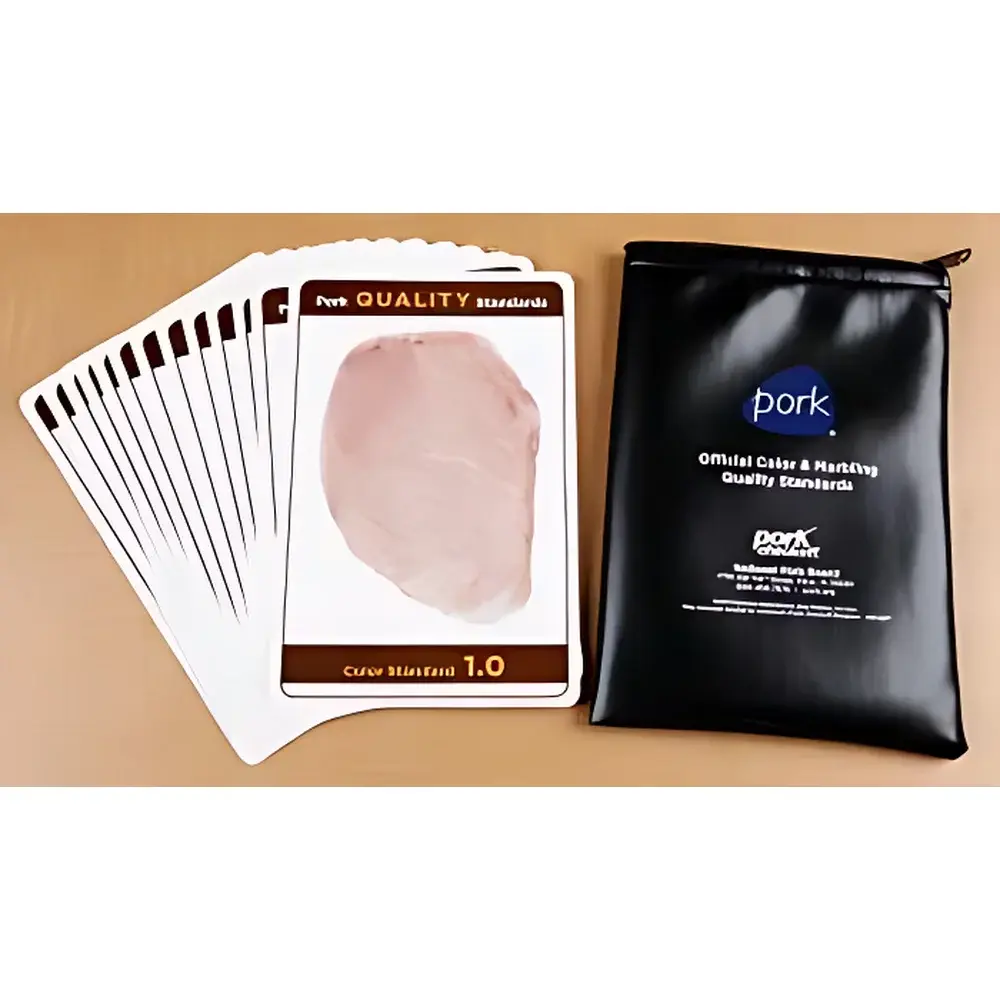
NPPC Pork Color and Marbling Standard Reference Chart
| Origin | USA |
|---|---|
| Manufacturer Type | Authorized Distributor |
| Origin Category | Imported |
| Model | NPPC |
| Pricing | Available Upon Request |
Overview
The NPPC Pork Color and Marbling Standard Reference Chart is a calibrated, industry-recognized visual assessment tool engineered for objective, repeatable evaluation of fresh pork quality attributes—specifically lean color and intramuscular fat (marbling) distribution. Developed in alignment with the National Pork Producers Council (NPPC) standardized grading protocols, this reference chart implements a dual-scale, empirically validated visual metric system grounded in decades of meat science research. Unlike subjective descriptive terminology, the NPPC chart translates qualitative sensory observations into quantifiable scores via side-by-side comparison against physically stable, spectrally consistent color and marbling standards. It operates on the principle of human visual perception under controlled illumination (D65 daylight simulant recommended), enabling rapid, non-destructive, operator-independent assessment without instrumentation. Its primary application domain spans commercial pork processing facilities, USDA-inspected slaughterhouses, university meat science laboratories, and third-party quality assurance auditors conducting routine or regulatory compliance evaluations.
Key Features
- Two independent, co-located rating scales: a 6-point lean color scale (1–6) and a 10-point marbling scale (1–10), both traceable to NPPC-established reference thresholds.
- Color scale calibrated to reflect myoglobin oxidation states: Score 1 = pale, grayish-white (indicative of PSE—pale, soft, exudative condition); Score 3 = bright cherry-red (optimal oxymyoglobin stability); Score 5 = dark, purplish-red (suggestive of DFD—dark, firm, dry condition); Score 6 = near-black (advanced metmyoglobin formation).
- Marbling scale quantifies visible intramuscular fat deposition across five macroscopic levels (1 = trace, 5 = excessive), with half-point interpolation (e.g., 3.5) permitted for enhanced resolution.
- Printed on archival-grade, UV-stabilized polypropylene substrate with fade-resistant pigments; maintains spectral fidelity under standard 2000–3000 lux lighting conditions for ≥5 years.
- Includes supplementary poster chart depicting standardized ham color, texture appearance, and purge (exudate) severity benchmarks—aligned with USDA-FSIS and ISO 20933:2020 guidelines for processed pork product evaluation.
Sample Compatibility & Compliance
The NPPC Reference Chart is designed exclusively for fresh, uncooked porcine longissimus dorsi (loin eye muscle) cross-sections, evaluated within 45–60 minutes post-exposure at 4°C ambient temperature. It is not validated for cooked, cured, frozen-thawed, or non-porcine species. The chart conforms to ASTM E308-23 (Standard Practice for Computing the Colors of Objects by Using the CIE System) for chromaticity consistency and supports GLP-compliant documentation when used with standardized observation protocols (e.g., ISO/IEC 17025:2017 Annex A.3). While not a regulatory instrument per se, it serves as an accepted reference in USDA-FSIS HACCP verification audits and is referenced in NPPC’s Pork Quality Assurance® Plus (PQA Plus®) training modules.
Software & Data Management
As a physical reference standard, the NPPC Chart requires no software integration or firmware. However, its scoring outputs are fully compatible with digital quality management systems (QMS) such as SGS QMS, SAP QM, or LabVantage LIMS when entered manually or via barcode-scanned worksheet templates. Score logs support audit-ready traceability—including observer ID, sample ID, date/time stamp, and environmental notes (e.g., lighting calibration certificate number). For electronic record retention, the chart’s use satisfies FDA 21 CFR Part 11 requirements when paired with validated electronic signature workflows and version-controlled score sheets.
Applications
- Real-time grading during harvest line inspection to segregate carcasses by color/marbling class for value-based marketing.
- Research studies correlating ante-mortem handling stressors (transport duration, lairage time) with post-mortem pH decline and color stability.
- Validation of packaging interventions (e.g., high-O₂ MAP, CO-modified atmospheres) on lean color retention kinetics.
- Training new QA technicians in standardized visual assessment methodology per NPPC certification curricula.
- Third-party audit preparation for Global Food Safety Initiative (GFSI)-benchmarked schemes including BRCGS Food Issue 9 and SQF Edition 9.
FAQ
Is the NPPC Chart suitable for beef or poultry evaluation?
No. It is scientifically validated only for fresh pork longissimus dorsi tissue. Beef uses the USDA Beef Color Scale (1–7), while poultry employs the USDA Poultry Color Guide.
Does the chart require recalibration or periodic replacement?
Yes. Users must replace charts every 24 months or immediately if physical damage, discoloration, or exposure to direct sunlight occurs. A calibration log must be maintained per ISO/IEC 17025 clause 6.4.10.
Can scores be converted to instrumental color values (e.g., CIELAB L*, a*, b*)?
Not directly. The chart provides ordinal categorical data. Correlation studies between NPPC scores and spectrophotometric measurements (e.g., Minolta CR-400) have been published in Meat Science (Vol. 145, 2018), but conversion requires lab-specific regression models.
What lighting conditions are required for valid scoring?
Assessment must occur under standardized D65 illuminant (CIE 15:2018), 2000–3000 lux intensity, with observer acuity verified annually per ANSI Z80.25.
Is training required to use the NPPC Chart accurately?
Yes. Inter-rater reliability (kappa ≥0.85) requires completion of NPPC-certified visual assessment training and biannual proficiency testing using blinded reference samples.





