
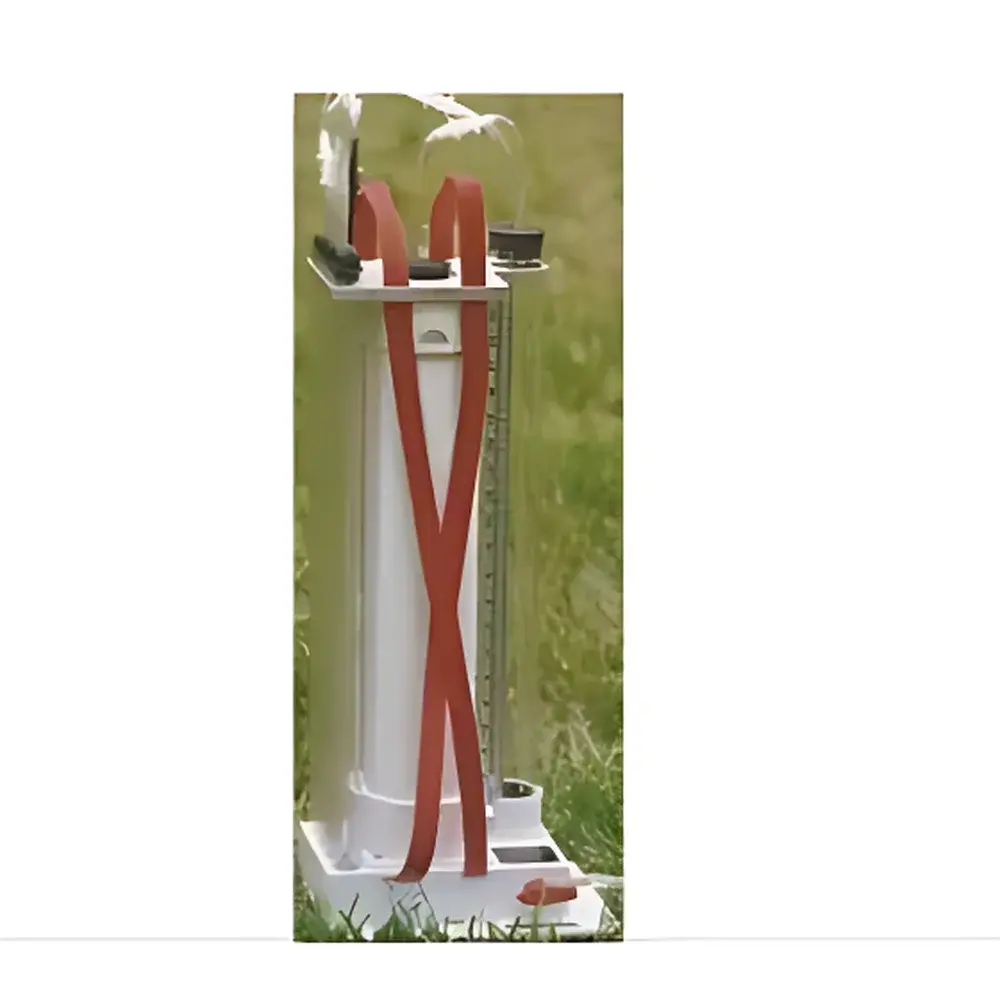
CHPP Ksat Soil Saturated Hydraulic Conductivity Measurement System
| Origin | USA |
|---|---|
| Manufacturer Type | Distributor |
| Origin Category | Imported |
| Model | CHPP |
| Instrument Type | Soil Moisture / Water Potential Analyzer |
| Ksat Range | 0.01–5000 cm/d |
| Ceramic Plate Ksat | 20,000 cm/d |
| Measurement Accuracy | ±2% |
| Pressure Sensor Accuracy | ±1 Pa |
| Temperature Sensor Accuracy | ±0.2 °C |
| Sample Volume | 250 mL |
| Ring Sampler Dimensions | 50 mm height × 80 mm inner diameter |
Overview
The CHPP Ksat Soil Saturated Hydraulic Conductivity Measurement System is a precision laboratory instrument engineered for the quantitative determination of saturated hydraulic conductivity (Ksat) in undisturbed soil cores. Based on Darcy’s Law, the system applies a controlled hydraulic gradient across a fully water-saturated soil column and measures volumetric flow rate under steady-state conditions. This principle enables direct, traceable quantification of Ksat—a fundamental hydrodynamic parameter governing water infiltration, drainage efficiency, solute transport, and vadose zone modeling. Designed for rigorous environmental and agricultural research, the CHPP system supports reproducible characterization of soils ranging from fine clays to coarse sands, with a validated measurement range spanning 0.01 to 5000 cm/d. Its operation eliminates evaporative loss through sealed percolation chambers and incorporates real-time temperature compensation to correct viscosity-driven variations in water flux—ensuring metrological integrity across seasonal or climatic laboratory conditions.
Key Features
- Automated Ksat calculation with integrated temperature compensation (±0.2 °C sensor resolution) to normalize dynamic viscosity effects in Darcy-based computation
- High-fidelity pressure control using calibrated transducers (±1 Pa accuracy) enabling stable hydraulic gradients across low-permeability samples
- Dual-ceramic plate configuration: top and bottom plates rated at 20,000 cm/d, ensuring negligible resistance relative to soil matrix and minimizing boundary layer artifacts
- Standardized ring sampler compatibility (50 mm height × 80 mm internal diameter; 250 mL sample volume), aligned with ASTM D5084 and ISO 27201 protocols for saturated permeability testing
- Sealed percolation assembly with zero-evaporation design—critical for long-duration tests on low-Ksat soils (e.g., clays, compacted subsoils)
- Repeatability <3% RSD across replicate measurements on homogenous cores, verified per GLP-compliant validation procedures
Sample Compatibility & Compliance
The CHPP system accommodates intact soil monoliths collected via standard stainless-steel ring samplers, preserving natural pore structure and fabric anisotropy. It is compatible with mineral soils (sand, silt, clay), organic-mineral mixes (e.g., peat-amended loams), and anthropogenically modified profiles (e.g., biochar-amended or compacted layers). All fluid-contact components are chemically inert (316 stainless steel, borosilicate glass, PTFE seals), preventing ion exchange or surface adsorption that could bias flow kinetics. The system conforms to core regulatory frameworks for environmental data generation: test procedures align with ASTM D5084 (Standard Test Method for Measurement of Saturated Hydraulic Conductivity), ISO 27201 (Soil Quality — Determination of Saturated Hydraulic Conductivity), and USDA-NRCS Soil Survey Laboratory Methods Manual Chapter 5. Data acquisition meets audit-trail requirements for GLP and GMP environments when paired with compliant software (see Software & Data Management).
Software & Data Management
Instrument control and data reduction are managed via dedicated PC-based software supporting both manual protocol setup and preconfigured test sequences (e.g., constant-head, falling-head, or step-gradient modes). Raw sensor outputs—including differential pressure, cumulative effluent volume, and ambient temperature—are timestamped at 1 Hz resolution and stored in CSV/Excel-compatible formats. The software implements automated Ksat computation per Darcy’s equation: Ksat = (Q × L) / (A × Δh × t), where Q is outflow volume, L is sample length, A is cross-sectional area, Δh is hydraulic head difference, and t is elapsed time. Audit logs record operator ID, calibration dates, sensor drift corrections, and version-controlled firmware metadata—fully compliant with FDA 21 CFR Part 11 requirements when deployed with electronic signature modules and role-based access controls.
Applications
- Quantifying infiltration capacity for irrigation scheduling, drainage design, and flood risk assessment in agricultural and urban watersheds
- Evaluating compaction effects on root-zone aeration and leaching potential in turfgrass, orchard, and row-crop systems
- Validating pedotransfer functions (PTFs) used in regional hydrologic models (e.g., SWAT, HYDRUS-1D)
- Assessing contaminant mobility in landfill liner evaluation, remediation site characterization, and vadose zone transport studies
- Supporting soil health monitoring programs by tracking Ksat trends under conservation tillage, cover cropping, or organic amendment regimes
FAQ
What sample preparation is required prior to Ksat measurement?
Soil cores must be carefully extracted using sharpened ring samplers to minimize disturbance, saturated via capillary rise (not vacuum saturation) to preserve macroporosity, and equilibrated at target temperature for ≥24 h prior to testing.
Can the CHPP system measure unsaturated hydraulic conductivity?
No—it is specifically configured for saturated-state measurements only. Unsaturated K(h) characterization requires complementary instrumentation such as evaporation or centrifuge methods.
Is ceramic plate replacement necessary after repeated use?
Ceramic plates are rated for >500 cycles under standard operating conditions; however, periodic verification against distilled water flux is recommended every 100 tests to confirm nominal permeability retention.
Does the system support multi-sample sequential testing?
Yes—optional multi-port manifolds enable up to four independent columns to be tested in parallel under identical hydraulic conditions, improving throughput for comparative studies.
How is calibration traceability maintained?
Pressure sensors are factory-calibrated against NIST-traceable deadweight testers; temperature probes are certified per ISO/IEC 17025; volumetric collection is verified using Class A glassware calibrated to ISO 4787 standards.







