
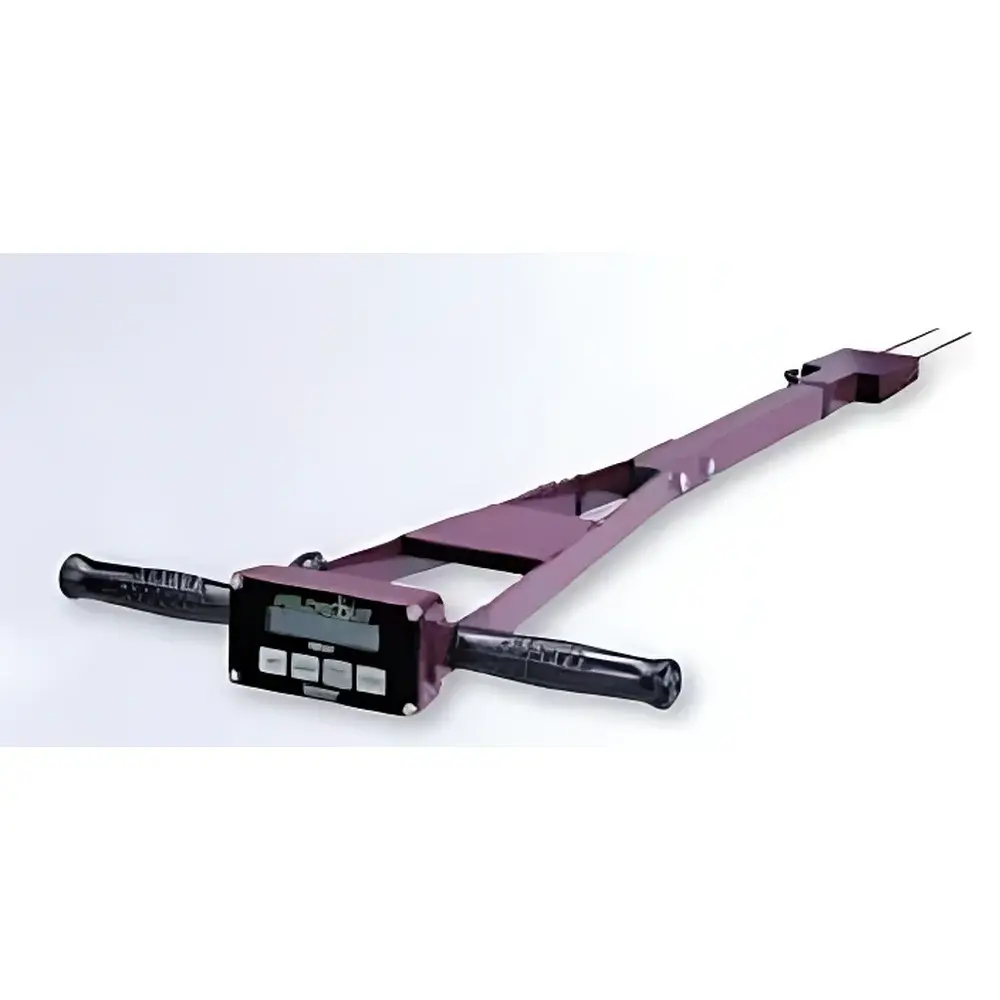
TDR300 Portable Time-Domain Reflectometry Soil Moisture Analyzer
| Origin | USA |
|---|---|
| Manufacturer Type | Authorized Distributor |
| Origin Category | Imported Instrument |
| Model | TDR300 |
| Price Range | USD 1,400–2,800 (FOB) |
| Instrument Type | Volumetric Water Content (VWC) and Relative Water Content (RWC) Analyzer |
Overview
The TDR300 Portable Time-Domain Reflectometry Soil Moisture Analyzer is a field-deployable, high-reliability instrument engineered for rapid, non-destructive quantification of volumetric water content (VWC) in mineral soils. It operates on the physical principle of time-domain reflectometry (TDR), wherein a precisely timed electromagnetic pulse is transmitted along parallel stainless-steel waveguide rods embedded in soil; the propagation velocity and reflection characteristics of the pulse are directly correlated to the dielectric permittivity of the surrounding medium—primarily governed by water content. This physics-based measurement eliminates reliance on empirical calibrations for most mineral soils and ensures robust performance across variable textures, provided bulk electrical conductivity remains below 2 dS/m and clay content does not exceed 30% by mass. Designed for repeated field use under ambient environmental conditions, the TDR300 delivers consistent, traceable readings without requiring soil extraction or laboratory processing.
Key Features
- True portable architecture: integrated handheld readout unit with ergonomic grip, weighing only 1.36 kg (3.0 lb), enabling extended survey operations without fatigue.
- Modular probe system: four standardized probe lengths available (3.8 cm, 7.5 cm, 12 cm, and 20 cm) to support depth-resolved profiling from surface horizons to root-zone layers.
- High-fidelity TDR electronics: digital signal sampling at ≥1 GHz resolution ensures accurate determination of pulse travel time and reflection coefficient.
- Dual-parameter output: simultaneous real-time calculation of both volumetric water content (VWC, % v/v) and relative water content (RWC, % of field capacity), supporting irrigation scheduling and drought stress assessment.
- Long-duration power management: powered by four standard AAA alkaline cells with estimated operational life exceeding 12 months under typical usage (≤200 measurements/day).
- Onboard data storage: internal memory retains up to 2,700 measurement records; GPS-enabled logging reduces capacity to 1,250 entries to accommodate geotagged metadata.
Sample Compatibility & Compliance
The TDR300 is validated for use in mineral soils ranging from sandy loam to silty clay, with optimal accuracy achieved when bulk electrical conductivity (ECb) remains below 2 dS/m and clay fraction is ≤30%. It is not recommended for highly saline soils (>4 dS/m), organic substrates (e.g., peat, compost), or saturated clays exhibiting strong polarization effects. The instrument conforms to ASTM D5778–22 (“Standard Test Method for Determining the In-Situ Pulse Velocity and Attenuation of P-Waves Using the Seismic Refraction Method”) for signal integrity verification and supports GLP-compliant data collection workflows through timestamped, non-erasable record storage. Probe geometry (rod diameter: 5 mm; inter-rod spacing: 33 mm; probe cross-section: 10.41 cm × 7.11 cm × 1.78 cm) complies with ISO 11274:2021 recommendations for TDR probe dimensional consistency.
Software & Data Management
The TDR300 is supported by proprietary PC-based software compatible with Windows 10/11, offering bilingual interface (English and Chinese) for global deployment. The software enables bidirectional RS-232 communication for firmware updates, configuration parameter adjustment (e.g., averaging cycles, calibration offsets), and batch download of stored datasets. All exported files include UTC timestamps, GPS coordinates (if enabled), probe ID, temperature-compensated VWC/RWC values, and raw waveform metadata. Audit-trail functionality logs user-initiated actions—including file export, parameter changes, and memory reset—with immutable timestamps, satisfying basic requirements for FDA 21 CFR Part 11–aligned documentation in regulated agronomic research settings.
Applications
- Field-scale irrigation scheduling and water-use efficiency optimization in precision agriculture.
- Soil hydrological monitoring for watershed modeling, infiltration studies, and vadose zone characterization.
- Ecological research on plant–soil water relations, including drought response phenotyping and root-zone moisture dynamics.
- Environmental site assessment for landfill cover performance, remediation monitoring, and erosion control validation.
- Educational use in soil physics, hydrology, and environmental science curricula requiring hands-on TDR methodology training.
FAQ
What soil types are compatible with the TDR300?
The TDR300 is calibrated for mineral soils with clay content ≤30% and bulk EC < 2 dS/m. Performance degrades in organic media, highly saline soils, or frozen ground.
Can the TDR300 measure soil water potential or matric suction?
No. The TDR300 measures dielectric permittivity-derived volumetric water content only. Water potential requires separate tensiometric or thermocouple psychrometric instrumentation.
Is the device suitable for long-term unattended monitoring?
It is designed for manual spot measurements. For continuous monitoring, consider fixed-installation TDR systems with dataloggers and solar power.
Does the software support automated report generation?
Yes—customizable templates allow export of CSV, Excel, and PDF reports with configurable metadata fields, statistical summaries, and spatial visualization overlays.
How is measurement reproducibility verified?
Users may perform in-field verification using reference standards (e.g., gravimetric moisture samples) or conduct repeat measurements at identical locations to assess intra-operator repeatability (typical CV < 2.5%).
Related Products







