
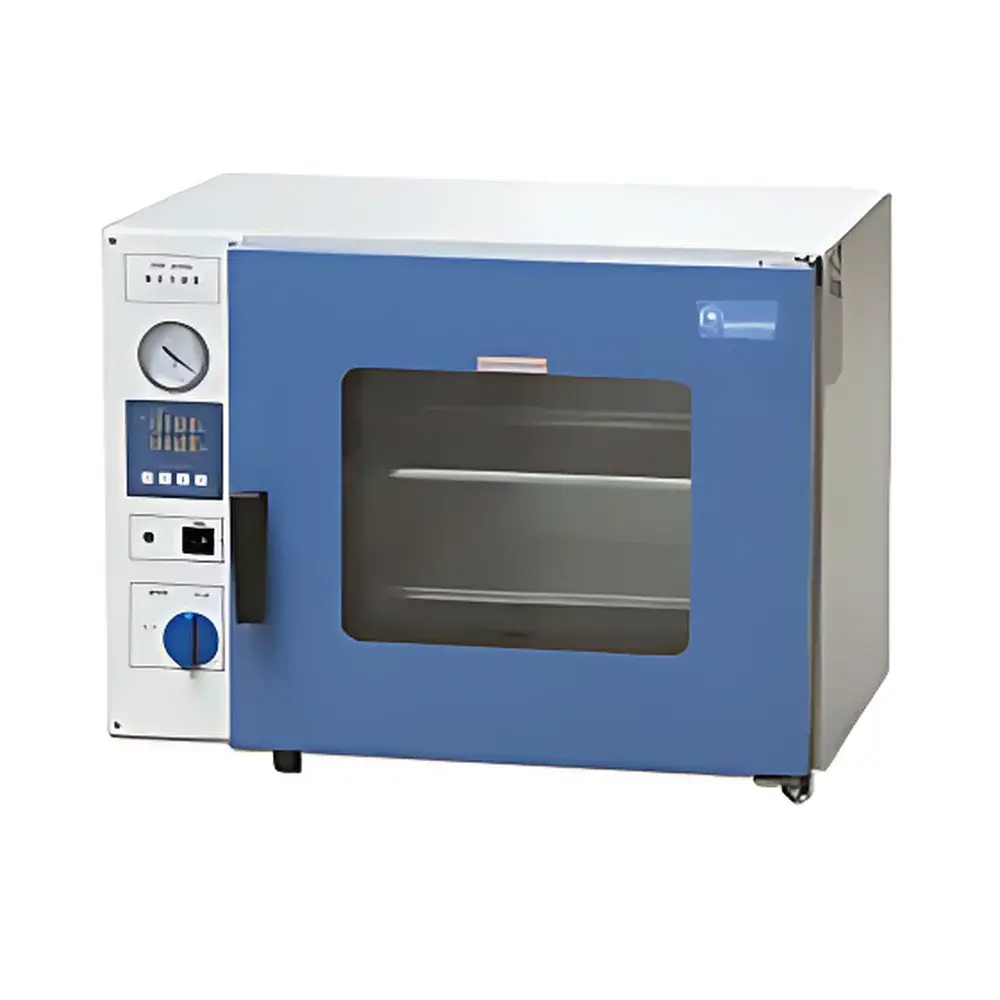
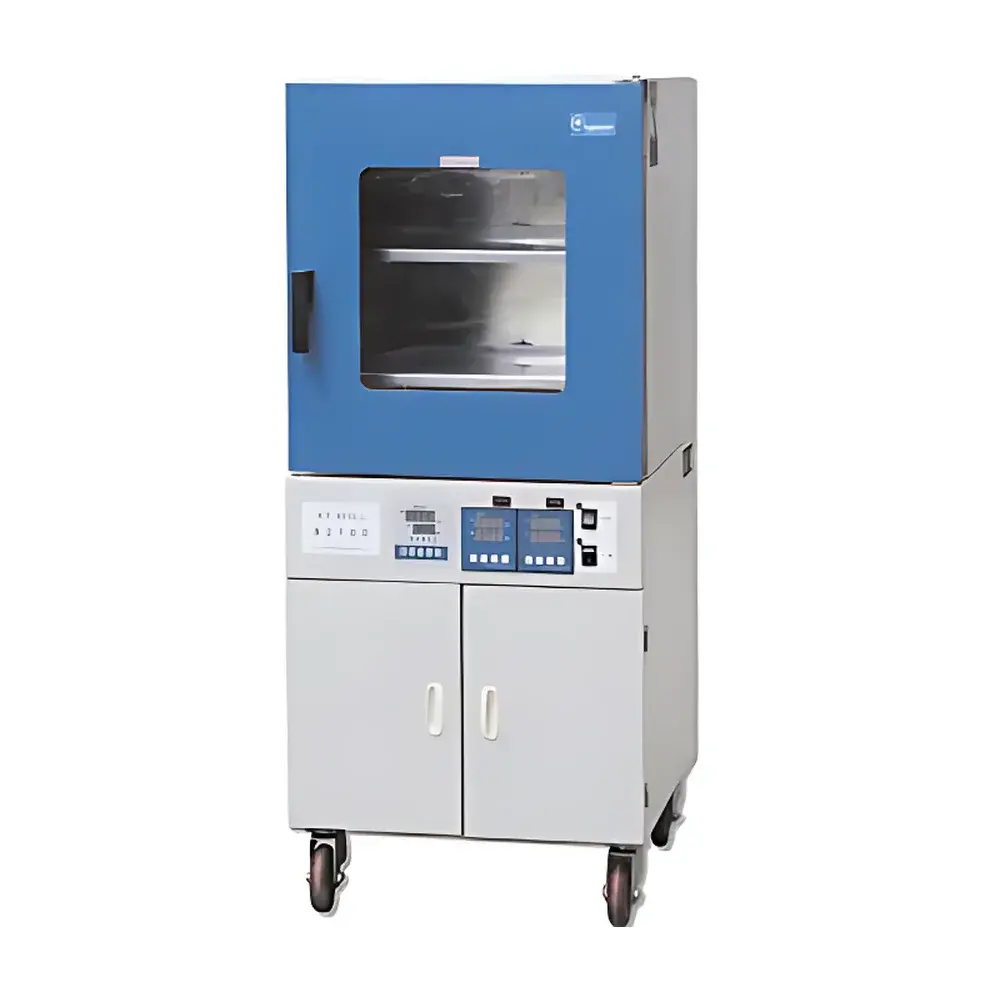
Heilongjiang HEP Vacuum Drying Oven DZF-6050
| Brand | Jihepu (Jinan HEP) |
|---|---|
| Origin | Shandong, China |
| Model | DZF-6050 |
| Instrument Type | Vacuum Drying Oven |
| Temperature Range | RT+10 °C to 250 °C |
| Temperature Uniformity | ±1 °C |
| Interior Dimensions (W×D×H) | 415 mm × 370 mm × 345 mm |
| Exterior Dimensions (W×D×H) | 730 mm × 560 mm × 550 mm |
| Interior Material | Stainless Steel (AISI 304 equivalent) or Galvanized Steel |
| Heating Method | Forced-Air Convection with Adjustable Airflow |
| Vacuum Level | ≤133 Pa (absolute) |
| Power Supply | 220 V, 50 Hz |
| Input Power | 1450 W |
| Timer Range | 1–9999 minutes |
| Shelf Capacity | 2 removable stainless steel shelves |
| Control System | Digital Microcomputer Controller with 10-Stage Programmable Logic (D-series), Optional Vacuum Display Module (LC-series) |
Overview
The Jihepu DZF-6050 Vacuum Drying Oven is an engineered solution for thermal processing under reduced pressure, designed specifically for applications requiring moisture removal from heat-sensitive, oxidation-prone, or chemically unstable materials. Operating on the principle of vacuum-assisted evaporation—where lowered ambient pressure reduces the boiling point of solvents and water—the DZF-6050 enables gentle, uniform drying at temperatures significantly below atmospheric boiling thresholds. This physical principle ensures minimal thermal degradation of active pharmaceutical ingredients (APIs), polymer precursors, biological extracts, and electronic component coatings. Unlike standard convection ovens, the DZF-6050 integrates a sealed chamber with a high-efficiency forced-air heating system, allowing precise thermal distribution while maintaining stable vacuum integrity. Its operational envelope (RT+10 °C to 250 °C, ±1 °C stability) supports both low-temperature desiccation and elevated-temperature outgassing protocols common in QC laboratories and pilot-scale manufacturing environments.
Key Features
- Microprocessor-based digital temperature controller with 0.1 °C resolution and programmable 10-segment ramp-soak profiles—enabling reproducible multi-stage drying sequences compliant with ASTM E145 and ISO 18877 standards.
- Double-layer tempered glass observation door with reinforced silicone gasket seal, rated for continuous operation at ≤133 Pa absolute pressure; visual monitoring without vacuum breakage.
- Stainless steel (AISI 304-grade equivalent) interior chamber—electropolished finish optional—resistant to corrosion from organic solvents, weak acids, and alkaline residues encountered in pharmaceutical and fine chemical workflows.
- Adjustable door-tightening mechanism and compression-molded silicone door seal ensure long-term vacuum retention and eliminate leakage-induced process drift.
- Forced-air convection system with rear-mounted fan and baffle-guided airflow—optimized for uniform temperature distribution across the full working volume (±1.5 °C max deviation, per IEC 60068-2-2 verification protocol).
- Integrated timer with 1–9999 minute range and auto-shutdown function—supports unattended overnight drying cycles under GLP-compliant documentation practices.
Sample Compatibility & Compliance
The DZF-6050 accommodates heterogeneous sample types including lyophilized intermediates, solvent-cast thin films, catalyst powders, herbal extract pastes, and PCB substrates coated with moisture-sensitive adhesives. Its inert atmosphere capability—via optional nitrogen or argon purge ports—permits controlled drying of oxygen-labile compounds such as metal-organic frameworks (MOFs) or perovskite precursors. The unit meets mechanical safety requirements per IEC 61010-1 and electromagnetic compatibility per EN 61326-1. While not certified to UL or CSA standards out-of-box, its design aligns with FDA 21 CFR Part 11 data integrity expectations when paired with validated external logging systems. Vacuum performance is verified per ISO 2859-1 sampling plans using calibrated Pirani gauges traceable to NIST standards.
Software & Data Management
The DZF-6050 operates via embedded firmware without proprietary software dependency. All setpoints, run logs, and alarm events are stored locally in non-volatile memory with timestamping (YYYY-MM-DD HH:MM format). Optional RS-485 interface (Modbus RTU protocol) enables integration into centralized lab automation platforms for remote parameter adjustment and real-time vacuum/temperature telemetry. For audit-ready operations, users may connect third-party data loggers compliant with 21 CFR Part 11—supporting electronic signatures, audit trails, and user-access-level configuration (e.g., operator vs. administrator privileges). Firmware updates are performed via USB port using signed binary files, preserving cryptographic integrity during field maintenance.
Applications
- Pharmaceutical: Residual solvent removal from granules prior to tablet compression; moisture content validation per USP <921>; stability testing of hygroscopic APIs under accelerated conditions.
- Electronics: Degassing of conformal coatings and encapsulants; pre-bake of printed circuit boards to prevent popcorning during reflow soldering.
- Materials Science: Activation of zeolites and silica gels; thermal conditioning of battery electrode slurries before calendaring.
- Academic Research: Solvent exchange in aerogel synthesis; dehydration of hydrogels without structural collapse; preparation of anhydrous metal salt precursors.
- Chemical Manufacturing: Final drying of specialty catalysts; purification of organometallic complexes sensitive to hydrolysis.
FAQ
Does the DZF-6050 include a built-in vacuum pump?
No—the DZF-6050 requires an externally connected vacuum pump (e.g., dual-stage rotary vane or diaphragm type) to achieve ≤133 Pa. Pump selection must match chamber volume and outgassing rate; recommended pumping speed ≥1.5 L/s for optimal evacuation time.
Can the oven be operated under inert gas purge?
Yes—two 6-mm BSP threaded ports (inlet and outlet) are provided for continuous nitrogen or argon flow control, enabling oxygen-free drying environments critical for pyrophoric or redox-sensitive materials.
What is the maximum load weight per shelf?
Each stainless steel shelf is rated for 15 kg distributed load; total chamber capacity is limited by thermal mass—exceeding 8 kg of dense material may extend stabilization time beyond specification.
Is calibration documentation available?
Factory calibration certificates (temperature uniformity, vacuum sensor accuracy) are supplied with each unit; optional IQ/OQ protocols and traceable NIST-calibrated probe kits are available upon request.
How is thermal recovery managed after door opening?
The microcontroller implements adaptive PID tuning that compensates for thermal lag; full recovery to setpoint (±1 °C) typically occurs within 8–12 minutes following brief (<15 s) door access under steady-state vacuum.



