
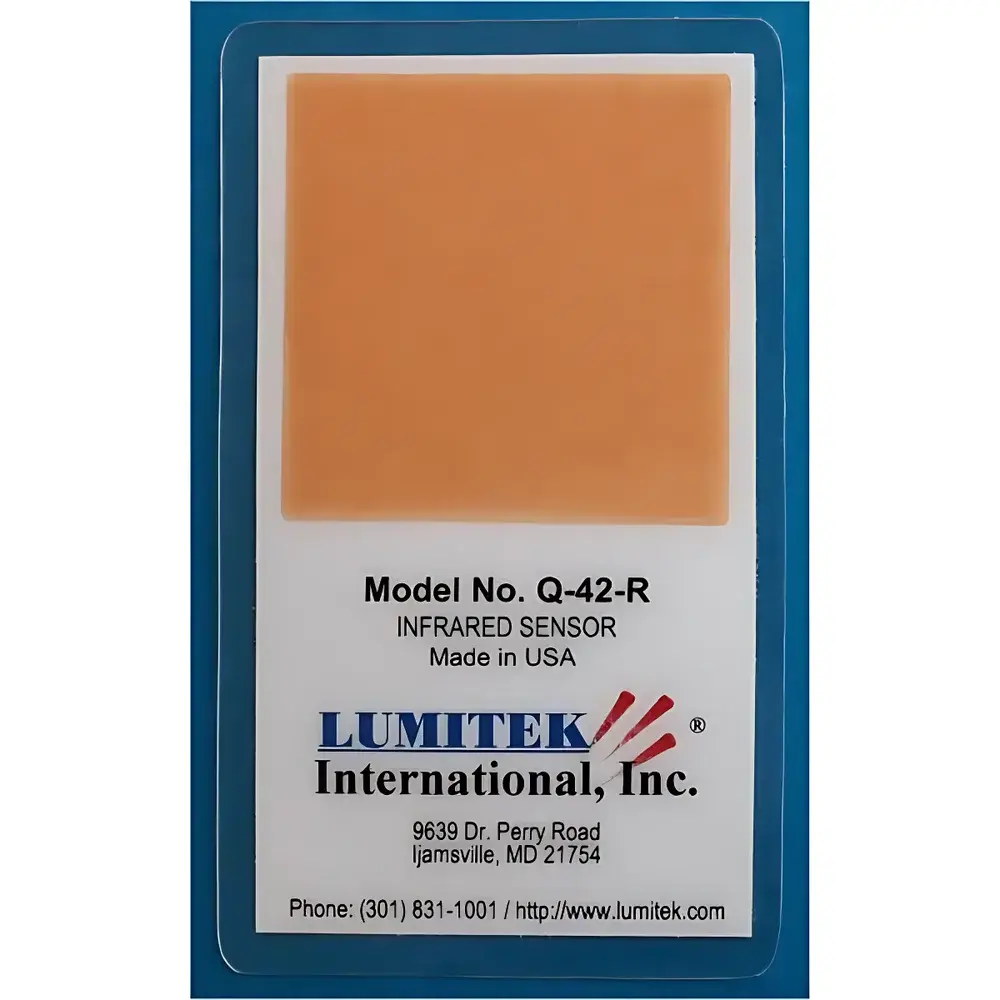
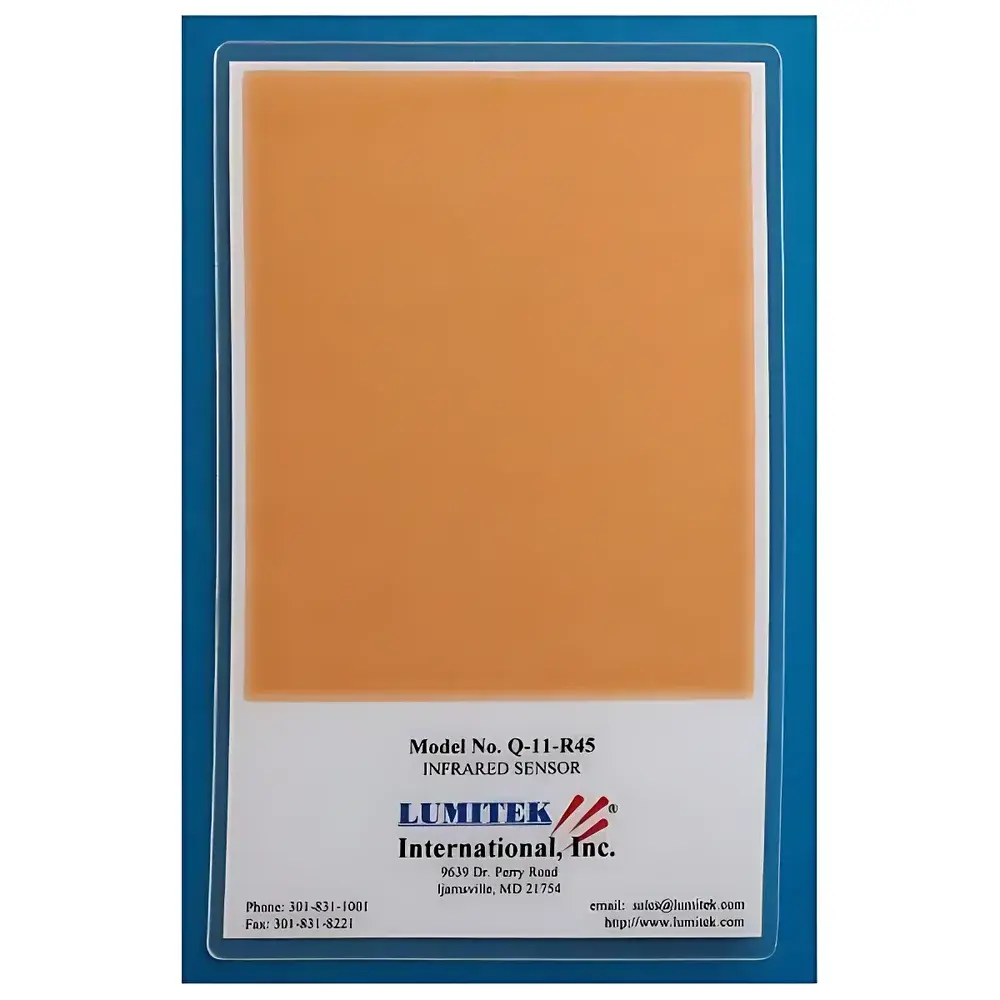
Lumitek Q-32-R High-Sensitivity Infrared Upconversion Viewing Card
| Brand | Thorlabs |
|---|---|
| Origin | USA |
| Manufacturer Type | Authorized Distributor |
| Origin Category | Imported |
| Model | Q-32-R |
| Price | USD 500 |
Overview
The Lumitek Q-32-R is a high-sensitivity, passive infrared (IR) upconversion viewing card engineered for real-time visualization of near-infrared (NIR) and short-wave infrared (SWIR) radiation in the 700–1550 nm range. Unlike active electronic detectors or thermal imaging systems, the Q-32-R operates on solid-state upconversion physics—specifically, electron trapping and thermally stimulated luminescence in rare-earth-doped phosphor composites. When exposed to incident IR photons, electrons in the phosphor matrix are promoted to metastable trap states; subsequent thermal stimulation (e.g., ambient heat or localized IR-induced heating) releases these electrons, resulting in visible green-to-yellow luminescence (~520–580 nm). This mechanism enables immediate, non-contact, spatially resolved detection of IR beam position, shape, and relative intensity without external power, cooling, or calibration. Designed as a reflective-format card (R-series), the Q-32-R features a 2″ × 2″ (50.8 mm × 50.8 mm) active area with matte-finish surface optimized for diffuse reflection and glare-free observation under standard lab lighting.
Key Features
- Passive, battery-free operation: No electronics, no bias voltage, no signal processing required.
- Reflective configuration (R-series): Optimized for direct beam visualization on illuminated surfaces; minimal backscatter interference.
- High spatial resolution: Capable of resolving beam diameters down to ~100 µm under controlled illumination conditions.
- Wide spectral sensitivity: Effective response from 700 nm (edge of visible red) through 1550 nm (common telecom wavelength), with peak sensitivity near 1064 nm and 1550 nm.
- Durable, rigid substrate: Aluminum-backed card with protective coating resists mechanical abrasion and solvent exposure during routine handling.
- Consistent batch-to-batch performance: Manufactured under ISO 9001-certified processes with traceable phosphor lot documentation.
- Compatible with Class 1–4 laser safety protocols: Used as an auxiliary alignment tool within ANSI Z136.1-compliant optical setups.
Sample Compatibility & Compliance
The Q-32-R is compatible with continuous-wave (CW) and pulsed IR sources including Nd:YAG (1064 nm), Er:YAG (2940 nm), fiber lasers (1030–1550 nm), superluminescent diodes (SLDs), and edge-emitting IR LEDs. It does not require optical coupling gels or index-matching fluids. As a passive consumable, it is exempt from RoHS Directive 2011/65/EU restrictions on hazardous substances, and contains no mercury, lead, or cadmium above threshold limits. While not a calibrated measurement device, its qualitative output supports verification workflows aligned with ISO/IEC 17025-accredited laboratories’ internal alignment SOPs. For GMP/GLP environments, usage logs may be maintained per 21 CFR Part 11 guidelines when integrated into documented alignment procedures.
Software & Data Management
The Q-32-R requires no proprietary software, drivers, or firmware. Its output is purely optical and intended for visual inspection or documentation via standard digital photography or machine vision cameras (e.g., CMOS sensors with visible-light sensitivity). When used in conjunction with image-based beam profiling systems (e.g., Thorlabs BP209-VIS, Ophir Pyrocam III), the card serves as a rapid coarse-alignment reference prior to quantitative acquisition. Metadata such as exposure time, ambient temperature, and IR source parameters should be manually recorded in laboratory notebooks or LIMS platforms to ensure traceability during method validation.
Applications
- Laser system alignment and collimation verification for NIR/SWIR sources.
- Fiber optic coupling and end-face inspection in telecom and sensing applications.
- Qualitative assessment of IR LED emission patterns and uniformity.
- Educational demonstrations of photon upconversion and non-linear optical phenomena.
- Field-deployable IR presence confirmation where portable electronic detectors are impractical.
- Pre-screening tool prior to quantitative beam profiling or M² measurements.
FAQ
Is the Q-32-R reusable? How many times can it be used?
Yes—the card exhibits no permanent photobleaching under typical alignment exposures (<100 mW/cm², <1 s dwell time). Repeated use over months is common; performance degradation is gradual and visually detectable as reduced brightness.
Does it work with CO₂ lasers (10.6 µm)?
No—Q-32-R is insensitive beyond ~1700 nm. For mid-IR wavelengths, consider thermal paper or pyroelectric viewers.
Can it be used in vacuum or high-humidity environments?
It is rated for ambient lab conditions (20–25°C, 30–70% RH). Prolonged exposure to >85% RH may cause temporary haze; vacuum use is not recommended due to potential outgassing of binder materials.
How does it compare to CCD-based IR viewers?
Unlike active IR viewers, Q-32-R provides zero-latency, wide-field visualization but lacks quantitative intensity linearity or dynamic range. It complements—not replaces—electronic detectors in tiered alignment workflows.
Is there a calibration certificate available?
No—this is a qualitative indicator, not a metrological instrument. NIST-traceable irradiance measurements require separate radiometric calibration tools.



