
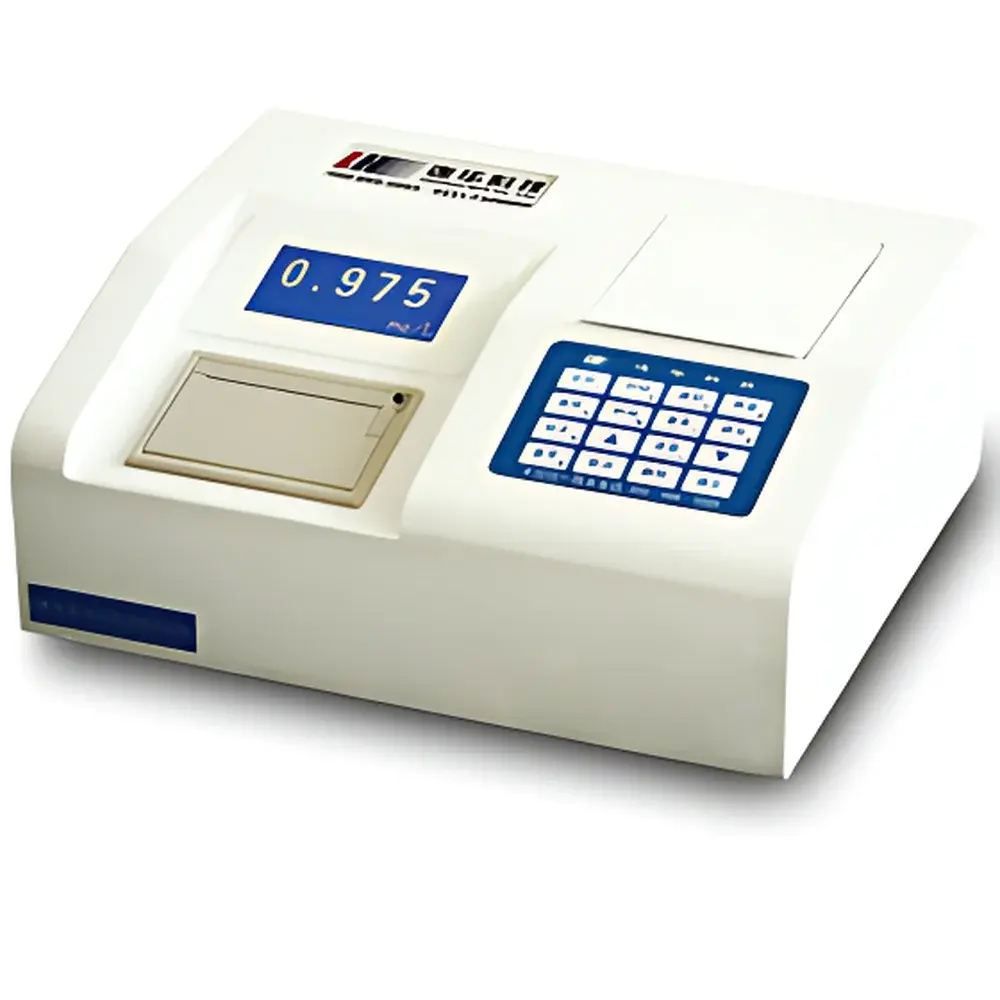
Hebei HOPU 5B-6D(V8) Ammonia Nitrogen Analyzer
| Brand | Hebei HOPU |
|---|---|
| Origin | Shandong, China |
| Type | Benchtop Laboratory Analyzer |
| Measurement Principle | Nesslerization Colorimetry |
| Range | 0.02–60 mg/L NH₃-N |
| Accuracy | ≤ ±5% |
| Detection Limit | 0.01 mg/L |
| Measurement Time | 10–15 min per batch |
| Sample Throughput | 10 samples per run (expandable) |
| Repeatability | ≤ ±5% |
| Optical Stability | ≤ ±0.001 A/10 min |
| Light Source | Cold LED (100,000 h lifetime) |
| Calibration Curves | 99 preloaded (5 standard + 94 user-adaptable) |
| Data Storage | 1,000 records with timestamp, parameters & results |
| Display | Backlit LCD with Chinese interface |
| Connectivity | RS232 for data export to PC |
| Power Supply | AC 220 V ±10%, 50 Hz |
Overview
The Hebei HOPU 5B-6D(V8) Ammonia Nitrogen Analyzer is a benchtop spectrophotometric instrument engineered for routine quantification of ammonia nitrogen (NH₃-N) in environmental water matrices—including surface water, wastewater, effluent, and treated drinking water. It operates on the internationally recognized Nesslerization method: free ammonia or ammonium ions react with Nessler’s reagent (a solution of potassium iodide, mercury(II) chloride, and sodium hydroxide) to form a stable, yellow-to-brown colloidal complex—iodo-mercurate of ammonia—whose absorbance at 420 nm is directly proportional to NH₃-N concentration. This photometric principle delivers high reproducibility under controlled laboratory conditions and aligns with established reference methods including ISO 7150-1:1984 and EPA Method 350.1. The analyzer integrates a precision optical path with a long-life cold LED source and narrow-band interference filter (center wavelength ±1 nm tolerance), minimizing spectral drift and ensuring robust baseline stability over extended operation cycles.
Key Features
- Optimized Nesslerization workflow: Integrated reaction chamber design supports standardized digestion-free color development for ammonia nitrogen, eliminating need for distillation or catalytic oxidation steps.
- Dual-format sample compatibility: Accepts both 10-mm rectangular cuvettes and 16-mm round glass test tubes—enabling flexibility across lab protocols and legacy sample handling practices.
- High-stability optical architecture: LED light source rated for 100,000 hours with <±0.001 A/10 min photometric drift ensures measurement consistency across multi-shift operations and long-term calibration intervals.
- Embedded calibration management: Stores 99 programmable calibration curves—5 factory-validated reference curves compliant with national standard GB/T 7479-2008, plus 94 user-definable curves for matrix-specific compensation (e.g., saline wastewater, humic-rich groundwater).
- Full audit-ready data handling: Timestamped records include date/time stamp, operator ID (manually entered), measurement range, curve ID, raw absorbance, and final NH₃-N result—all stored locally in non-volatile memory (1,000-entry capacity).
- Regulatory-compliant output: RS232 serial interface enables secure transfer of current and historical datasets to LIMS or validated laboratory software; supports manual export for GLP documentation and internal QA review.
Sample Compatibility & Compliance
The 5B-6D(V8) is validated for use with clarified, low-turbidity aqueous samples (turbidity 0.5 mg/L) require masking with tartaric acid; and high alkalinity (>200 mg/L CaCO₃) necessitates pH adjustment to 7.0–7.4 before reagent addition. The instrument meets electromagnetic compatibility requirements per IEC 61326-1:2020 and electrical safety standards IEC 61010-1:2010 for laboratory equipment. While not FDA 21 CFR Part 11-certified out-of-box, its data export functionality supports integration into Part 11–compliant workflows when paired with validated third-party data acquisition software.
Software & Data Management
No proprietary PC software is bundled; however, the device exports ASCII-formatted data via RS232 using a fixed-field protocol compatible with Excel import, LabVIEW drivers, and most LIMS platforms. Each record includes: [YYYY-MM-DD],[HH:MM:SS],[Curve_ID],[Absorbance_AU],[Result_mg/L],[Operator_Code]. Internal memory retains full traceability: all curve modifications, zero-point adjustments, and calibration validations are logged with timestamps and parameter snapshots. Users may generate hardcopy reports via optional thermal printer (not included), supporting QA sign-off and regulatory submission packages. Data retention complies with ISO/IEC 17025:2017 clause 7.5.2—records remain accessible for minimum 5 years post-analysis without degradation.
Applications
- Wastewater treatment plant (WWTP) process control: Monitoring influent, activated sludge return, nitrification/denitrification effluent, and discharge compliance per local limits (e.g., China’s GB 18918-2002 Class I-A).
- Environmental monitoring stations: Field-deployable in mobile labs for rapid screening of river, lake, and reservoir water quality during seasonal algal bloom events.
- Drinking water utility QA/QC: Verification of ammonia residuals post-chloramination and pre-ozonation to prevent NDMA formation.
- Educational laboratories: Teaching core principles of colorimetric analysis, Beer-Lambert law validation, and method interference studies in undergraduate environmental chemistry curricula.
- Industrial pretreatment verification: Confirming ammonia removal efficiency in electroplating, semiconductor, and food processing facility effluents prior to municipal sewer discharge.
FAQ
Does the 5B-6D(V8) require daily recalibration?
No—calibration stability is verified per ISO 8466-1:2021; users perform initial calibration upon startup and repeat only after maintenance, reagent lot change, or if QC check standards deviate by >5% from target value.
Can the instrument measure total Kjeldahl nitrogen (TKN)?
No—this model is specific to ammonia nitrogen only. TKN determination requires separate digestion (ISO 5667-16:2009) and is outside its analytical scope.
Is Nessler’s reagent supplied with the instrument?
No—reagents are consumables sold separately; users must procure certified-grade Nessler’s reagent meeting ISO 6779:2017 specifications.
What is the recommended maintenance interval?
Optical path cleaning every 3 months; LED intensity verification annually using manufacturer-provided neutral density filters; full performance verification against CRMs semiannually.
How is method validation documented for regulatory submissions?
Users must conduct in-house validation per ISO/IEC 17025 Annex B, documenting linearity (r² ≥0.999), LOD/LOQ, recovery (85–115%), and inter-operator precision—records retained with instrument-generated data logs.







