
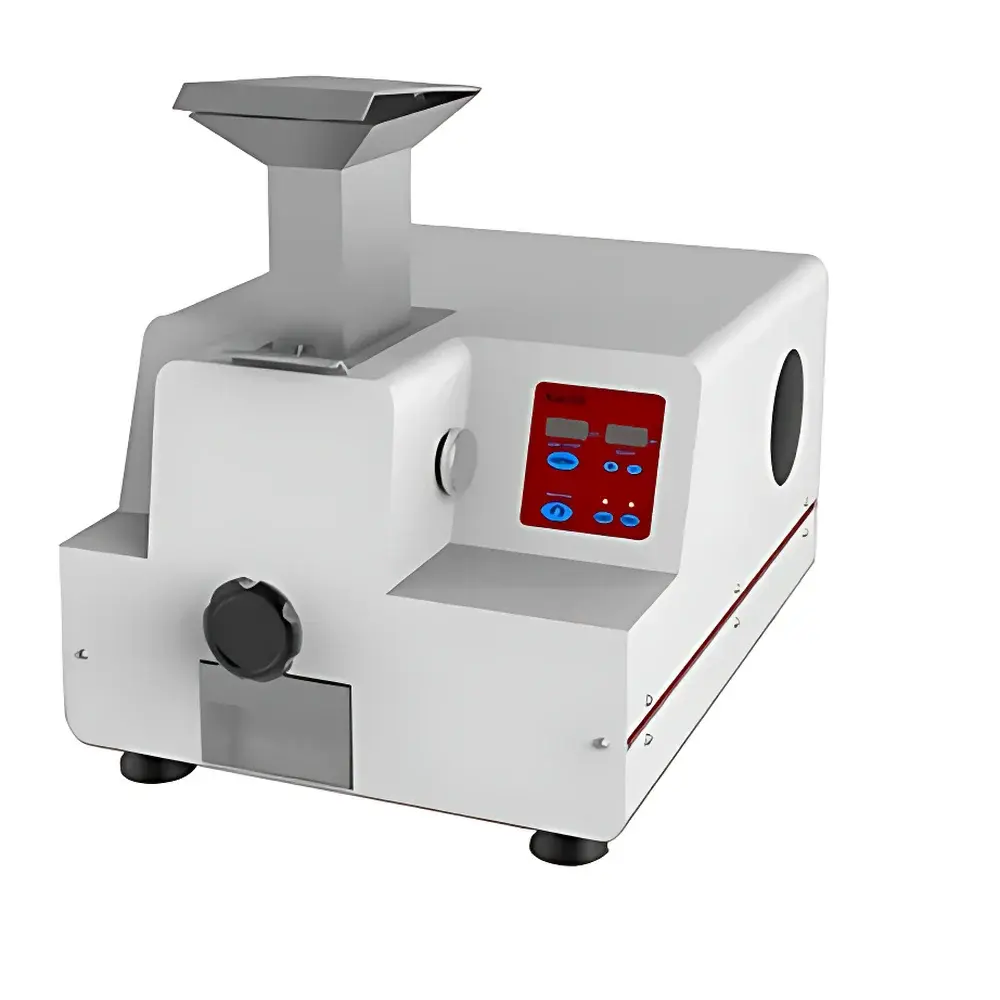
Jihepu AM750 Desktop Jaw Crusher
| Brand | Jihepu |
|---|---|
| Origin | Shandong, China |
| Model | AM750 |
| Instrument Type | Jaw Crusher |
| Sample Type | Medium-hard to hard, brittle materials |
| Max. Feed Size | ≤40 mm |
| Output Particle Size | D90 < 250 µm |
| Batch Capacity | 3 L |
| Motor Power | 1100 W |
| Voltage | 220 V AC |
| Jaw Gap Adjustment | Digital scale with zero-point calibration |
| Jaw Speed | Adjustable |
| Safety Features | Interlocked front door, safety lock on grinding chamber and collection bin |
| Dust Control | Integrated dust extraction port and splash-resistant feed hopper |
| Jaw Plate Material | Replaceable, optional materials available (e.g., manganese steel, tungsten carbide) |
| Compliance | Designed for GLP-compliant sample preparation workflows |
Overview
The Jihepu AM750 Desktop Jaw Crusher is an engineered solution for controlled, reproducible size reduction of medium-hard to hard, brittle solid samples in analytical and quality control laboratories. Based on the principle of compressive crushing—where material is fed between two opposing jaw plates, one fixed and one reciprocating—the AM750 delivers consistent particle size distribution through precise mechanical force application. Its compact footprint (≤0.5 m²) enables integration into fume hoods, glove boxes, or benchtop workflows without compromising throughput. Unlike industrial jaw crushers, the AM750 is optimized for batch-wise, low-volume sample preparation (up to 3 L per cycle), making it suitable for pre-analytical processing prior to XRF, XRD, ICP-OES, or sieve analysis. The device operates under ambient conditions and requires no cooling or inert gas purge, supporting routine use in environmental testing labs, geological survey units, academic research facilities, and building materials QA/QC departments.
Key Features
- Adjustable jaw gap via calibrated digital scale with zero-point correction—ensures repeatable crush geometry and extends jaw plate service life.
- Variable jaw oscillation speed allows optimization for diverse sample matrices (e.g., limestone vs. slag vs. ceramic tile), minimizing overgrinding and heat-induced phase alteration.
- Splash-resistant feed hopper with integrated dust extraction port (standard 50 mm OD connection) mitigates airborne particulate release, supporting ISO 16283-1 and OSHA PEL compliance during operation.
- Front-access grinding chamber with interlocked safety door enables rapid visual inspection and residue removal; jaw plates are tool-free detachable for thorough cleaning between sample batches.
- Modular jaw plate system supports material-specific configurations—including high-manganese steel for general-purpose crushing and tungsten carbide-faced plates for highly abrasive ores or refractory ceramics.
- Integrated safety locks on both grinding chamber and 3 L polypropylene collection bin prevent inadvertent operation during maintenance or sample transfer.
Sample Compatibility & Compliance
The AM750 accepts feed particles up to 40 mm in maximum dimension and reduces them to a D90 particle size below 250 µm—verified using laser diffraction (ISO 13320) and dry sieve analysis (ASTM C136). It is validated for use with silicates, carbonates, oxides, and sulfides exhibiting Mohs hardness ≤7. Not recommended for fibrous, ductile, or highly elastic materials (e.g., polymers, rubber, metals >95 HB). All electrical components meet CE marking requirements (EN 61000-6-3, EN 61000-6-4), and mechanical design adheres to EN ISO 12100:2010 for machinery safety. The unit supports audit-ready documentation when operated within a GLP framework, including manual log entries for jaw gap settings, batch ID, operator name, and date/time stamp per run.
Software & Data Management
The AM750 is a standalone electromechanical instrument with no embedded firmware or digital connectivity. All operational parameters—including jaw gap setting (mm), estimated runtime (min), and batch identification—are manually recorded by the user. This analog architecture eliminates cybersecurity vulnerabilities and ensures long-term compatibility with laboratory information management systems (LIMS) that require human-entered metadata. For regulated environments (e.g., ISO/IEC 17025-accredited labs), users may integrate the AM750 into electronic lab notebooks (ELN) via standardized SOP templates referencing ASTM D7508 (Standard Practice for Sample Preparation of Solid Waste) and USP <421> (Particle Size Distribution).
Applications
- Geochemical sample homogenization prior to multi-element analysis (ICP-MS, XRF)
- Reduction of construction aggregates (concrete, asphalt, brick) for gradation testing per ASTM C136/C136M
- Preparation of coal and coke samples for proximate and ultimate analysis (ASTM D3172–D3176)
- Size reduction of metallurgical slags and fly ash for leaching studies (TCLP, SPLP)
- Fragmentation of ceramic and refractory fragments for phase identification (XRD) and microstructural evaluation (SEM-EDS)
FAQ
What is the maximum allowable feed size for the AM750?
The AM750 accepts feed particles with a maximum dimension of 40 mm. Feeding oversized material may cause jamming, uneven wear, or motor overload.
Can the AM750 achieve sub-100 µm output consistently?
No—its typical D90 output range is 150–250 µm under standard operating conditions. Sub-100 µm sizing requires downstream milling (e.g., planetary ball mill) per ASTM E2909.
Is the collection bin compatible with solvent-based samples?
The standard 3 L polypropylene bin is chemically resistant to water, dilute acids (≤10% HCl), and alcohols; for aggressive solvents (e.g., chloroform, THF), users must specify optional stainless-steel liners.
Does the AM750 comply with FDA 21 CFR Part 11 requirements?
As a non-computerized device with no electronic record generation, the AM750 falls outside the scope of Part 11—but its mechanical traceability supports ALCOA+ principles when paired with controlled paper-based or ELN documentation.
How often should jaw plates be inspected or replaced?
Inspection is recommended after every 50 operational hours or 200 batches; replacement intervals depend on sample abrasivity—typically 200–500 hours for manganese steel plates processing limestone, and 80–200 hours for tungsten carbide plates processing bauxite residue.



