
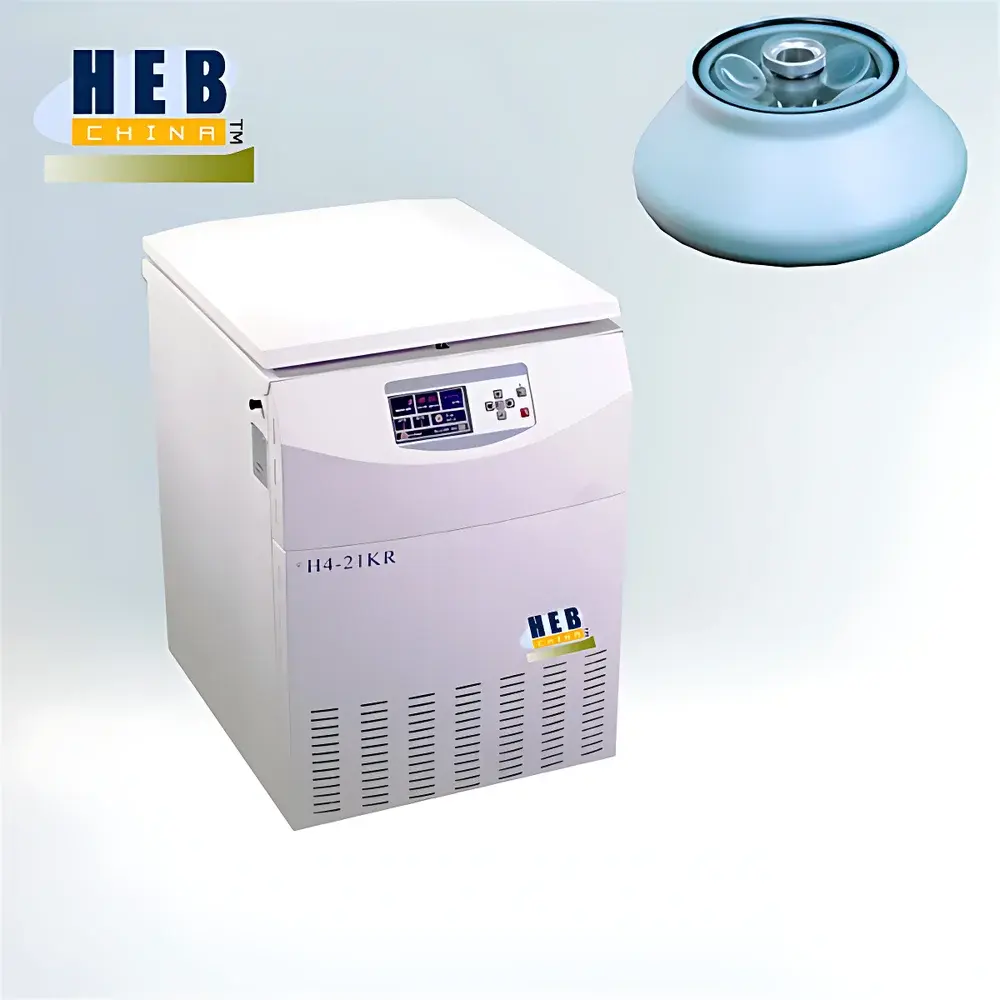
HePu H4-21KR High-Speed Refrigerated Centrifuge
| Brand | HePu (Jihepu) |
|---|---|
| Origin | Shandong, China |
| Model | H4-21KR |
| Type | Benchtop High-Speed Refrigerated Centrifuge |
| Max Speed | 23,000 rpm |
| Max RCF | 35,500 × g |
| Max Capacity | 4 × 750 mL |
| Temperature Range | −20 °C to +40 °C |
| Temp. Accuracy | ±2.0 °C |
| Timer Range | 1 min – 23 h 59 min |
| Speed Accuracy | ±20 rpm |
| Noise Level | ≤65 dB(A) |
| Power Supply | AC 220 V ±10%, 50 Hz, 15 A |
| Total Power | 1300 W |
| Dimensions (W×D×H) | 570 × 660 × 780 mm |
| Net Weight | 150 kg |
| Rotor Cavity Diameter | Φ420 mm |
Overview
The HePu H4-21KR High-Speed Refrigerated Centrifuge is an engineered solution for laboratories requiring precise, temperature-controlled separation of biological macromolecules—including nucleic acids, proteins, organelles, and viral particles—under high gravitational forces. Designed around a robust horizontal-axis architecture with a sealed refrigerated chamber and brushless AC frequency-controlled motor, the system delivers stable rotational dynamics across its full operational range (0–23,000 rpm). Its cryogenic capability (−20 °C to +40 °C), combined with real-time RCF and rpm dual-mode display, enables reproducible pelleting and gradient-based fractionation in applications demanding strict thermal management—such as plasma fractionation, monoclonal antibody purification, and exosome isolation. The unit complies with IEC 61010-1 safety standards for laboratory electrical equipment and incorporates fail-safe thermal monitoring to prevent sample degradation during extended runs.
Key Features
- Microprocessor-controlled operation with dual-parameter input: users may set either rotational speed (rpm) or relative centrifugal force (RCF), with automatic cross-conversion and live display.
- Refrigerated chamber with independent compressor cooling system, maintaining setpoint accuracy within ±2.0 °C across the full temperature range (−20 °C to +40 °C).
- Full-steel reinforced rotor chamber and electromagnetic door lock ensure structural integrity and personnel safety during high-speed operation.
- Low-noise design (<65 dB[A]) achieved via precision-balanced rotor assembly, vibration-damping base, and optimized airflow management.
- Optional rotor auto-recognition module provides firmware-enforced speed limits based on installed rotor geometry and maximum rated load—preventing mechanical over-speed conditions.
- Timer resolution adapts dynamically: displays in seconds for durations under 60 seconds; switches to minutes/hours format thereafter for intuitive protocol execution.
Sample Compatibility & Compliance
The H4-21KR accommodates a comprehensive suite of fixed-angle and swing-bucket rotors—17 configurations in total—supporting volumes from 0.2 mL PCR strips to 4 × 750 mL bottles. Compatible sample formats include microtubes (1.5–2.2 mL), conical tubes (5–250 mL), round- and conical-bottom centrifuge tubes (50 mL), blood collection tubes (5–7 mL), 96-well microplates, and custom adapters for specialized vessels. All rotors are certified to ISO 15195:2018 for calibration traceability and manufactured to EN 61000-6-3 EMC emission standards. The system supports GLP/GMP workflows through audit-ready event logging (power-on/off, temperature deviations, rotor ID registration, and run completion timestamps), and meets essential requirements for FDA 21 CFR Part 11 compliance when paired with validated LIMS integration.
Software & Data Management
While the H4-21KR operates via an embedded front-panel interface without external PC dependency, its firmware supports exportable run logs via USB port (CSV format), including timestamped records of setpoints, actual values, duration, rotor ID, and thermal deviation alerts. Optional RS-232 or Ethernet modules enable remote status monitoring and centralized fleet management in multi-instrument core facilities. All stored data retain metadata such as operator ID (user-defined tag), date/time stamp, and protocol name—facilitating traceability in regulated environments. Firmware updates are delivered via encrypted USB key to maintain system integrity and cybersecurity alignment with ISO/IEC 27001 principles.
Applications
This centrifuge serves critical roles across life science research and bioprocessing: isolation of mitochondria and lysosomes from tissue homogenates; clarification of bacterial and mammalian cell lysates prior to chromatography; concentration of low-abundance extracellular vesicles from serum or conditioned media; preparation of density gradients for sucrose or iodixanol-based separations; and large-volume processing of clinical specimens—including whole blood fractionation into platelet-rich plasma (PRP) and cryoprecipitate. Its 4 × 750 mL capacity and 35,500 × g performance make it particularly suited for scale-up steps in downstream biomanufacturing, while its compact footprint (570 × 660 × 780 mm) allows integration into space-constrained cleanrooms or BSL-2 laboratories.
FAQ
What is the minimum and maximum operating temperature?
The refrigerated chamber maintains temperatures from −20 °C to +40 °C, with stability controlled to ±2.0 °C under standard ambient conditions (18–25 °C).
Can the centrifuge operate without refrigeration?
Yes—the cooling system can be disabled via software setting, allowing ambient-temperature high-speed runs when thermal control is not required.
Is rotor calibration traceable to national standards?
All factory-installed rotors include individual calibration certificates aligned with ISO 15195:2018, with RCF values verified using NIST-traceable tachometry and gravimetric methods.
How is safety ensured during rotor imbalance events?
The system continuously monitors vibration amplitude via integrated accelerometers; automatic deceleration is triggered if imbalance exceeds ISO 21500 Class A thresholds, followed by audible/visual alarm and locked rotor status until manual reset.
Does the unit support regulatory-compliant electronic records?
When equipped with optional communication modules and validated third-party LIMS interfaces, the H4-21KR supports 21 CFR Part 11–compliant audit trails, including user authentication, electronic signatures, and immutable run history archiving.



