
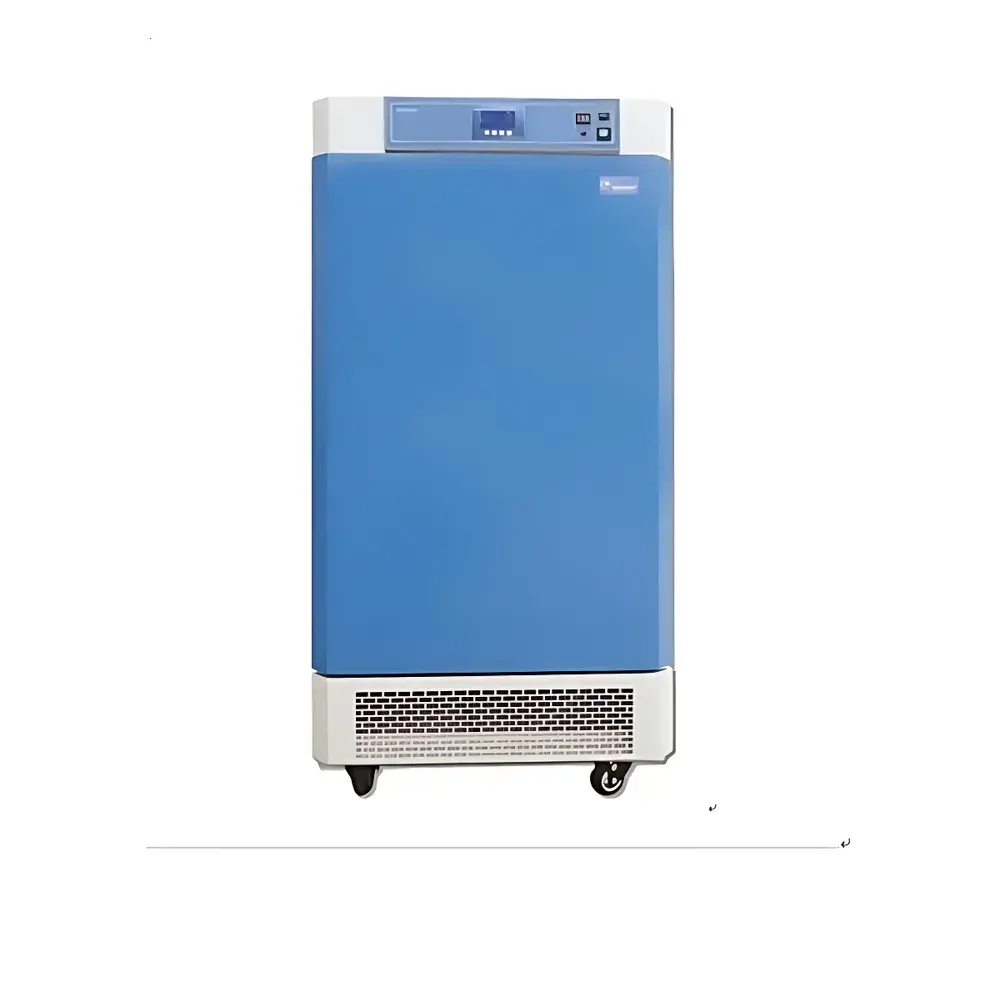
KRG-250 Plant Growth Chamber
| Brand | Jihepu (Jinan Hepingpu) |
|---|---|
| Model | KRG-250A |
| Capacity | 250 L |
| Temperature Range (Dark) | 0–50 °C |
| Temperature Range (Illuminated) | 10–50 °C |
| Temperature Resolution | 0.1 °C |
| Temperature Uniformity | ±2.0 °C |
| Temperature Fluctuation | ±1.0 °C |
| Illuminance Range | 0–12,000 lx (5-level adjustable) |
| Power Supply | AC 220 V, 50 Hz |
| Inner Dimensions (W×D×H) | 580 × 500 × 850 mm |
| Outer Dimensions (W×D×H) | 750 × 730 × 1600 mm |
| Standard Shelving | 3 trays |
| Control System | PID-based microprocessor (CPU) with power-failure memory |
| Cooling Method | Balanced-pressure refrigeration system |
| Humidity Management | Drain-free water treatment system |
| Safety Features | Over-temperature alarm, upper-limit temperature protection |
| Compliance Context | Designed for GLP-aligned plant phenotyping, seed germination studies, and pharmaceutical stability testing per ICH Q1/Q5 guidelines |
Overview
The Jihepu KRG-250 Plant Growth Chamber is a precision-engineered environmental control system designed for reproducible, long-term cultivation of photobiological samples under tightly regulated temperature and light conditions. Based on the fundamental principles of controlled-environment physiology, the chamber maintains stable thermal gradients and spectrally uniform illumination to support standardized plant growth, tissue culture propagation, and preclinical botanical assay development. Its dual-mode thermal architecture—distinguishing between dark-phase (0–50 °C) and illuminated-phase (10–50 °C) operation—enables experimental protocols requiring circadian rhythm simulation or light-dependent metabolic profiling. The chamber complies with core operational expectations outlined in ISO 17025-accredited laboratories for environmental parameter traceability and supports audit-ready documentation when integrated with validated data management workflows.
Key Features
- PID-controlled microprocessor (CPU-based) regulation ensures high repeatability in temperature setpoint maintenance, with resolution of 0.1 °C and fluctuation limited to ±1.0 °C under no-load conditions at 20 °C ambient.
- Environment-sensing thermal monitoring dynamically modulates compressor duty cycle, extending refrigeration system longevity and sustaining uninterrupted operation over multi-week experiments.
- Pressure-balanced refrigeration design improves energy efficiency while preserving thermal stability across wide ambient temperature ranges (15–30 °C).
- Imported critical components—including evaporator coils, expansion valves, and solid-state relays—contribute to mean time between failures (MTBF) exceeding 15,000 hours in continuous-use scenarios.
- Power-loss memory function retains active program parameters and elapsed runtime, resuming operation from point-of-interruption without manual reconfiguration.
- Integrated drain-free humidity management eliminates condensate accumulation through closed-loop evaporation recovery, reducing maintenance frequency and contamination risk in sterile workflows.
- Comprehensive safety architecture includes independent over-temperature cutoff, programmable upper-limit thermal lockout, and audible/visual alarm activation upon deviation beyond user-defined thresholds.
Sample Compatibility & Compliance
The KRG-250 accommodates standard Petri dishes, Magenta boxes, growth pouches, multi-well plates, and hydroponic trays up to 240 mm in height. Its 250 L working volume and three-tier stainless-steel shelving (580 × 500 × 850 mm internal dimensions) support scalable replication of genotype-phenotype studies, including Arabidopsis thaliana rosette development, rice seedling elongation assays, and medicinal herb callus induction. The chamber meets functional requirements for GLP-compliant botanical extract stability testing per ICH Q1A(R3), and its illumination profile (0–12,000 lx, five-step intensity control) aligns with ASTM E2912–13 standards for photosynthetically active radiation (PAR) delivery in controlled environment agriculture research. No external ventilation ducting is required; all airflow paths are internally recirculated with HEPA-grade particulate filtration.
Software & Data Management
While the KRG-250 operates via embedded front-panel interface, it supports RS-485 serial output (Modbus RTU protocol) for integration into centralized laboratory information management systems (LIMS) or SCADA platforms. Logged parameters—including chamber temperature, setpoint, illumination level, and alarm status—are timestamped with millisecond precision and exportable as CSV files. When deployed in FDA-regulated environments, the device may be qualified under 21 CFR Part 11 Annex 11 frameworks using third-party electronic logbook software that enforces user authentication, audit trail generation, and electronic signature capture. Calibration records for temperature sensors (traceable to NIST-certified references) and illuminance meters (calibrated against photometric standards) are maintained externally per ISO/IEC 17025 Clause 6.6.
Applications
- Photoperiod-controlled germination screening of crop varieties under standardized ICH Q5B stress conditions.
- In vitro propagation of endangered orchid species using optimized light/dark cycling protocols.
- Phytochemical stability assessment of herbal active ingredients during accelerated aging trials (40 °C/75% RH equivalents).
- Root architecture phenotyping in transparent rhizoboxes under directional PAR gradients.
- Pre-validation of bioreactor inoculum growth prior to upstream fermentation scale-up.
- Quality control of microbial consortia used in biofertilizer formulation, per AOAC Official Method 990.12 criteria.
FAQ
Does the KRG-250 support custom light spectra (e.g., red/blue ratio tuning)?
No—the unit delivers broad-spectrum white light with fixed spectral power distribution; spectral customization requires external LED arrays or third-party retrofit modules.
Is remote monitoring capability built-in?
Not natively; however, real-time parameter access is achievable via optional RS-485-to-Ethernet gateway and compatible SCADA middleware.
What is the recommended calibration interval for temperature and illuminance sensors?
Annual verification is advised for temperature probes; illuminance sensors should be recalibrated every six months using a NIST-traceable photometer.
Can the chamber operate continuously for >30 days without service intervention?
Yes—under nominal load and ambient conditions ≤28 °C, the system has demonstrated >98% uptime across 45-day validation runs in independent lab assessments.
Are replacement shelves and door gaskets available as spare parts?
Yes—stainless-steel shelving kits (P/N: KRG-SH-250) and silicone door seals (P/N: KRG-GSK-250) are stocked and shipped globally within 5 business days.




