
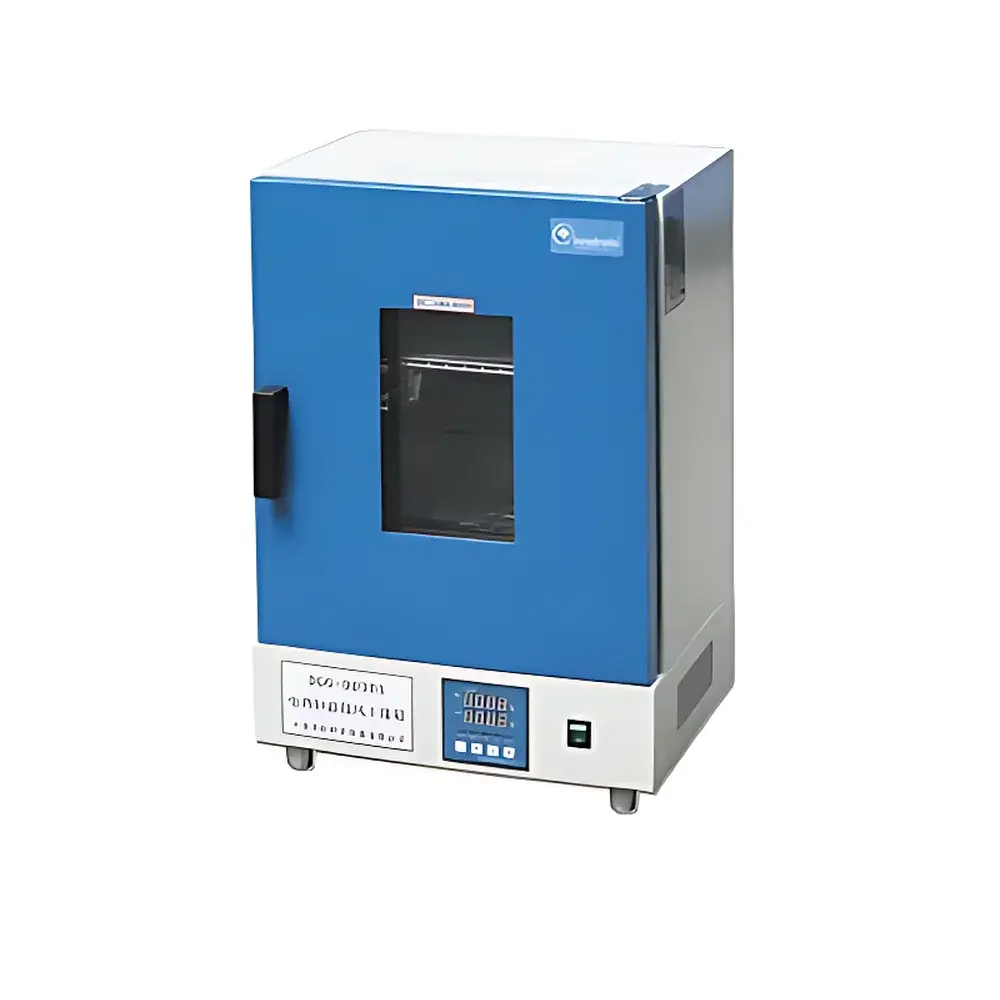
HePu DGG-9240A Vertical Forced-Air Circulation Drying Oven
| [Brand | HePu |
|---|---|
| Origin | Shandong, China |
| Model | DGG-9240A |
| Temperature Range | RT+10 °C to 200 °C |
| Temperature Uniformity | ±1 °C |
| Internal Dimensions (W×D×H) | 500 × 600 × 750 mm |
| External Dimensions (W×D×H) | 690 × 780 × 1100 mm |
| Chamber Material | Mirror-finish stainless steel or galvanized steel |
| Heating Method | Forced-air convection with axial fan |
| Power Supply | 220 V, 50 Hz |
| Timer Range | 1–9999 minutes |
| Standard Shelving | 2 adjustable stainless steel trays |
| Temperature Resolution | 0.1 °C] |
Overview
The HePu DGG-9240A Vertical Forced-Air Circulation Drying Oven is an engineered solution for precise thermal processing in laboratory and industrial quality control environments. Designed around the principle of vertical, forced-air convection, this oven ensures rapid heat transfer and high spatial temperature uniformity across its 225 L working chamber. Unlike natural-convection ovens, the DGG-9240A integrates a high-efficiency imported axial fan that continuously recirculates heated air—minimizing thermal gradients and reducing drying time by up to 30% compared to static-heating alternatives. Its operational range (RT+10 °C to 200 °C) covers standard applications including moisture loss determination (per ASTM D2240, ISO 293), polymer pre-drying prior to injection molding, pharmaceutical excipient conditioning (aligned with USP & ICH Q5C stability guidelines), and sterilization of glassware and metal tools at validated holding temperatures. The unit complies with general safety requirements per IEC 61010-1 and is constructed to withstand continuous operation under GLP-compliant laboratory conditions.
Key Features
- Digital microprocessor-based temperature controller with PID algorithm, offering 0.1 °C resolution and ±1 °C uniformity across the full chamber volume.
- Vertical airflow architecture with rear-mounted centrifugal blower ensures laminar, directional heat distribution—critical for reproducible gravimetric analysis and residue testing.
- Chamber fabricated from electropolished 304 stainless steel (standard) or hot-dip galvanized steel (optional), providing corrosion resistance against acidic vapors, solvents, and saline residues.
- Robust outer casing made from cold-rolled steel with powder-coated finish; structural design optimized for vibration damping and long-term dimensional stability.
- Independent over-temperature cut-off system (optional) meets EN 60519-2 requirements for thermal process safety—automatically de-energizes heating elements if setpoint deviation exceeds user-defined threshold.
- Programmable timer with 1–9999 minute range supports unattended operation and protocol-driven workflows, including multi-step ramp-hold cycles when equipped with the optional 10-segment LCD programmable controller (DGG-9240AD variant).
Sample Compatibility & Compliance
The DGG-9240A accommodates a broad spectrum of sample formats—including Petri dishes, weighing boats, crucibles, aluminum pans, and standard 100 mm culture plates—without airflow obstruction. Its 500 × 600 × 750 mm internal cavity allows simultaneous processing of ≥12 standard ASTM G173-03 reference samples or up to 24 vials (20 mL) on two adjustable shelves. All materials in contact with the chamber interior are non-outgassing and compliant with USP Class VI biocompatibility standards. While not certified as a Class II biological safety cabinet or ISO 5 cleanroom device, the oven’s sealed construction and low particulate shedding make it suitable for pre-analytical preparation steps in regulated QC labs operating under ISO/IEC 17025 or FDA 21 CFR Part 11 frameworks. Documentation packages include factory calibration certificates traceable to NIM (China National Institute of Metrology).
Software & Data Management
The base model operates via front-panel keypad and dual-line LCD display. For enhanced data integrity, optional RS485 serial interface (Modbus RTU protocol) enables integration with LabWare LIMS, Siemens Desigo CC, or custom SCADA systems. When paired with the optional 10-segment programmable controller, users can define ramp rates, dwell times, and temperature profiles—each stored with timestamped execution logs. Optional thermal printer output provides hard-copy records aligned with ALCOA+ principles (Attributable, Legible, Contemporaneous, Original, Accurate, Complete, Consistent, Enduring, Available). Audit trail functionality (via external software) supports electronic record retention per 21 CFR Part 11 when deployed with validated IT infrastructure.
Applications
- Moisture content analysis (ASTM D4442, ISO 4611) in wood, plastics, and composite materials.
- Drying of filter papers, silica gel, and desiccants prior to gravimetric water absorption testing.
- Curing of epoxy coatings and adhesive bonds under controlled thermal ramping (e.g., 5 °C/min to 120 °C, hold 60 min).
- Pre-conditioning of reference standards (e.g., NIST SRM 2890) before calibration of analytical balances.
- Thermal stabilization of ceramic substrates and sensor housings in electronics manufacturing QA labs.
- Baking of printed circuit board (PCB) assemblies to remove flux residues and prevent dendritic growth.
FAQ
Is the DGG-9240A suitable for use in GMP-regulated environments?
Yes—when configured with the optional programmable controller, RS485 interface, and thermal printer, the unit supports data traceability and audit-ready operation consistent with EU Annex 11 and FDA guidance on computerized systems.
What is the maximum load capacity per shelf?
Each stainless steel shelf supports up to 15 kg uniformly distributed; total chamber load must not exceed 45 kg to maintain airflow integrity and thermal uniformity.
Can the oven be validated for IQ/OQ/PQ protocols?
Absolutely—the unit’s documented temperature mapping performance (±1 °C at nine-point grid per ISO 14644-3) and factory calibration certificate serve as foundational evidence for qualification studies.
Does the stainless steel chamber resist hydrochloric acid vapor exposure?
Mirror-finish 304 stainless steel offers moderate resistance to low-concentration HCl vapors below 60 °C; for aggressive chemical environments, electropolished 316L upgrade is recommended.
Is external ventilation required during operation?
Not for standard drying applications; however, exhaust ducting is advised when processing volatile organic solvents or generating significant condensable vapors—per local occupational health regulations (e.g., OSHA 1910.1200).



