
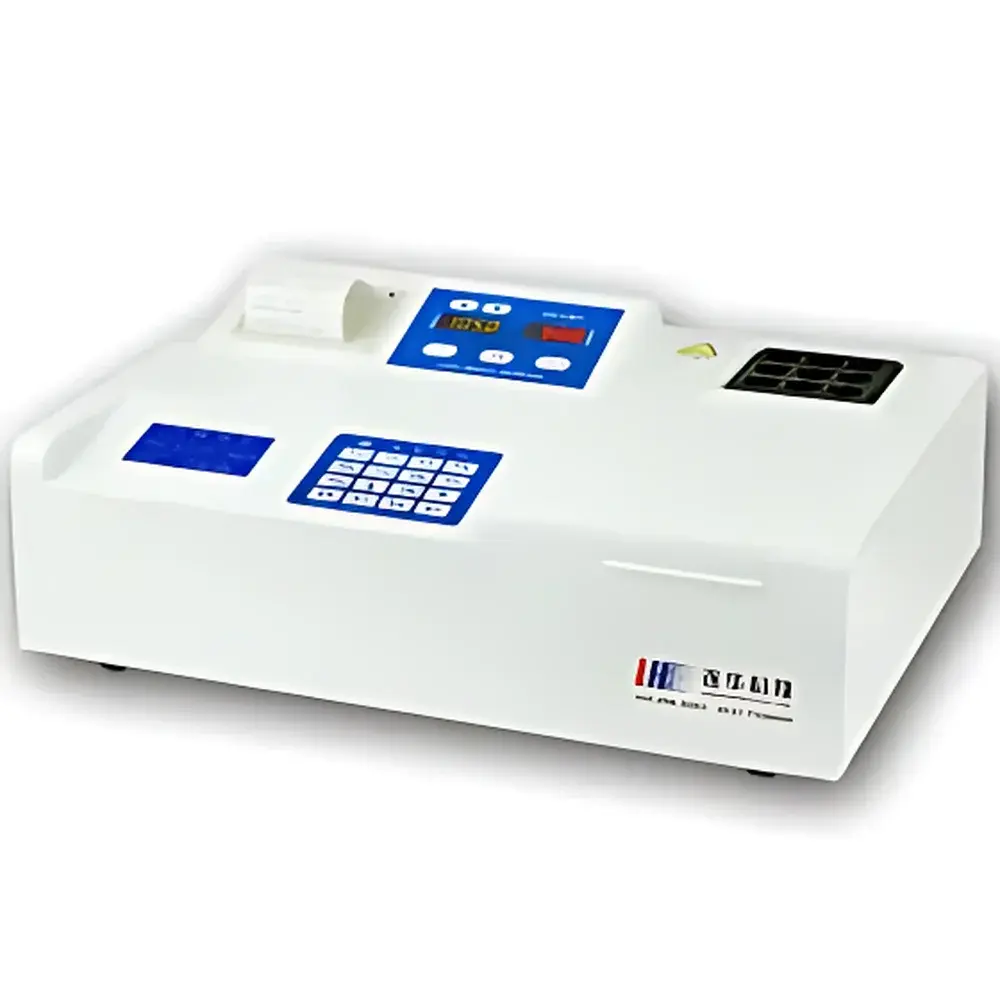
HePu 5B-6P Total Phosphorus Analyzer
| Brand | HePu (Jinan, Shandong) |
|---|---|
| Model | 5B-6P |
| Application | Laboratory-based water quality analysis |
| Measurement Principle | Colorimetric method (molybdenum blue reaction after acid digestion) |
| Range | 0.002–20 mg/L (multi-range auto-segmentation) |
| Accuracy | ≤ ±5% |
| Detection Limit | 0.01 mg/L (at ≤ ±5% error) |
| Resolution | 0.001 mg/L |
| Repeatability | ≤ ±5% |
| Measurement Time | 35–50 min per batch |
| Sample Throughput | 9 samples per run |
| Optical Stability | ≤ ±0.001 A/10 min |
| Light Source Lifetime | 100,000 hours |
| Data Storage Capacity | 1,000 records (including timestamp, parameter ID, result) |
| Calibration Curves | 60 preloaded, user-editable and savable |
| Display | Integrated LCD |
| Communication Interface | RS232 |
| Power Supply | 220 V AC |
Overview
The HePu 5B-6P Total Phosphorus Analyzer is a dedicated laboratory instrument engineered for precise, routine quantification of total phosphorus (TP) in environmental water samples—including wastewater, surface water, groundwater, and effluent streams. It operates on the standardized colorimetric principle based on the molybdenum blue reaction: following high-temperature acidic digestion (typically using potassium persulfate under reflux or microwave-assisted conditions), orthophosphate released from all phosphorus-containing species reacts with ammonium molybdate and antimony potassium tartrate under acidic conditions to form phosphomolybdate, which is then reduced to an intensely colored molybdenum blue complex. Absorbance is measured spectrophotometrically at 700 nm, and concentration is calculated via built-in calibration algorithms. Designed for compliance with ISO 6878:2004, EPA Method 365.1, and HJ 670–2013 (China’s standard for total phosphorus in water), the 5B-6P integrates digestion control, optical measurement, and data handling into a single compact platform—eliminating inter-instrument variability and reducing operator dependency.
Key Features
- Integrated digestion unit with programmable timer and thermal alert system—ensures consistent oxidation of organic and condensed phosphates prior to color development.
- Self-contained optical module featuring a long-life LED light source (rated >100,000 hours) and precision photodiode detection, delivering optical stability of ≤ ±0.001 A over 10 minutes—critical for low-concentration measurements near the detection limit (0.01 mg/L).
- Preloaded library of 60 calibration curves, compliant with common regulatory standards; users may revise, validate, and save new curves using certified reference materials (CRMs) without software licensing restrictions.
- Direct concentration readout in mg/L—no manual unit conversion or dilution factor input required during routine operation.
- Onboard data management: stores up to 1,000 complete test records, each containing sample ID (user-definable), measurement timestamp, selected curve ID, raw absorbance, and final TP concentration.
- RS232 serial interface enables bidirectional communication with LIMS or laboratory PCs for automated data export, audit trail generation, and integration into GLP/GMP-compliant workflows.
Sample Compatibility & Compliance
The 5B-6P accommodates standard 10–25 mm rectangular quartz or high-transmission glass cuvettes (10 mm path length). It supports direct analysis of clarified, filtered, or centrifuged aqueous samples with turbidity < 5 NTU. For highly colored or suspended matrices (e.g., industrial wastewater), optional dilution protocols and matrix-matched calibration are supported within the firmware. The analyzer meets functional requirements outlined in ISO/IEC 17025:2017 for testing laboratories, and its measurement uncertainty profile aligns with QA/QC expectations for Class II environmental monitoring under China’s “Environmental Monitoring Technical Specifications” (HJ/T 91–2002). While not FDA 21 CFR Part 11-certified out-of-the-box, audit logs (including user login, curve edits, and result modifications) are time-stamped and non-erasable—facilitating internal validation and external inspection readiness.
Software & Data Management
No external PC software is required for basic operation. All calibration, measurement, and reporting functions are executed via the embedded firmware. Historical data can be exported as CSV or TXT files via RS232 to standard terminal emulators (e.g., Tera Term) or custom LIMS interfaces. Each exported record includes ISO 8601-formatted timestamps, instrument serial number, operator ID (if enabled), and full metrological traceability metadata. Firmware supports password-protected administrator mode for curve management and system configuration—enabling role-based access control in multi-user labs. Data backups are retained across power cycles; no volatile memory is used for critical calibration or result storage.
Applications
- Regulatory compliance testing for municipal wastewater treatment plants (WWTPs) reporting to local ecological environment bureaus.
- Source water quality assessment in reservoirs and rivers under national surface water monitoring networks.
- Process control in phosphate removal units, including coagulation-flocculation and biological nutrient removal (BNR) systems.
- Research applications involving phosphorus speciation studies—when coupled with sequential extraction or enzymatic hydrolysis pretreatment.
- Educational laboratories requiring robust, low-maintenance instrumentation for undergraduate environmental chemistry curricula.
FAQ
Does the 5B-6P measure total nitrogen?
No—the 5B-6P is specifically configured for total phosphorus only. Although marketed alongside total nitrogen analyzers in some catalogs, it does not perform TN determination; separate instrumentation (e.g., HePu 5B-3N) is required for Kjeldahl or persulfate UV-digestion based TN analysis.
Is digestion performed automatically inside the instrument?
Yes—the integrated heater block provides temperature-controlled digestion (typically 120–150 °C) with adjustable timing (10–60 min); however, users must manually load digested samples into the cuvette chamber post-digestion.
Can the instrument be validated per ISO/IEC 17025 requirements?
Yes—its documented measurement uncertainty, traceable calibration hierarchy (using NIST-traceable phosphate CRMs), and full audit logging support method validation and internal quality assurance programs.
What maintenance is required for long-term reliability?
Annual verification of optical alignment and photometer linearity using neutral density filters; biannual cleaning of digestion chamber residue; replacement of silica cuvettes every 6–12 months depending on sample matrix aggressiveness.
Related Products







