
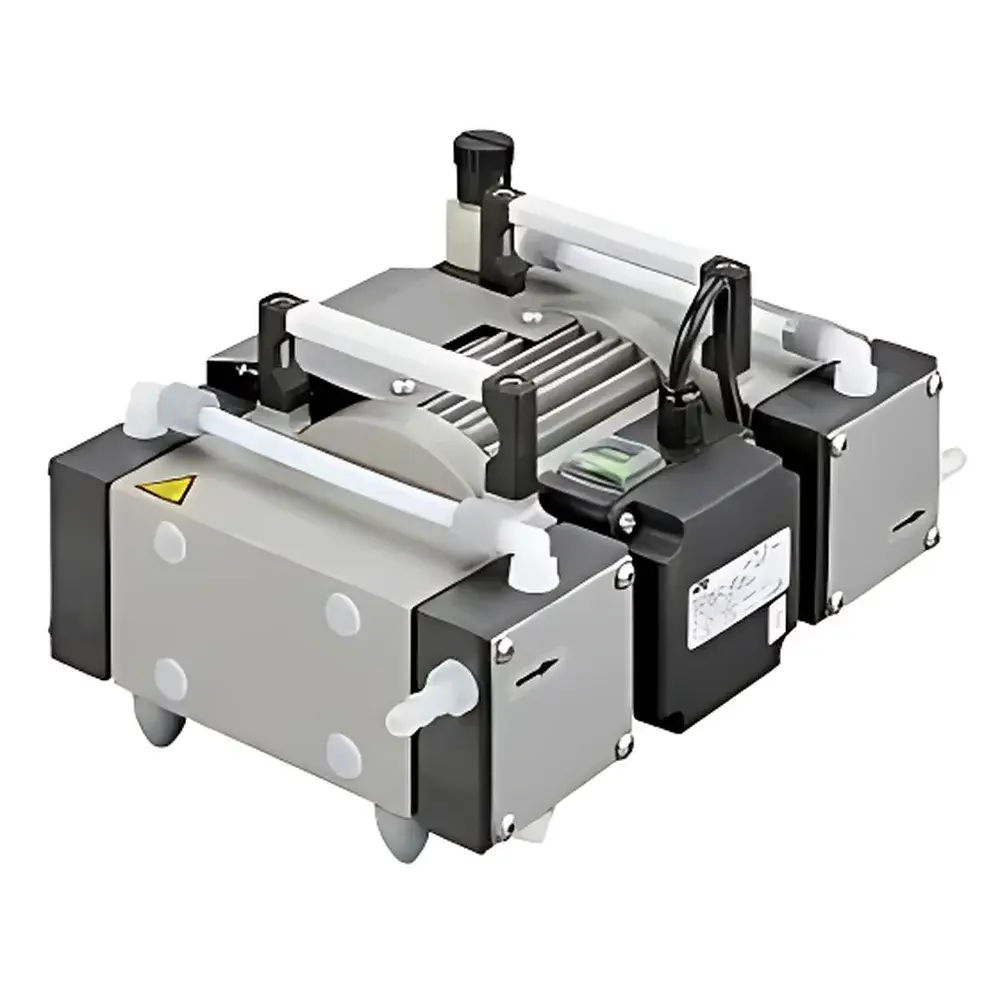
Jihepu MPC201T Chemical-Resistant Diaphragm Vacuum Pump
| Brand | Jihepu |
|---|---|
| Origin | Shandong, China |
| Model | MPC201T |
| Pump Type | Oil-Free Diaphragm Vacuum Pump |
| Ultimate Vacuum | <2 mbar |
| Pumping Speed | 2.0 m³/h (33.3 L/min) |
| Dimensions (L×W×H) | 260 × 200 × 150 mm |
| Weight | 10.3 kg |
| Motor Power | 100 W |
| Electrical Supply | 220 V, 50/60 Hz |
| Gas-Wetted Materials | PTFE-Coated + Carbon-Fiber-Reinforced Components |
| Diaphragm Construction | Multi-Layer Sandwich Design |
| Compliance | CE-marked for laboratory use under IEC 61000-6-3/6-4 |
Overview
The Jihepu MPC201T is an oil-free, chemically resistant diaphragm vacuum pump engineered for continuous-duty operation in demanding laboratory and pilot-scale applications where exposure to aggressive vapors, solvents, or acidic/basic gases is unavoidable. Unlike rotary vane or scroll pumps requiring lubricating oil—prone to degradation and contamination—the MPC201T operates on a dry, positive-displacement principle: a motor-driven eccentric mechanism actuates a reinforced elastomeric diaphragm, generating suction and exhaust cycles without internal lubrication. Its core design centers on chemical inertness: all gas-path components—including valve plates, chamber walls, and inlet/outlet fittings—are fully coated with polytetrafluoroethylene (PTFE) and structurally reinforced with carbon fiber. This dual-material strategy ensures long-term dimensional stability and resistance to swelling, cracking, or permeation when handling halogenated hydrocarbons (e.g., chloroform, DCM), strong acids (e.g., HCl, HNO₃ vapor), alkalis (e.g., NaOH solutions under vacuum), and organic esters. The multi-layer sandwich diaphragm—comprising alternating PTFE barrier layers and high-tensile carbon-fiber composite substrates—delivers exceptional fatigue life (>10,000 hours at rated load), minimizing downtime and eliminating the need for routine replacement.
Key Features
- Chemically inert wetted path: Full PTFE coating + carbon-fiber reinforcement across all gas-contact surfaces
- True dry operation: No oil, no mist, no condensate carryover—ideal for solvent-sensitive processes
- Stable vacuum performance: Maintains consistent ultimate pressure (<2 mbar) and pumping speed (33.3 L/min) across variable backpressure conditions
- Compact footprint and low mass: 260 × 200 × 150 mm dimensions and 10.3 kg weight enable benchtop integration without structural reinforcement
- Energy-efficient drive: 100 W brushless AC motor with thermal overload protection and EMI suppression per IEC 61000-6-3
- Vibration-damped mounting: Integrated rubber isolators reduce transmitted vibration to ≤0.15 mm/s RMS (ISO 10816-1 Class A)
Sample Compatibility & Compliance
The MPC201T is validated for use with corrosive and condensable process streams commonly encountered in synthetic chemistry, pharmaceutical development, and materials science workflows. It complies with CE marking requirements under the EU Machinery Directive 2006/42/EC and Electromagnetic Compatibility Directive 2014/30/EU. While not certified to ISO 8573-1 for compressed air purity (as it is a vacuum device), its oil-free architecture inherently meets ISO 8573-1 Class 0 for absence of lubricant contamination—critical for GLP-compliant vacuum drying and USP filtration validation. The pump is suitable for installation in Class II biosafety cabinets and fume hoods per EN 14175-3, provided exhaust is routed externally. It supports GMP-aligned documentation: serial-number traceability, factory calibration certificate (vacuum stability test at 2 mbar for 120 min), and material compliance declarations (RoHS 2011/65/EU, REACH SVHC-free).
Software & Data Management
The MPC201T operates as a standalone analog device with no embedded microcontroller or digital interface. However, its stable electrical signature and linear pressure-speed response make it compatible with third-party vacuum monitoring systems via 0–10 V analog output (optional add-on module, part #MPC-IO1). When integrated into automated platforms—such as reaction monitoring systems (e.g., ChemSpeed AutoMate) or lyophilizer control units—it supports audit-trail-ready operation when paired with FDA 21 CFR Part 11–compliant data loggers (e.g., Omega OM-DAQPRO-5300). Pump runtime can be tracked via external kWh meters or PLC pulse counters, enabling preventive maintenance scheduling based on cumulative operating hours rather than calendar time.
Applications
- Vacuum distillation of acid-labile compounds and thermally sensitive APIs
- PTFE-lined filtration manifolds for aggressive precipitant recovery (e.g., HF-based etching waste streams)
- Controlled-concentration evaporation in parallel synthesis reactors (e.g., Biotage Initiator+)
- Desiccation of hygroscopic catalysts (e.g., Pd/C, Raney Ni) under inert gas purge
- Sample preparation for XRD and SEM—eliminating hydrocarbon residue from oil-based pumps
- Environmental testing chambers requiring non-outgassing vacuum sources (ASTM D3951-22 compliant)
FAQ
Is the MPC201T suitable for pumping hydrogen chloride (HCl) gas?
Yes—its PTFE/carbon-fiber wetted path resists HCl corrosion up to 150°C vapor temperature; however, condensation must be prevented via heated lines or cold trap placement upstream.
Can it be used continuously for 72 hours without interruption?
Yes—rated for continuous duty (IEC 60034-1 S1 rating); thermal management and diaphragm fatigue resistance are validated per ISO 5801-2017 endurance testing protocols.
Does it meet FDA requirements for pharmaceutical manufacturing environments?
While not individually FDA-registered, its Class 0 oil-free operation, RoHS/REACH compliance, and absence of extractables support qualification under FDA Process Validation Guidance (2011) and EU Annex 15.
What maintenance is required beyond periodic inspection?
None—no oil changes, no valve replacements, no lubrication; only visual inspection of inlet filter and diaphragm integrity every 6 months under typical lab use.
Is it compatible with vacuum controllers that modulate speed?
Not natively—the MPC201T runs at fixed speed; however, vacuum regulation can be achieved via proportional throttle valves (e.g., VAT 11.1 series) or by cascading with a secondary vacuum gauge-controlled solenoid vent.



