
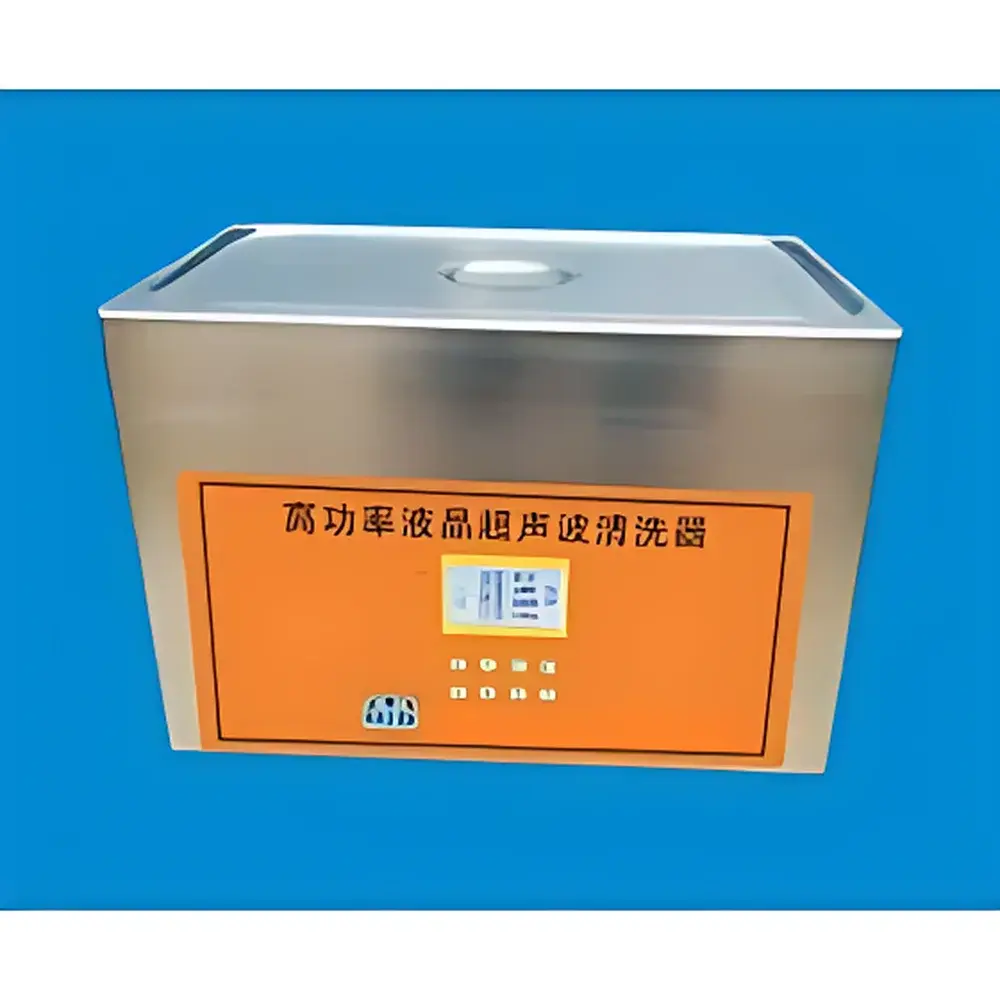
Jihepu KS-400KDE High-Power LCD Ultrasonic Cleaner
| Brand | Jihepu |
|---|---|
| Origin | Shandong, China |
| Model | KS-400KDE |
| Tank Capacity | 10 L |
| Ultrasonic Frequency | 40 kHz |
| Ultrasonic Power Output | 400 W |
| Power Adjustment | Yes (10–100% in 1% increments) |
| Temperature Control Range | 10–80 °C |
| Timer Range | 1–9999 minutes |
| Sound-Dampening Lid | Included |
| Auto Fill & Drain Function | Yes |
| Construction Material | 304 Stainless Steel (tank, basket, lid, and housing) |
Overview
The Jihepu KS-400KDE High-Power LCD Ultrasonic Cleaner is an integrated benchtop ultrasonic cleaning system engineered for reproducible, high-intensity cavitation-based cleaning across academic, industrial, and quality control laboratories. It operates on the principle of piezoelectric transduction—converting high-frequency electrical energy into mechanical vibrations at 40 kHz—generating controlled acoustic cavitation within aqueous or compatible solvent media. This process produces transient microbubbles that collapse near submerged surfaces, delivering localized shockwaves and microstreaming forces sufficient to dislodge particulate contaminants, organic residues, biofilms, and entrapped air from complex geometries—including microfluidic channels, optical components, precision machined parts, and laboratory glassware. Designed with a monolithic architecture—where the ultrasonic generator and stainless steel tank are co-engineered—the KS-400KDE ensures minimal energy loss, thermal stability during extended operation, and consistent power delivery across the full 400 W output range.
Key Features
- Backlit 3.2-inch full-color LCD interface with native Chinese language support—displaying real-time parameters including frequency (40 kHz), power level (10–100%), temperature (10–80 °C), elapsed/remaining time (1–9999 min), and system status alerts.
- Dual-stage safety protection: hardware-level monitoring of low liquid level, overtemperature, overvoltage, and overcurrent conditions—with audible alarm and automatic shutdown to prevent transducer damage or tank dry-run.
- High-efficiency 100 W per transducer array (total 4 × 100 W) mounted directly to the tank bottom, optimized for uniform energy distribution and enhanced cavitation density across the entire 10 L working volume.
- Integrated auto-fill and auto-drain solenoid valves enabling programmable fluid management—reducing manual handling, improving repeatability between cycles, and supporting unattended multi-batch operation.
- Full 304 stainless steel construction: seamless tank body, removable perforated mesh basket, sound-dampening hinged lid, and corrosion-resistant enclosure—ensuring long-term durability in humid or chemically aggressive environments.
Sample Compatibility & Compliance
The KS-400KDE accommodates a broad spectrum of sample types, including but not limited to glassware (vials, cuvettes, pipettes), metal components (surgical instruments, calibration standards), ceramic substrates, silicon wafers, and polymer-based microdevices. Its 40 kHz operating frequency balances penetration depth and surface cleaning efficacy—making it suitable for both macro-scale degreasing and sub-micron particle removal. The unit complies with IEC 61000-6-3 (EMC emission limits) and IEC 61000-6-2 (immunity requirements). While not certified for medical device reprocessing under ISO 15883 or FDA 21 CFR Part 820, its programmable parameters and audit-ready operational logs support GLP-aligned documentation workflows when deployed in R&D, QC, or pre-analytical sample preparation settings.
Software & Data Management
The embedded firmware supports fully independent parameter programming without external PC connectivity. Each cleaning cycle stores timestamped metadata—including setpoint values, actual measured temperature, power delivery profile, and fault codes—in non-volatile memory (retains ≥10,000 cycles). Optional RS-232 or USB-to-serial interface (available upon request) enables remote configuration and export of cycle reports in CSV format for integration into LIMS or electronic lab notebooks. All user-modifiable settings adhere to ALCOA+ principles: attributable, legible, contemporaneous, original, accurate, complete, consistent, enduring, and available—facilitating internal audits and regulatory review.
Applications
- Pre-analytical sample preparation: removal of residual solvents, salts, or biological matrix from HPLC vials, GC autosampler trays, and ICP-MS nebulizer components.
- Materials science: debubbling polymer precursors prior to casting; dispersing nanomaterials (e.g., graphene oxide, TiO₂ nanoparticles) in aqueous suspension.
- Electronics manufacturing: cleaning solder paste residue, flux contaminants, and particulate debris from PCB assemblies and MEMS devices.
- Life sciences: sterilization-assist cleaning of reusable electrophoresis combs, gel trays, and centrifuge rotors; cell culture flask decontamination prior to autoclaving.
- Quality assurance: validation of cleaning efficacy per ASTM D2247 (standard practice for testing cleaning agents) using standardized test soils (e.g., bovine serum albumin, kaolin clay).
FAQ
What is the maximum recommended cleaning temperature for aqueous solutions?
The system maintains stable thermal control up to 80 °C; however, prolonged operation above 60 °C in pure water may accelerate transducer aging. For optimal longevity, use temperature-regulated duty cycles with dwell times ≤30 minutes at >60 °C.
Can this unit be used with organic solvents such as acetone or isopropanol?
Only with explicit manufacturer approval and appropriate explosion-proof modifications. Standard configuration is rated for aqueous and mild detergent solutions only. Solvent compatibility requires verification against material safety data sheets (MSDS) and tank sealant chemical resistance charts.
Is the timer resolution adjustable in seconds or minutes?
The timer displays and executes in 1-minute increments across the full 1–9999 minute range. Sub-minute timing is not supported in standard firmware.
Does the auto-drain function include pump-assisted evacuation?
No—drainage relies on gravity flow via the integrated outlet valve. A floor drain or waste container must be positioned below the outlet port for effective fluid removal.
How frequently should the transducers be recalibrated?
Transducer performance is factory-characterized and does not require periodic recalibration. However, annual verification of power output (using calorimetric or radiometric methods per ASTM E1272) is recommended for GxP environments.



