
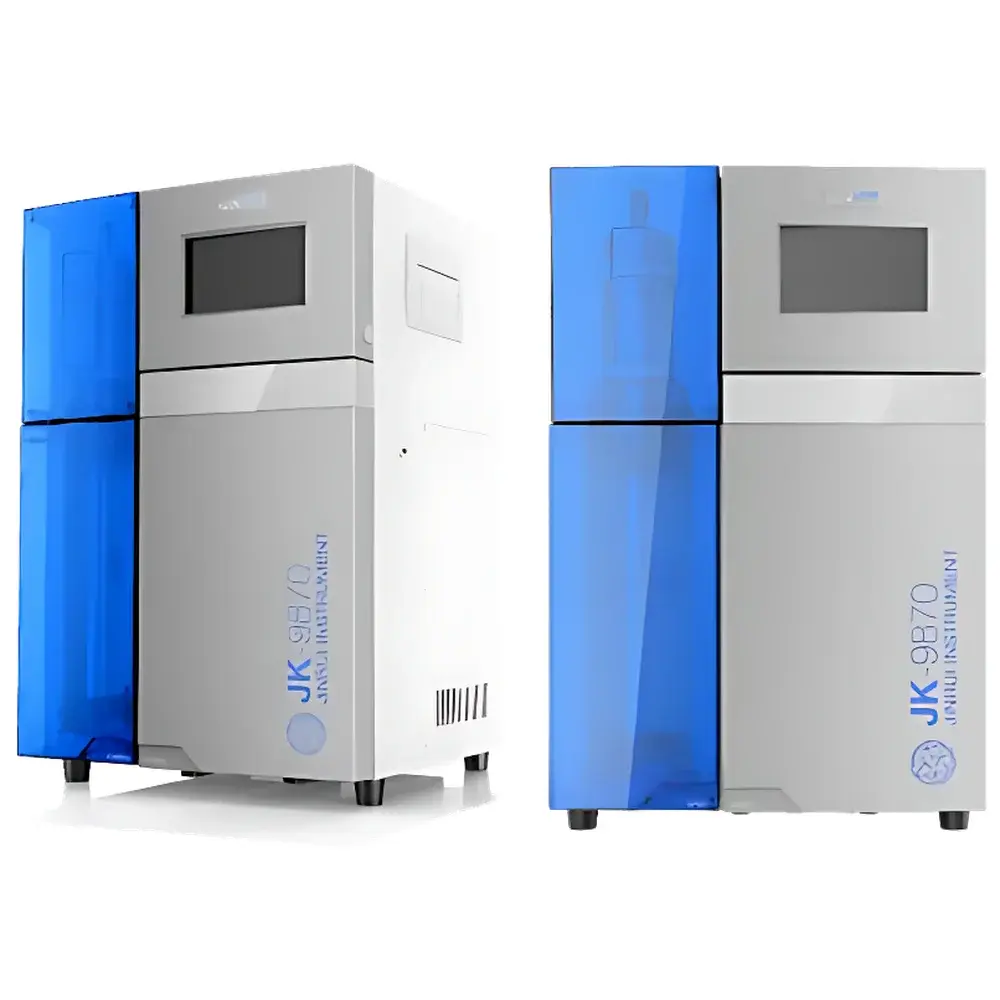
JK9870 Fully Automated Kjeldahl Nitrogen Analyzer
| Brand | Jihepu (Jinan Hepu) |
|---|---|
| Origin | Shandong, China |
| Model | JK9870 |
| Nitrogen Determination Range | 0.01–5 mol/L (as NH₃ equivalent) |
| Distillation Time | 5–7 min/sample |
| Repeatability | ≤1.0% RSD |
| Recovery Rate | 99.5% |
| Power Consumption | 1200 W |
Overview
The JK9870 Fully Automated Kjeldahl Nitrogen Analyzer is a precision-engineered instrument designed for quantitative determination of total nitrogen content in organic and inorganic samples via the classical Kjeldahl digestion–distillation–titration method. Based on standardized wet-chemical oxidation (H₂SO₄ catalytic digestion), alkaline distillation under controlled steam conditions, and potentiometric or colorimetric titration, the system delivers traceable, regulatory-compliant nitrogen quantification across diverse matrices. It is validated for use in food safety testing (AOAC 984.27, ISO 8968-1), feed analysis (AOAC 981.10), pharmaceutical raw material verification (USP <281>), environmental soil testing (EPA Method 350.1), and agricultural nutrient management programs. The analyzer operates fully autonomously from digestion product loading through endpoint detection and report generation—eliminating manual intervention during distillation and titration phases.
Key Features
- High-precision German-sourced peristaltic metering pumps: Corrosion-resistant, pulse-free reagent delivery ensures volumetric accuracy for alkali (0–99 mL), boric acid absorbent (0–50 mL), and pre-dilution water (0–50 mL), independent of container geometry or sealing requirements.
- U.S.-sourced fluidic components: Chemically inert tubing and fittings guarantee long-term integrity under repeated exposure to concentrated H₂SO₄, NaOH, and NH₃ vapor—minimizing leakage risk and maintenance frequency.
- Siemens industrial-grade control architecture: Integrated PLC-based motherboard with embedded Siemens CPU ensures deterministic real-time process control, low failure rate, and electromagnetic compatibility in laboratory environments.
- Sub-microliter titration resolution: Motorized burette with 0.5 µL/step dispensing precision enables high-resolution endpoint detection in both strong-acid and weak-base titrations—critical for low-nitrogen samples and nitrate mode calibration.
- Dual-mode analytical capability: Switchable operation between standard ammonium-N determination and direct nitrate-N measurement (after cadmium column reduction), supporting fertilizer and environmental water analysis without hardware modification.
- 7.5-inch capacitive touch interface: Bilingual (Chinese/English) HMI with intuitive workflow navigation, real-time status monitoring, and parameter logging—designed for GLP-compliant operator training and audit readiness.
- Comprehensive safety interlocks: Includes digest tube presence sensing, steam overpressure cutoff (≤0.2 MPa), low-water shutdown, door-actuated distillation inhibition, earth-leakage circuit protection, and staged alkali addition to mitigate exothermic hazards during neutralization.
Sample Compatibility & Compliance
The JK9870 accommodates standard 100–500 mL Kjeldahl digestion tubes (including 250 mL borosilicate glass) and supports solid, semi-solid, and liquid samples following AOAC-approved digestion protocols. Its design conforms to IEC 61010-1 (Safety Requirements for Electrical Equipment for Measurement, Control, and Laboratory Use) and meets mechanical stability criteria per ISO/IEC 17025:2017 Annex A.2 for automated analyzers used in accredited testing laboratories. Data integrity features—including electronic signature support, audit trail logging, and user-access level configuration—align with FDA 21 CFR Part 11 requirements when deployed with compliant LIMS integration.
Software & Data Management
Embedded firmware records all critical process variables (digestion temperature ramp, distillation time, steam pressure, titrant volume, pH curve slope, and endpoint confirmation) with timestamped metadata. Raw data export is supported via USB 2.0 to CSV or PDF formats. Optional Ethernet connectivity enables remote diagnostics and centralized instrument fleet monitoring. Calibration logs, maintenance history, and QC check results are stored locally with automatic backup to external drives. All reports include instrument ID, operator ID, sample ID, method version, and uncertainty estimates derived from RSD validation data (≤1.0% at 10–200 mg N).
Applications
- Food & Beverage: Crude protein calculation in dairy, meat, cereals, and plant-based alternatives (N × 6.25 or matrix-specific factors)
- Agriculture: Soil total N assessment, fertilizer formulation QA/QC, and manure nutrient mapping
- Pharmaceuticals: Excipient nitrogen screening, amino acid quantification, and residual catalyst analysis
- Environmental: Wastewater TN (total nitrogen), sludge digestate N speciation, and compost maturity indexing
- Research & Education: Method development for non-protein nitrogen (NPN) correction, enzymatic hydrolysis validation, and isotopic nitrogen tracer studies
FAQ
What digestion systems are compatible with the JK9870?
The analyzer accepts standard Kjeldahl digestion tubes (100–500 mL) and integrates seamlessly with HePu’s HT series block digesters and fume hood–compatible exhaust modules.
Does the system support USP <281> or Ph. Eur. 2.5.21 compliance?
Yes—when operated with validated digestion protocols, certified reference materials (e.g., NIST SRM 84b), and documented preventive maintenance, it fulfills pharmacopeial requirements for nitrogen assay accuracy and repeatability.
Can the instrument be connected to a laboratory information management system (LIMS)?
Via optional RS-232 or TCP/IP interface, raw data and summary reports can be transmitted to LIMS platforms supporting ASTM E1384 or HL7 messaging standards.
Is nitrate-N measurement included in the base configuration?
Yes—the nitrate reduction module is factory-installed and activated via software license; no additional hardware is required.
What cooling water specifications are required?
Continuous flow of deionized or tap water at 1–3 mL/min and 10–30°C inlet temperature is sufficient; optional chiller integration supports ambient temperatures up to 40°C.




