
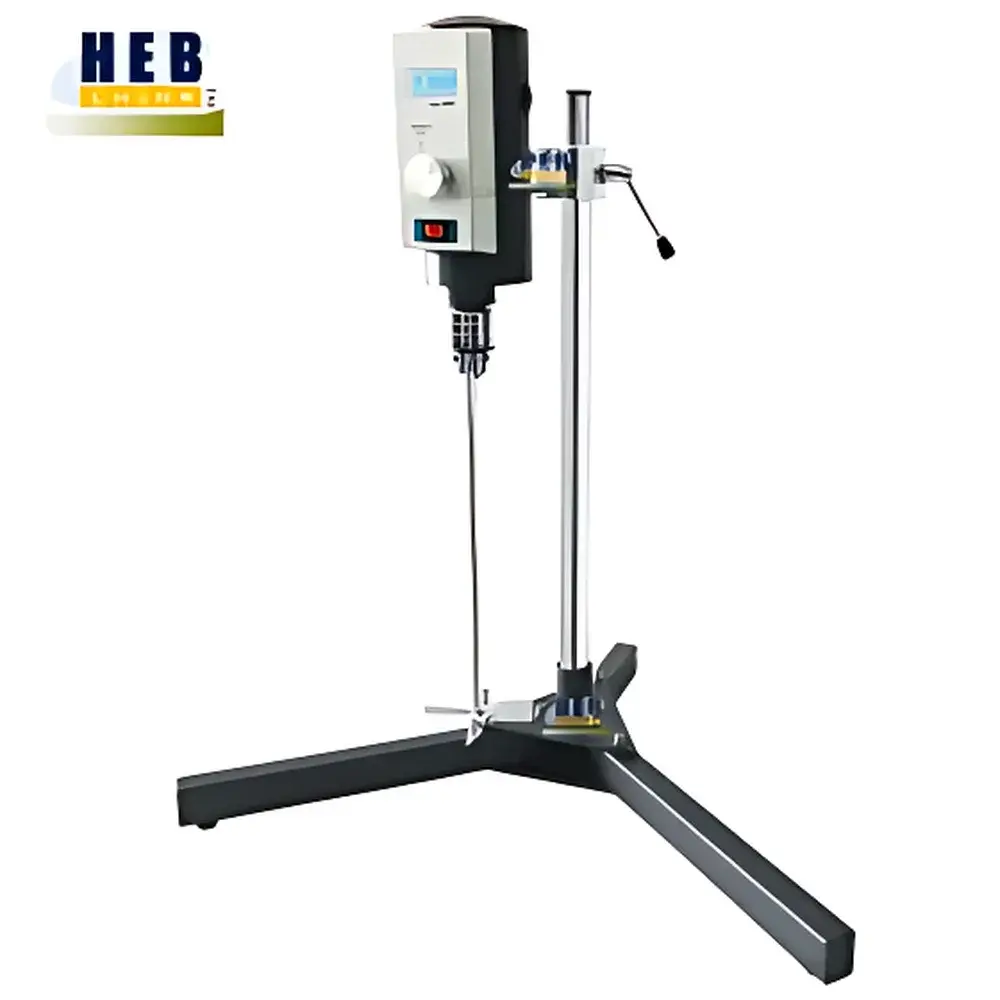
HePu E40-H Digital Display Electric Laboratory Stirrer
| [Brand | HePu (Jinan Hepu) |
|---|---|
| Origin | Shandong, China |
| Model | E40-H |
| Power Supply | 220 V / 50 Hz |
| Motor Power | 300 W |
| Speed Range | 100–1800 rpm |
| Max. Mixing Volume (Water) | 60 L |
| Max. Viscosity Handling | 20,000 mPa·s |
| Torque | 142 N·cm |
| Shaft Clamp Type | Chuck |
| Clamp Diameter Range | Ø0.3–10 mm |
| Wetted Materials | SUS304 (SUS316L optional) |
| Display | 3-digit LED |
| Speed Control | Electronic Knob (Stepless) |
| Memory Function | Yes |
| Overheat & Overload Protection | Yes |
| Ambient Temperature | 5–40 °C |
| Ambient Humidity | ≤80 % RH |
| Dimensions (W×D×H) | 660 × 450 × 760 mm (standard height |
| Net Weight | 10 kg |
| Enclosure Material | Anodized Aluminum Alloy] |
Overview
The HePu E40-H Digital Display Electric Laboratory Stirrer is an engineered solution for precise, repeatable, and scalable mixing in research and quality control laboratories. Designed around Couette-type shear mixing principles, it delivers consistent rotational agitation across a wide dynamic range—enabling effective homogenization, suspension stabilization, dissolution enhancement, and emulsion formation in low- to medium-viscosity liquid systems. Its core architecture integrates a high-efficiency 300 W induction motor with thermal and current-limiting safeguards, ensuring stable operation during prolonged duty cycles typical in pharmaceutical formulation development, polymer dispersion studies, or catalyst slurry preparation. Unlike basic analog stirrers, the E40-H employs closed-loop speed feedback via integrated tachometric sensing, maintaining setpoint accuracy within ±2% of nominal rpm across load variations—critical for method transfer and regulatory documentation.
Key Features
- Robust anodized aluminum alloy housing provides superior heat dissipation, mechanical rigidity, and long-term dimensional stability—reducing vibration-induced measurement drift during sensitive kinetic experiments.
- Stepless electronic speed control via precision potentiometer enables rapid, tactile adjustment from 100 to 1800 rpm with real-time 3-digit LED readout—eliminating calibration drift associated with mechanical gearboxes.
- Non-volatile memory function retains last-used speed setting after power cycling, supporting SOP-driven workflows where protocol consistency is mandatory (e.g., USP dissolution testing or ASTM D2196 viscosity screening).
- Integrated dual-protection circuitry includes thermistor-based overtemperature cutoff and instantaneous current limiting—preventing motor burnout during high-torque starts or sudden viscosity spikes (e.g., gelation onset in hydrocolloid systems).
- Standard chuck-type shaft holder accepts stainless steel impellers (SUS304 or optional SUS316L) with diameters from 0.3 mm to 10 mm—compatible with flat-blade, propeller, anchor, and paddle configurations per ISO 8504-2 mixing geometry standards.
Sample Compatibility & Compliance
The E40-H supports aqueous, organic, and mildly corrosive media up to 20,000 mPa·s (measured at 25 °C using standard DIN 53019 spindle). It complies with IEC 61010-1:2010 safety requirements for electrical equipment used in laboratory environments. All wetted components meet FDA-compliant material specifications (SUS304 per ASTM A276), and optional SUS316L construction satisfies enhanced corrosion resistance needs for chloride-containing buffers or acidic reagents. The unit operates within GLP/GMP-aligned conditions: ambient temperature 5–40 °C, relative humidity ≤80% non-condensing, and installation on vibration-damped surfaces per ISO 25316 recommendations. No built-in temperature regulation is provided; external jacketed vessels or Peltier-cooled baths must be used for thermal control.
Software & Data Management
While the E40-H operates as a standalone instrument without embedded software, its analog-compatible 0–10 V DC tachometer output (optional interface module available) permits integration into third-party data acquisition systems (e.g., LabVIEW, MATLAB, or DeltaV DCS). This facilitates time-stamped speed logging, alarm-triggered event capture, and audit-trail generation compliant with FDA 21 CFR Part 11 when paired with validated SCADA infrastructure. For manual recordkeeping, the LED display ensures legibility under ISO 8596-compliant lighting (≥500 lux), and the memory function reduces transcription errors during multi-step protocols.
Applications
- Pharmaceutical R&D: Suspension preparation of insoluble actives (e.g., griseofulvin), buffer blending for bioprocess intermediate hold steps, and excipient dispersion in oral solid dosage form development.
- Materials Science: Exfoliation of graphene oxide in aqueous surfactant systems, carbon nanotube dispersion in epoxy prepolymers, and silica nanoparticle suspension for sol-gel coating precursors.
- Chemical Process Development: Emulsification of pesticide concentrates, asphalt modifier dispersion in cutback formulations, and polyurethane prepolymer chain extension under inert atmosphere.
- Quality Control Labs: Standardized mixing per ASTM D1210 haze measurement procedures, ISO 787-12 pigment dispersion evaluation, and USP tablet dissolution medium conditioning.
FAQ
Does the E40-H support external speed control via analog signal input?
Yes—when equipped with the optional analog interface module, the unit accepts 0–10 V DC input for remote speed setpoint modulation and provides isolated tachometer feedback.
Can the stirring shaft accommodate custom impellers beyond standard fan blades?
Yes—the chuck-type holder accepts any cylindrical shaft within Ø0.3–10 mm, including Rushton turbines, helical ribbons, or customer-fabricated geometries meeting ISO 8504-2 torque transmission criteria.
Is the device suitable for continuous operation at maximum speed and load?
It is rated for intermittent duty (≤60% duty cycle); sustained operation above 1500 rpm with >40 L viscous loads requires active cooling of the motor housing and periodic thermal monitoring per IEC 60034-1 insulation class B limits.
What documentation is supplied for regulatory validation?
Factory calibration certificate (speed accuracy ±2% full scale), CE Declaration of Conformity, RoHS compliance statement, and material traceability reports for SUS304 components are included. IQ/OQ protocols can be developed per client-specified Annex 15 or GAMP5 frameworks.
Is firmware upgradability supported?
No—the control logic is hardwired; however, hardware revision history and component-level schematics are available upon request for maintenance and risk assessment purposes.



