
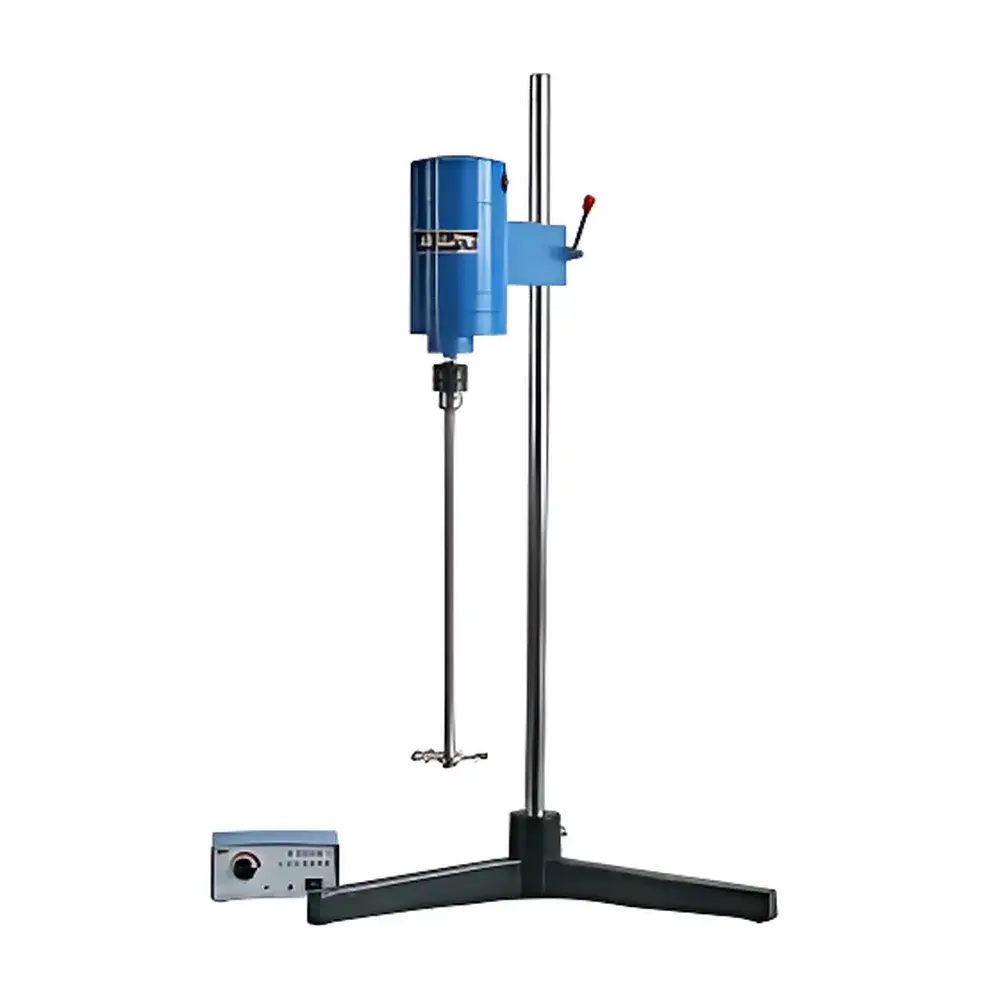
English Product Name
| Brand | Jihepu |
|---|---|
| Origin | Shandong, China |
| Model | AM500L-P |
| Instrument Type | Electric Stirrer |
| Max. Mixing Volume | 100 L (water) |
| Speed Range | 100–2500 rpm |
| Input Power | 810 W |
| Output Power | 500 W |
| Output Torque | 191.2 N·cm |
| Stirring Shaft Clamp Range | Φ5–16 mm |
| Max. Viscosity Handling | 100,000 mPa·s |
| Operating Ambient | ≤40 °C, ≤80% RH |
| Dimensions (W×D×H) | 600 × 450 × 1200 mm |
| Weight | 30.0 kg |
| Duty Cycle | S1 (Continuous) |
| Voltage/Frequency | AC 220 V, 50/60 Hz |
Overview
The Jihepu AM500L-P High-Torque Laboratory Stirrer is an engineered solution for reproducible, scalable mixing of low- to high-viscosity liquids in research laboratories, pilot-scale development facilities, and quality control environments. It operates on the principle of mechanical rotational agitation—transferring torque from a series- wound universal motor through a precision gear-reduction mechanism to drive impellers at controlled angular velocities. Unlike magnetic stirrers limited by heat sensitivity and load capacity, the AM500L-P delivers direct-drive mechanical power with high starting torque, enabling effective homogenization of viscous suspensions, polymer solutions, emulsions, and particulate-laden slurries up to 100 L. Its robust aluminum die-cast housing ensures thermal stability and structural rigidity during prolonged operation, while the S1 continuous-duty rating supports uninterrupted batch processing under standard ambient conditions (≤40 °C, ≤80% RH). Designed for integration into regulated workflows, the unit complies with general electrical safety standards for laboratory equipment (IEC 61010-1), and its non-explosive, non-ventilated architecture suits general-purpose chemical and biological containment areas.
Key Features
- High-output series-wound motor delivering 500 W mechanical output power and peak torque of 191.2 N·cm—optimized for viscous media handling without stalling
- Stepless speed control across a broad 100–2500 rpm range, enabling precise shear-rate modulation for Newtonian and non-Newtonian fluid characterization
- Quick-release chuck system (Φ5–16 mm) with 191.0 N·cm clamping torque, supporting rapid interchange of standard ISO-compliant impellers (e.g., propeller, anchor, paddle, and helical ribbons)
- Die-cast aluminum mainframe providing superior heat dissipation, dimensional stability, and corrosion resistance in humid or chemically exposed lab settings
- Integrated electronic speed controller with analog potentiometer interface—no software dependency, ensuring operational reliability and ease of validation
- Compact vertical footprint (600 × 450 × 1200 mm) and 30.0 kg mass facilitate placement on standard lab benches or mobile carts without structural reinforcement
Sample Compatibility & Compliance
The AM500L-P accommodates aqueous, organic, and semi-aqueous systems—including shear-thinning hydrogels, ceramic slurries, pharmaceutical suspensions, and food-grade emulsions—within viscosity limits up to 100,000 mPa·s. It supports common laboratory vessel geometries (cylindrical glass or stainless-steel reactors, jacketed vessels, and open beakers) and is compatible with ASTM D1200 (Ford Cup viscosity), ISO 2557 (rotational viscometry sample preparation), and USP (dissolution testing auxiliary equipment) protocols. While not intrinsically rated for hazardous area use, its non-sparking motor design and absence of electronic enclosures make it suitable for Class I, Division 2 environments when operated with appropriate ventilation. The device meets CE marking requirements for electromagnetic compatibility (EN 61326-1) and low-voltage safety (EN 61010-1), and its mechanical construction aligns with GLP-aligned instrument qualification practices (IQ/OQ documentation support available upon request).
Software & Data Management
The AM500L-P operates as a standalone analog-controlled instrument without embedded firmware or network connectivity—intentionally designed to eliminate cybersecurity risks, software obsolescence, and regulatory validation burdens associated with digital interfaces. Speed settings are manually adjusted and visually indicated via calibrated analog dial; no data logging or remote control capability is provided. This architecture simplifies 21 CFR Part 11 compliance in GMP environments, as no electronic records, audit trails, or user access controls are generated. For labs requiring traceable operation, external digital tachometers (e.g., handheld laser RPM meters) or third-party data acquisition systems may be used to record speed profiles independently. All mechanical components—including gear train, shaft couplings, and clamp mechanisms—are serviceable using standard lab maintenance tools, supporting long-term calibration stability and lifecycle management.
Applications
This stirrer serves critical roles in method development and routine testing across multiple sectors: dissolution rate studies of solid oral dosage forms (per USP ); homogenization of vaccine adjuvant suspensions; blending of catalyst slurries in fine chemical synthesis; dispersion of nanomaterials in polymer matrices; rehydration and suspension of lyophilized biologics; and preparation of standardized reference materials for rheological calibration. In academic settings, it supports undergraduate fluid dynamics experiments, graduate thesis work on mixing efficiency modeling, and faculty-led process scale-up investigations. Its 100 L capacity bridges the gap between benchtop and pilot-scale mixing, allowing researchers to generate representative samples for downstream analysis (e.g., particle size distribution via laser diffraction, viscosity profiling via rotational viscometry, or pH/conductivity mapping).
FAQ
What is the maximum viscosity this stirrer can handle reliably?
It is rated for continuous operation with Newtonian fluids up to 100,000 mPa·s at 100 L volume and moderate impeller geometry—performance varies with impeller type, fill level, and thermal conditions.
Is the unit suitable for use with corrosive solvents?
The motor housing and base are aluminum alloy with protective anodized finish; however, direct contact with strong acids, halogenated solvents, or oxidizers requires assessment of material compatibility—stainless-steel shafts and PTFE-coated impellers are recommended for aggressive chemistries.
Can it be integrated into automated reactor systems?
No native digital interface exists; integration requires external analog signal conversion (e.g., 0–10 V speed command input) or mechanical linkage to programmable motion controllers.
Does it include temperature control?
No built-in heating or cooling functionality—the unit operates at ambient temperature only; external jacketed vessels or immersion heaters must be used for thermal regulation.
What documentation is provided for regulatory validation?
Factory calibration certificate, mechanical schematic, electrical safety test report, and IQ/OQ protocol templates are available upon order confirmation to support GLP/GMP compliance activities.



